
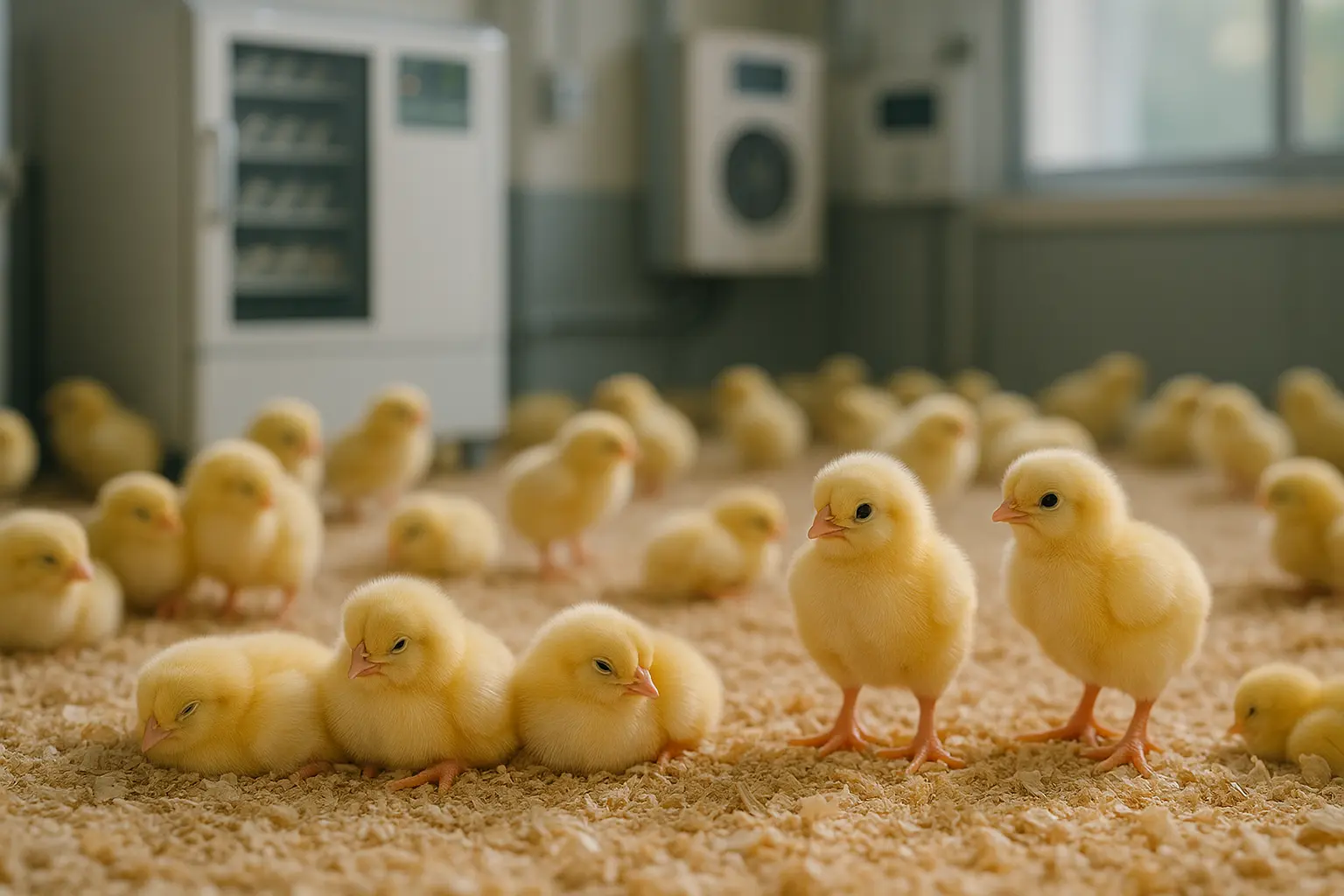
Chick quality gets judged on the farm, by someone who was never in the hatchery. That single fact explains most of the arguments between hatcheries and their customers: by the time anyone counts culls or watches how a flock starts, the conditions that produced the result are two or three days old and no longer measurable.
Key takeaways
- A commercial hatch window lasts at least 24 hours, so the first chick out waits roughly a day for the last one. That wait, not the hatching itself, is what spreads chick quality.
- Cobb’s hatcher guidance targets a chick cloacal temperature of 40.0 to 40.6 °C (104 to 105 °F) during holding. Measure the bird, not the room.
- EFSA (2022) places the comfort range near the chicks at 30 to 35 °C and caps time to first feed and water at 48 hours, holding time included.
- Regulation (EC) No 1/2005 allows 24 hours of transport for chicks provided the journey ends within 72 hours of hatching. That is a legal ceiling, not an operational target.
The clock starts at first pip, not at dispatch
The chick’s biological clock starts when the first bird breaks the shell, and dispatch has nothing to do with it. Every hour after that draws on a fixed reserve: the residual yolk sac, which has to cover maintenance, thermoregulation and gut development until the chick finds feed and water on the farm.
This is why the number worth writing on a whiteboard is not time in the holding room but time since first hatch. EFSA’s September 2022 opinion measures the withdrawal period exactly that way, from first hatch to the moment the last chick gets access to feed and water, and concludes that chicks held beyond 48 hours are at risk of severe prolonged hunger and thirst. Holding time at the hatchery, loading, transport and unloading all count inside that same envelope.
In practice, most hatcheries run comfortably inside 48 hours. The exposure comes from the tail of the distribution: a delayed truck, a customer who cannot take delivery before the afternoon, a hatch pulled early because the loading bay was booked. Those are logistics decisions that turn into welfare and performance decisions without anyone framing them that way.
Why the hatch window is a quality variable, not a schedule
A hatch window is the elapsed time between the first and the last chick hatching, and in commercial conditions it runs to at least 24 hours. That range is unavoidable, but its width is not fixed by nature alone. Egg storage duration, breeder flock age, egg size uniformity and setter temperature profile all pull the distribution wider or tighter.
Cobb’s hatcher guidance uses hatch progression rather than the calendar as the reference, checking the proportion hatched at set points around 480, 492 and 504 hours of incubation, with roughly 75 % hatched at 492 hours as a working benchmark. Managing to that curve, rather than to a fixed pull time, is what keeps the early chicks from sitting in a warm hatcher losing weight while the late ones catch up.
The width of the window is also the cheapest diagnostic a hatchery owns. A window that suddenly stretches by six hours is telling you something upstream changed, usually in egg storage or in setter profile, and the same causes tend to show up later as embryonic mortality in the last days of incubation.
The parameters worth holding, and what a miss costs
Four environmental parameters carry most of the outcome for a day-old chick. The table below groups the published targets we work to, and what typically shows up when each one drifts.
| Parameter | Published target | What a drift usually produces |
|---|---|---|
| Hatcher temperature at transfer | 36.7 to 36.9 °C (98 to 98.5 °F), Cobb | Late, drawn-out hatch or premature pipping, both widening the window |
| Relative humidity, first 24 h after transfer | About 52 to 54 %, Cobb | Sticky chicks and unhealed navels when low, wet chicks and delayed drying when high |
| Chick cloacal temperature in holding | 40.0 to 40.6 °C (104 to 105 °F), Cobb | Panting and heavy weight loss above range, huddling and slow start below it |
| Air temperature near the chicks | 30 to 35 °C comfort zone, EFSA 2022 | Cold stress below 30 °C, heat stress at the top of the range |
None of these figures are new. What changes results is measuring them where the chick is, in the box and at chick level, rather than where the sensor happens to be mounted.
Chick holding: the room nobody audits
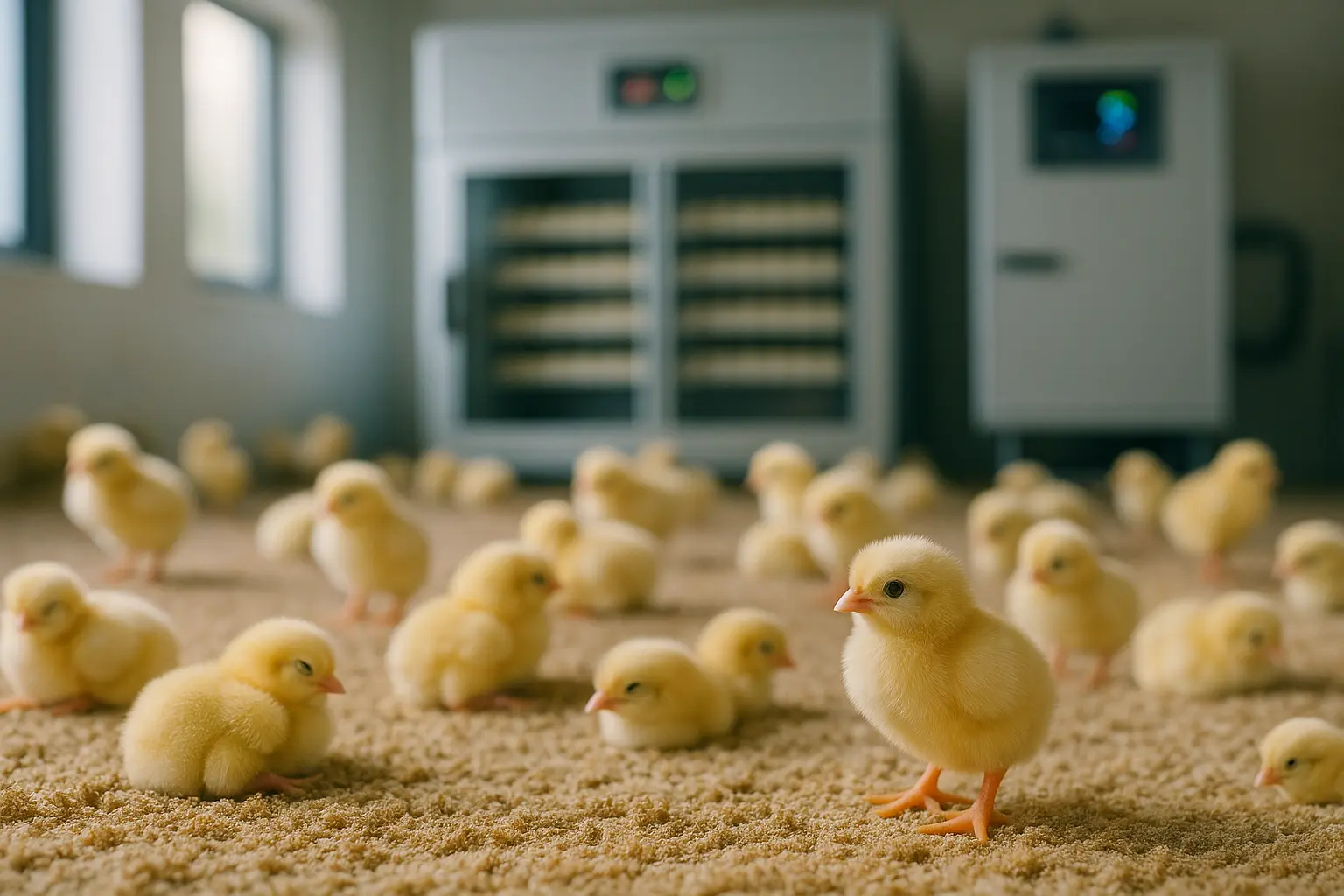
The holding room is where documented conditions and real conditions diverge most often, because it is the one space in the hatchery that runs on a thermostat and a door. Boxes stacked against a wall, a pallet parked in front of an air outlet, a loading door held open for twenty minutes in winter: each of these creates a microclimate that the room reading will never show.
Two habits close that gap. The first is spot-checking cloacal temperature on a sample of chicks from different positions in the stack, not from the top box within arm’s reach. The second is weighing a marked sample at pull and again at dispatch. Weight loss during holding is the honest measure of how the room actually performed, and Aviagen’s own hatchery work found that chicks held in an overheated atmosphere for 12 hours lost close to twice as much weight as chicks held comfortably.
Hygiene belongs to the same room. Chick down, meconium and warm still air make the holding area a good amplifier for anything that survived the previous cycle, which is why holding room cleaning belongs in the written plan alongside the setter and hatcher rooms rather than being treated as housekeeping. The general framework for that sits in hatchery biosecurity and disease prevention.
Transport and placement: protecting what is left of the window
Transport spends the remainder of the 48-hour envelope, and the legal frame is narrower than most schedules assume. Under Regulation (EC) No 1/2005, chicks may be transported for up to 24 hours provided the journey is completed within 72 hours of hatching, and a day-old chick is legally defined as poultry under 72 hours old that has not yet been fed.
Those two ceilings are compliance limits. The welfare limit sits well below them, at the 48-hour feed and water threshold EFSA identified, and it is the one that predicts first-week performance. A truck that arrives inside the legal window but outside the feeding window has complied with the law and lost the flock’s first three days.
Placement conditions finish the job. Litter and floor temperature at placement matter more than air temperature, because a chick that cannot warm its feet will not move to feed regardless of how comfortable the house reads. Checking crop fill on a sample of chicks a few hours after placement remains the fastest verification that the whole chain worked.
What the hatchery can measure itself, and what belongs to a veterinarian
The hatchery can and should own the physical measurements: hatch window width, cloacal temperature, holding weight loss, navel and yolk sac scoring on a sample, and time from first hatch to placement. All of these are within the operator’s competence and none require a diagnosis.
Anything that looks like a health pattern is a different matter. Raised first-week mortality, omphalitis, respiratory signs at placement or a repeated contamination profile are veterinary questions, and they need sampling and a diagnosis rather than a change of setpoint. Adjusting the hatcher profile in response to what is actually a bacterial contamination issue is a common and expensive detour.
Three questions we get from operators
Is a wide hatch window always a problem? Not by itself. A 24-hour window is normal in commercial conditions. What matters is whether it is stable. A window that widens without an explanation points to egg storage, flock age spread or setter uniformity, and it is worth investigating before it shows in hatchability.
Should chicks be fed in the hatchery? Early feeding systems exist and are used commercially, but the choice interacts with your legal definition of a day-old chick for transport purposes, since Regulation (EC) No 1/2005 defines these birds as not yet fed. Check the point with your competent authority before changing practice, rather than assuming the transport rules follow the equipment.
What single measurement would we add first? Chick cloacal temperature at dispatch, sampled from several positions in the stack. It costs a thermometer, it takes ten minutes, and it converts an argument about the holding room into a number.
https://www.youtube.com/watch?v=CyTsvpO1JJU
From spot checks to a continuous signal
Everything described here is measured by hand, on samples. The next step is instrumenting the same parameters so that a drift in the hatcher or the holding room raises a flag before it reaches a customer’s placement report.
Sources: EFSA, Scientific Opinion on the welfare of domestic birds and rabbits transported in containers, 7 September 2022; Cobb-Vantress, Managing the Hatcher Environment; Aviagen, Hatchery Tips; Council Regulation (EC) No 1/2005 on the protection of animals during transport. Consulted August 2026.
Published previously, fully revised on 6 August 2026. This article is general operational guidance for hatchery and poultry professionals. It does not replace the assessment of the veterinarian responsible for your flocks, nor the rules applied by your own competent authority.