
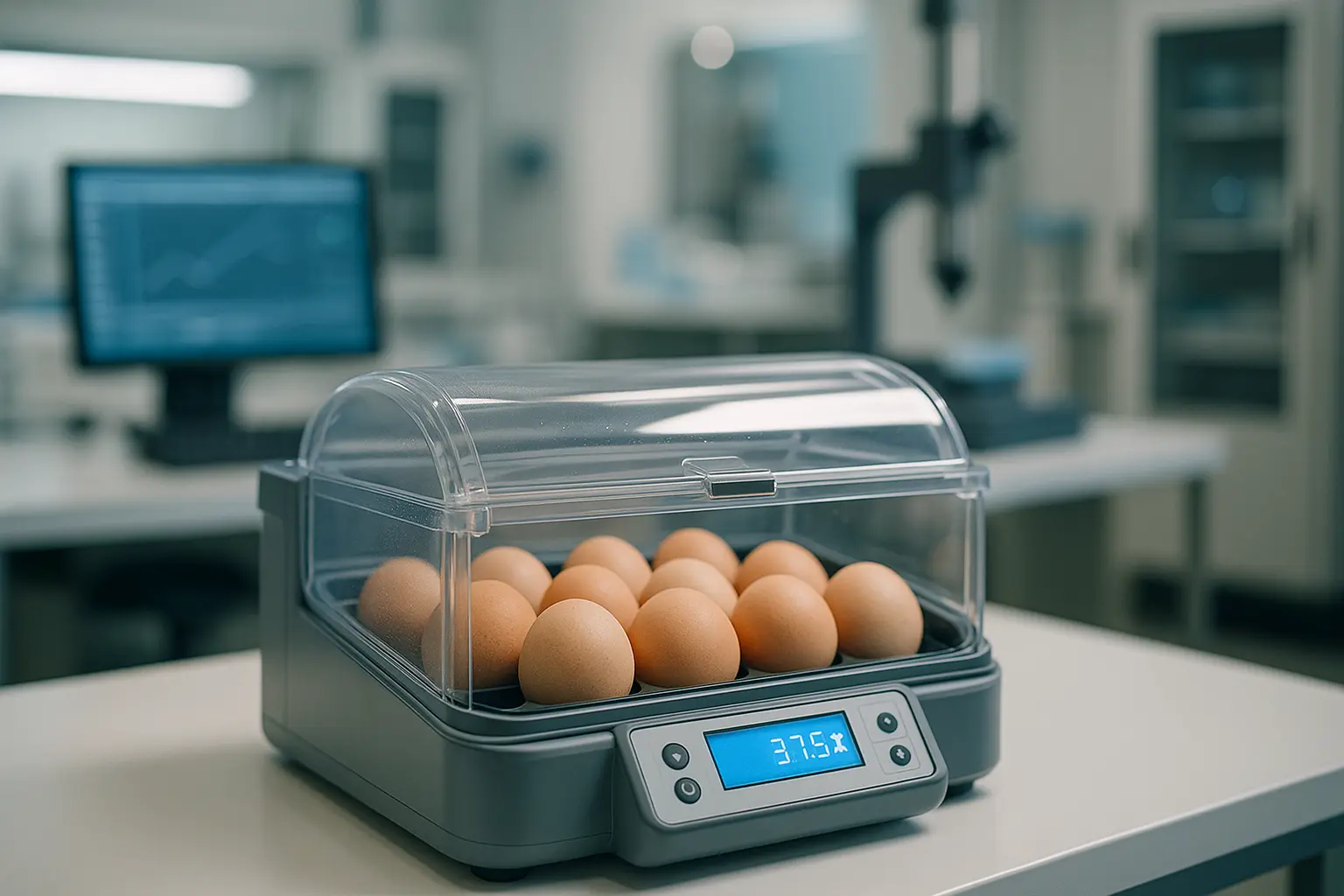
Precision in a hatchery is a measurement habit long before it is a piece of equipment. A cycle that loses embryos is telling you something quite specific about when they died, and that information sits in the unhatched eggs still on the trays rather than in the setter’s log.
Key takeaways
- Break out the unhatched eggs first. Changing an incubation profile without that step is guessing on a large scale.
- Each day of storage beyond the seventh costs more hatchability than each day before it, by a factor of roughly two and a half.
- Eggshell temperature measured at the equator of a live egg is the operative variable, not the air setpoint.
- Some embryonic mortality is normal, and chasing it to zero costs more than it returns.
Start with the day of death, not with the setpoint
A breakout tells you when an embryo stopped developing, and that is the one piece of evidence a setter log cannot give you. Petersime’s technical guidance makes the limit of the method explicit: the day of mortality tells you when an embryo died, not which problem led to its death, so the value of a breakout lies in reading the pattern across a batch rather than in classifying a single egg.
Two reference points help read that pattern. Early mortality, covering the first visible blood structures through to the black eye stage at four to five days, sits at a normal rate of roughly 2.5 to 5.5% depending on the age and condition of the breeder flock. And, according to the same technical guidance, incorrect incubation conditions account for around 65% of early embryo deaths, with temperature and the rate of temperature rise dominating the first week.
| Pattern in the breakout | Where to look first | What to check on the next batch |
|---|---|---|
| True infertiles, no development | Breeder flock, mating ratio, flock age | Fertility by flock rather than by hatchery average |
| Concentrated early deaths | Storage, transport, preheat and the first days of the profile | Storage temperature by age band, rate of temperature rise |
| Late deaths and dead in shell | Hatcher conditions, moisture loss, turning | Eggshell temperature late in incubation, egg weight loss |
Storage: the loss that happens before the setter is switched on
Storage is where hatchability leaks quietly, because nothing visible happens. The published storage regime varies the temperature with the length of the hold rather than fixing one number: 18 to 21 °C for eggs held nought to three days, 15 to 17 °C for four to seven days, and 10 to 12 °C beyond eight days, with relative humidity around 75% for the shorter holds and 80 to 88% for the longer ones.
The cost of a long hold has been quantified. An epidemiological study of Dutch hatchery data, published by Yassin and co-authors in 2008 and widely reproduced in hatchery technical guidance, found that each extra day of storage before the seventh day reduced hatchability by 0.2%, rising to 0.5% per day after the seventh day. Beyond ten days, the practical recommendations change again: store the eggs small end up from the first day, or, if they are on setter trays blunt end up, turn them 90 degrees once daily.
Where long storage cannot be avoided, short periods of incubation during egg storage offer partial recovery. Aviagen’s technical documentation on the practice reports that treated eggs recovered 63% of the hatch loss caused by long storage, and field work summarised elsewhere puts the recoverable share in a 60 to 70% band. Partial, not free, and worth setting up only where the storage pattern genuinely justifies it.
The consequence outlives the hatch. Research cited in the same body of guidance found that broiler chicks from eggs stored seven days weighed over 200 grams less at slaughter age than chicks from fresh eggs, with the difference in body weight only becoming visible from 14 days post hatch. A storage decision made in week one shows up in a weighbridge figure two months later.
Eggshell temperature, and why the setpoint misleads
The embryo does not experience the air in the machine, it experiences its own shell. That is why eggshell temperature has become the working variable in incubation control: it can be measured without harming the embryo, and it sits within about 0.1 to 0.2 °C of the embryo’s own temperature depending on the stage of incubation.
Where to point the thermometer
Readings are taken at the equator of the egg with an infrared thermometer, never over the air cell, where the reading runs lower than the true embryo temperature. The eggs sampled must contain live embryos, since an infertile egg produces no heat of its own and will quietly flatter your figures.
What the numbers mean
The reference point most widely cited for the setting phase is around 37.8 °C, or 100 °F, with an acceptable band of roughly 37.5 to 38.3 °C for hatchability and chick quality. Above 39 °C the situation is frankly dangerous, and in the middle period of incubation the risk rises as soon as readings pass 38.3 °C. Below 37.5 °C the usual sign is a delayed hatch rather than a dead embryo, which is why a slow hatch window deserves a thermometer before it gets a new profile.
The precision that costs nothing
Most of what separates a hatchery that improves from one that plateaus is comparability rather than instrumentation. Breaking out the same number of eggs, from the same tray positions, at the same point in the cycle, every cycle rather than only after a bad hatch, is what turns a set of observations into a trend. The same applies to egg weight loss, which is only interpretable if it is measured on identified trays from set to transfer.
Recording the flock, the storage duration and the tray position alongside the hatch result costs nothing and answers the question that always comes up when a hatch disappoints: was it this batch, or was it this machine. The practical routines behind that discipline are covered in our guide to running an incubation cycle without the common mistakes.
What precision will not fix
Incubation control cannot compensate for what arrived at the door. Fertility belongs to the breeder flock, shell quality belongs to flock age and nutrition, and a contaminated egg does not become clean because the profile is well written. Where breakout results suggest a health problem in a source flock, that is a veterinary matter for the flock concerned and not an incubation adjustment.
Once the mortality is located
Knowing when the embryos died narrows the causes. Turning that into a recovered percentage of hatch means working through the levers in order, from breeder flock to hatcher.
Sources: Royal Pas Reform technical knowledge base on hatching egg storage, for the storage temperature and humidity regime by holding period and for the Yassin et al. 2008 hatchability figures; Petersime technical guidance on analysing embryonic mortality, for normal early mortality rates and the share of early deaths attributable to incubation conditions; Aviagen technical documentation on SPIDES, for the recovered share of hatch loss; published guidance on eggshell temperature measurement and optimal ranges. Consulted August 2026.
Published previously, fully revised on 11 August 2026. General technical guidance for hatchery professionals. Suspected disease in a breeder flock or in a hatch should be referred to a qualified poultry veterinarian.