
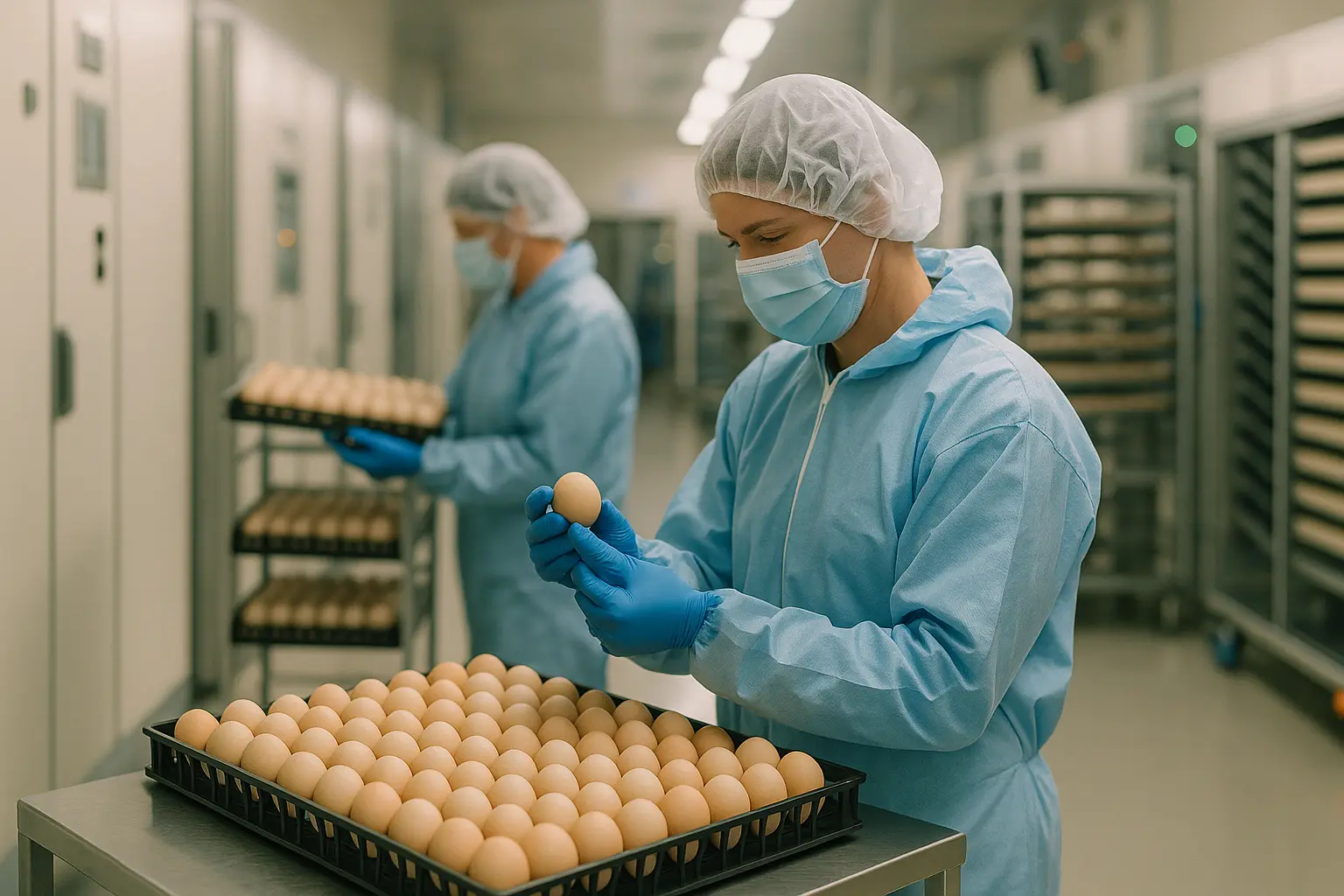
Hatchery biosecurity is usually presented as a set of habits: wash this, log that, change boots here. It is first a question of how the building is laid out and which way the air moves through it, because a plan that fights the architecture loses on the days when everyone is busy.
Key takeaways
- Chapter 6.5 of the WOAH Terrestrial Animal Health Code is the international reference behind most national hatchery rules.
- Eggs, chicks and air should travel in one direction only, from clean areas towards dirty ones, and never back.
- Pressure differentials decide what happens when a door opens, which is the moment a protocol cannot cover.
- Cleaning and disinfection is a separate discipline with its own contact times and verification, not a step in this sequence.
What Chapter 6.5 actually asks of a hatchery
Chapter 6.5 of the Terrestrial Animal Health Code covers biosecurity procedures in poultry production, and it is structured in a way worth knowing: after the introduction and scope, Article 6.5.4 deals with the location and construction of establishments, Article 6.5.5 with operations, Article 6.5.6 with what to do when infection is suspected or confirmed, and Article 6.5.7 with live bird markets. The construction article is the one that concerns a hatchery manager on the day a building is designed or refitted.
Its requirement is explicit. The hatchery buildings, in the Code’s own wording, “should include physical separation of areas used for” the distinct functions of the site. In practice that separation covers:
- personnel facilities, changing rooms and offices;
- egg receipt and egg storage;
- incubation, then hatching, as two separate areas;
- chick handling and dispatch;
- equipment storage and washing;
- waste handling and disposal.
The Code also situates all of this inside a wider frame, noting that biosecurity is enhanced by adopting Good Agricultural Practices and the principles of the HACCP system. That matters more than it sounds: it means the expectation is a documented analysis of your own hazards, not the transposition of a generic checklist.
One-way flow: eggs, chicks and air travel together
The second construction requirement is the one that most often gets compromised during an expansion. The Code asks that the design of the hatchery “take account of work flow and air circulation needs”, with one-way movement of eggs and chicks in the same direction as the airflow. Nothing that has been in a dirty area comes back through a clean one, and that includes trolleys, baskets, staff and, above all, air.
Expansions break this quietly. A new hatcher room added on the far side of the wash area, a temporary store for dispatch baskets placed where the shortest route runs backwards through incubation: the layout still passes an inspection room by room, while the flow through it now doubles back. Assurance schemes have codified the point, and the Dutch and Belgian IKB integrated chain control scheme requires a specific physical layout that avoids cross-contamination from the dirty zone to the clean zone.
The pressure cascade decides what a door opening does
A protocol can tell staff to keep a door shut. It cannot tell the air what to do when the door is open anyway, and that is what a pressure cascade is for. Petersime’s technical guidance on hatchery ventilation describes the principle plainly: the highest pressure is maintained in the setter room and the vaccine room, where cleanliness matters most, and the lowest in the washing rooms and the areas holding dirty baskets. When a door opens, air moves from the most critical rooms towards the dirty ones, never the other way.
Filtration is the companion measure on the intake side. The same guidance recommends two stages: a G4 pre-filter to stop particles visible to the eye, above roughly 10 micrometres, and an F7 main filter for fine dust and particles larger than about 1 micrometre. Filters that are not changed on a schedule quietly reduce the pressure they were installed to create, which is one of the few biosecurity failures that shows up on an energy bill before it shows up on a swab.
| Zone | Relative pressure | What belongs there | What must never come back in |
|---|---|---|---|
| Setter and vaccine rooms | Highest | Set eggs, vaccine preparation, filtered intake air | Anything returning from hatchers or wash |
| Hatchers and chick handling | Intermediate | Hatching, chick take-off, grading, dispatch | Dirty baskets, waste trolleys, delivery crews |
| Wash, waste and dispatch dock | Lowest | Basket washing, shell and waste handling, loading | Nothing returns upstream without a full cycle |
People and vehicles, the two mobile risks
Chapter 6.5 sets a clear expectation for entry: all personnel and visitors entering an establishment should follow a biosecurity procedure, and the preferred one is showering and changing into clean clothing provided by the facility. Where a full shower-in is not workable, the substitute has to be a genuine barrier rather than a boot dip at a door, and a visitor record that is completed on arrival rather than reconstructed afterwards, since its purpose is traceability during an investigation.
Vehicles carry the same weight in the Code, which asks that any vehicle entering an establishment be cleaned and disinfected in line with the biosecurity plan, and that delivery vehicles be cleaned and disinfected before loading each consignment. A chick delivery vehicle returning from a farm is, epidemiologically, an object that has been on a farm, whatever its condition looks like from the dock.
Where this stops and disinfection begins
Layout, flow and access control keep contamination out. Removing what has already arrived is a separate discipline, governed in the Code by its dedicated chapter on cleaning and disinfection, and it runs on its own variables: product choice, dilution, contact time and verification by swabbing. We have treated that side separately in our article on cleaning and disinfection methods for hatcheries, and the two only work as a pair.
What biosecurity does not cover
Structural biosecurity reduces the probability of introduction. It does not diagnose, and it does not treat. Where chick quality falls, where a source flock shows unexplained losses, or where a hatch pattern suggests vertical transmission, the question belongs to a qualified poultry veterinarian and to the laboratory, on the flocks concerned. Vaccination programmes sit in the same place: they are prescribed for a specific epidemiological situation, not selected from a general article.
The same logic, one step upstream
A hatchery inherits the biosecurity status of the farms that supply it. The controls that apply on the production site follow the same principles with a different geometry.
Sources: WOAH Terrestrial Animal Health Code, Chapter 6.5, Biosecurity procedures in poultry production, for the article structure and for the provisions on hatchery layout, one-way flow, personnel entry and vehicle cleaning and disinfection; Petersime technical guidance on the role of HVAC systems in hatcheries, for the pressure hierarchy between rooms and the G4 and F7 filtration stages; published description of the Dutch and Belgian IKB integrated chain control layout requirement. Consulted August 2026. National rules may be stricter than the Code and take precedence where they apply.
Published previously, fully revised on 11 August 2026. General technical guidance for hatchery professionals. Disease investigation, vaccination programmes and any suspected outbreak are veterinary matters for the flocks concerned.