
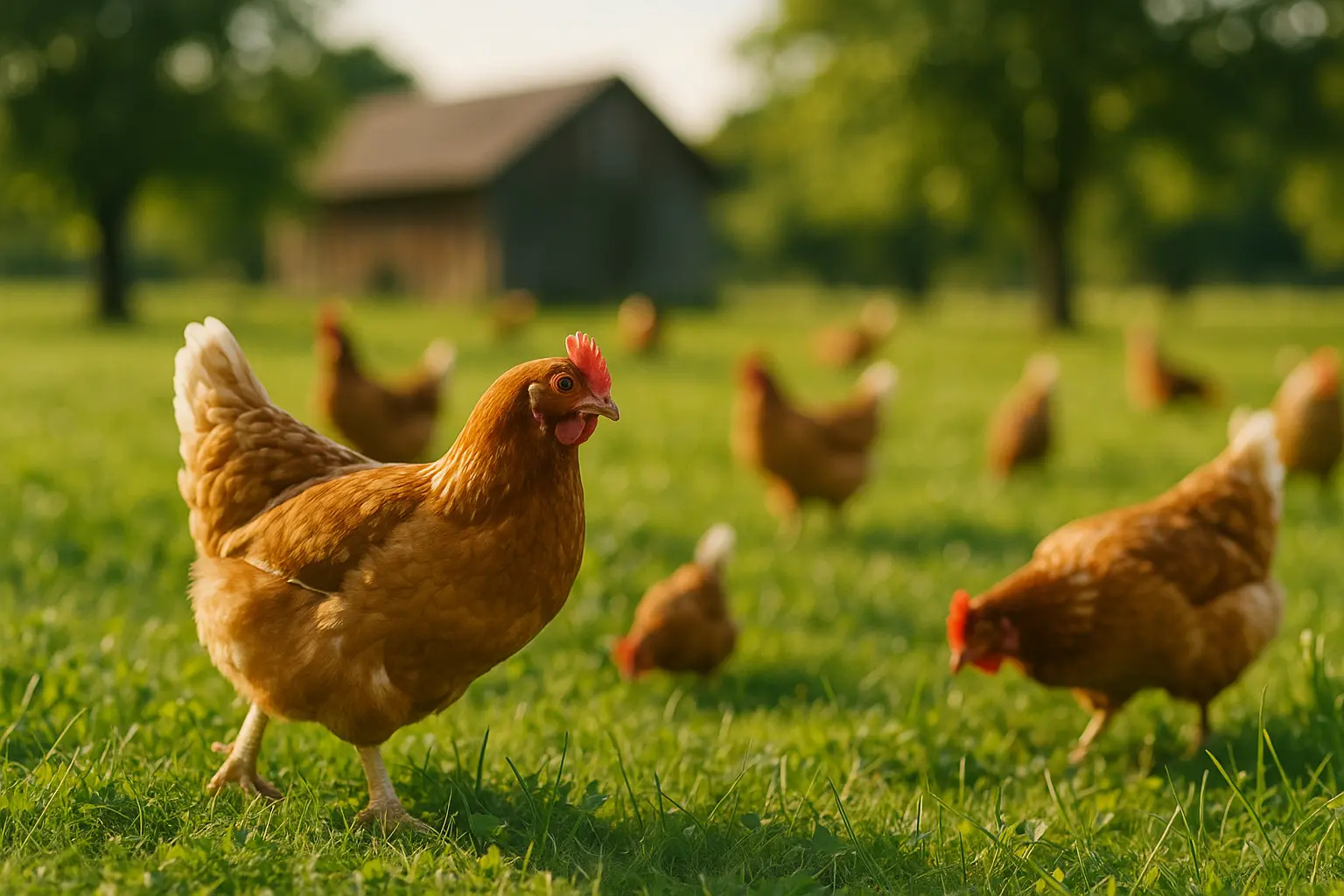
The word doing the heavy lifting in “easy-to-implement welfare practices” is easy. Most published welfare advice mixes measures that need a building project with measures that need nothing but attention, and then wonders why producers file the whole list under next year. This one only covers the second category.
Key takeaways
- Directive 2007/43/EC caps broiler stocking density at 33 kg/m², rising to 39 kg/m² where the Annex II environmental requirements are met, and 42 kg/m² only under the exceptional conditions of Annex V.
- The same directive requires a 24-hour light rhythm with at least six hours of darkness in total and one uninterrupted dark period of at least four hours, from day seven until three days before slaughter.
- Litter condition and footpad scoring are the cheapest welfare indicators available, and they respond to water line management before they respond to anything else.
- For transport, the binding text is Regulation (EC) No 1/2005; EFSA’s September 2022 opinion is the current scientific reference.
Where to start, ranked by what it actually costs you
Start with the practice that has the shortest distance between action and measurable change. The table sets out the five measures in the order we would tackle them on a farm that has not run a structured welfare review, with the indicator each one moves.
| Practice | What you measure | What it costs |
|---|---|---|
| Water line height, pressure and hygiene | Daily water intake, litter moisture under the lines | Staff time, no equipment |
| Litter and footpad management | Footpad score on a sample, litter friability by hand | Staff time, occasional bedding |
| Dark period in the light programme | Controller log against the six-hour requirement | A controller setting |
| Stocking headroom below the ceiling | kg/m² at peak weight, not at placement | Planning, real margin cost |
| Handling during catching and vaccination | Wing and leg damage, dead on arrival rate | Training time |
Water first, because everything else follows it
Water is the shortest route to a welfare gain because it drives litter, and litter drives footpads, hocks and air quality. A drinker line set too high for the smallest birds in the house restricts intake; a line leaking at 40 kPa too much pressure wets the litter directly under it and produces a strip of caked bedding you can see from the door.
Daily water intake, recorded and plotted rather than glanced at, is the single most sensitive early indicator a poultry house produces. A drop of ten per cent overnight precedes almost every health event worth catching early. The practical detail most farms miss is line hygiene between flocks, since biofilm reduces flow and carries organisms that no amount of house cleaning will reach. The broader case for treating it as an input rather than a utility sits in our guide to drinking water in poultry farming.
Litter and footpads: the audit you can run yourself
Footpad scoring is a welfare audit you can perform with your hands and ten minutes. Pick up thirty birds spread across the house, look at the plantar surface, and record how many show discolouration or lesions. Repeat it at the same age each cycle and the number becomes a trend rather than an opinion.
Litter is scored the same way and just as quickly: a handful that compacts into a ball and stays there is too wet, a handful that crumbles is where you want it. Neither test needs a consultant. What they need is for someone to do them on a fixed day rather than when something already looks wrong.

The dark period is the practice most often quietly skipped
A genuine dark period is a legal requirement, not a preference. Directive 2007/43/EC requires lighting on a 24-hour rhythm with darkness totalling at least six hours, including one uninterrupted block of at least four hours, applied from seven days after placement until three days before the expected slaughter date, with dimming periods excluded from the count. The same annex sets a light intensity of at least 20 lux at bird eye level over no less than 80 % of the usable area during light periods.
The reason it gets skipped is straightforward: darkness costs feed intake in the short term. The reason to keep it is that the dark block is what allows a circadian rhythm to establish, which shows up later in leg health and in how the flock behaves under stress. If your controller log cannot demonstrate the six hours, an inspector’s first question will be about the log, not the birds.
Stocking density: the ceiling is a limit, not a target
The legal ceiling and the density that produces good birds are two different numbers. Directive 2007/43/EC sets 33 kg/m² as the general maximum, allows up to 39 kg/m² where the holding meets the environmental requirements of Annex II, and permits 42 kg/m² only in the exceptional circumstances defined in Annex V. Houses operating at the higher figures must be equipped to hold temperature, humidity, CO₂ and NH₃ within the stated parameters.
The operational point is that density is calculated at peak weight, not at placement, and that ventilation capacity, not floor area, is what usually fails first. Planning a cycle two kilos per square metre below your permitted ceiling is one of the few welfare decisions that also buys you margin on a hot week.
Handling: welfare lost in minutes, not weeks
Catching and vaccination compress more welfare risk into a few minutes than the rest of the cycle does in weeks. Birds carried by one leg, crates loaded above their rated density, or a vaccination line run faster than the crew can keep up with all produce injuries that show up as damage at processing and as dead on arrival figures.
The fix is procedural. Fixed crew sizes, a stated rate per hour rather than an implied one, and a supervisor whose job during catching is to watch handling rather than to count crates. The same logic applies to vaccination, where technique determines both bird stress and the reliability of the dose, a subject we treat separately in our guidance on reducing animal stress during vaccination.
Enrichment, and what counts as evidence
Enrichment counts as a welfare practice when birds actually use it, which is a lower bar than it sounds and one that a lot of installed equipment fails. Perches, pecking objects and covered outdoor areas only earn their place if you can observe occupancy at different times of day, and that observation is the part that makes an enrichment claim defensible in an audit. Practical arrangements for outdoor areas are covered in our piece on enrichment and welfare in outdoor runs.
Transport: use the texts that exist
For transport, the binding instrument in the EU is Regulation (EC) No 1/2005 on the protection of animals during transport, and the current scientific reference is EFSA’s opinion of 7 September 2022 on birds transported in containers, which recommends greater space, lower temperatures and shorter journeys than current practice.
One clarification worth making, because the name circulates in older secondary guidance: we could find no traceable published standard from a body named the Center for Livestock Studies (CLS) when we checked in August 2026. Where a supplier or a template cites it, ask which text is meant. The regulation and the EFSA opinion are public, dated and citable; an unverifiable acronym is not a compliance reference.
If you change three things this quarter
- Plot daily water intake per thousand birds and set an alert threshold. Nothing else on this list gives a faster signal.
- Score footpads on thirty birds at a fixed age, every cycle, and keep the sheet. Three cycles in, you have a trend that argues for you in any audit.
- Pull your controller’s light log and check the dark block against the six-hour and four-hour requirements. If it is not there, it is the cheapest non-conformity you will ever fix.
The handling window that costs the most
Of the five practices above, the one that concentrates the most risk into the least time is handling during vaccination. Technique there decides both how the birds come through it and whether the dose does what it was meant to do.
Sources: Council Directive 2007/43/EC laying down minimum rules for the protection of chickens kept for meat production, Annexes I, II and V; Council Regulation (EC) No 1/2005 on the protection of animals during transport; EFSA, Scientific Opinion on the welfare of domestic birds and rabbits transported in containers, 7 September 2022. Consulted August 2026.
Published previously, fully revised on 6 August 2026. General operational guidance for poultry professionals. It does not replace the assessment of the veterinarian responsible for your flock, nor the requirements applied by your own competent authority, which may be stricter than the EU minimum.