
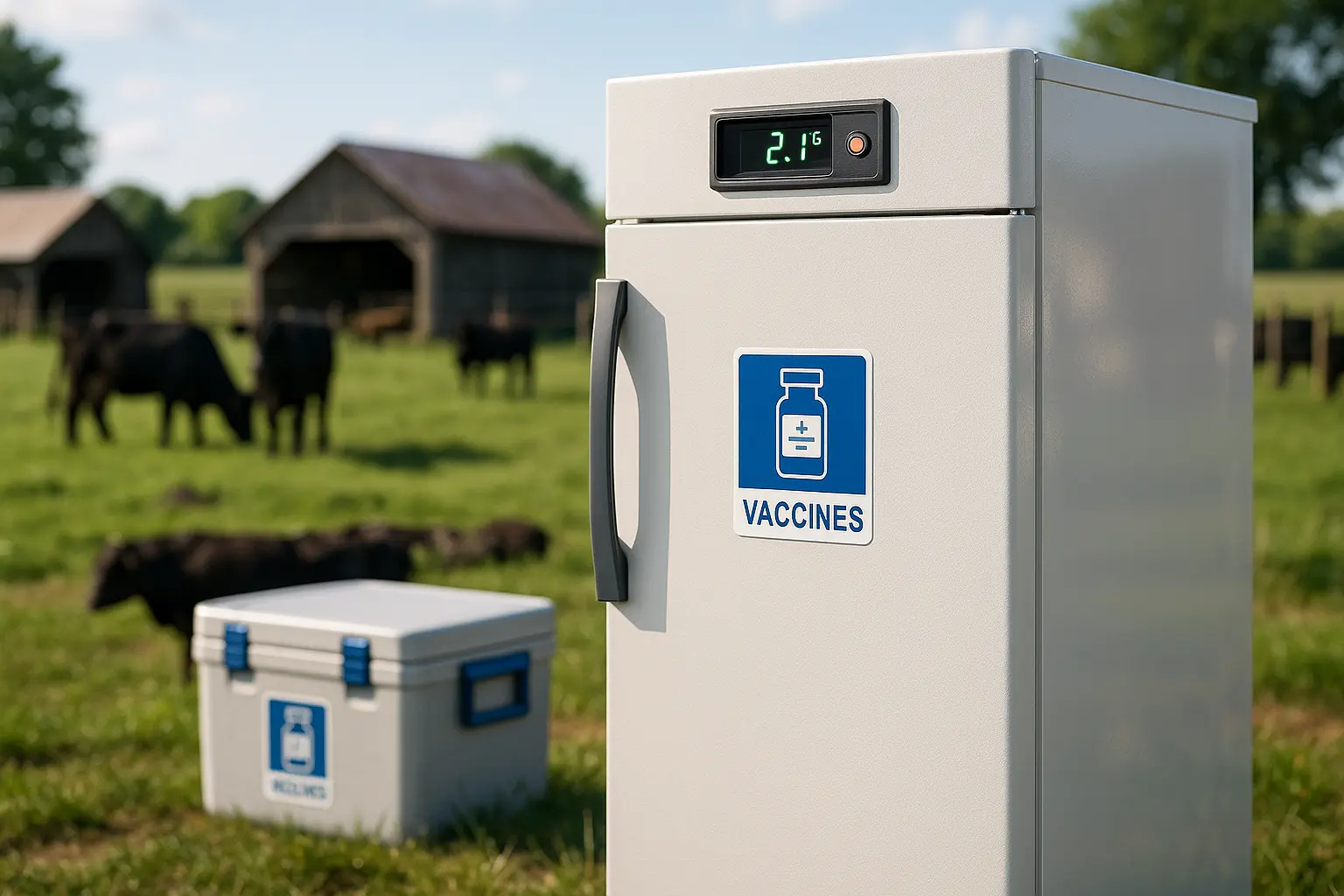
The cold chain in livestock vaccination is not one chain. Three temperature regimes run side by side in the same building, they fail in different ways, and the point where they break is almost never the lorry that everyone pictures.
Key takeaways
- A single freezing event can destroy the potency of a refrigerated vaccine, with no visible change in the vial.
- Thawing a cell-associated Marek’s vaccine is a timed procedure with published limits, not a matter of leaving the ampoule on a bench.
- The binding storage condition is the one on the product’s own authorised labelling, whatever a general guide says.
- In the United States, veterinary vaccines are licensed by USDA APHIS, not by the FDA, which regulates animal drugs.
| Regime | Typical products | Held at | Dominant failure mode |
|---|---|---|---|
| Cryogenic | Cell-associated Marek’s and HVT vector vaccines | Around -196 °C, in liquid nitrogen | Nitrogen level allowed to fall, or a mishandled thaw |
| Refrigerated | Most live and inactivated veterinary vaccines | +2 to +8 °C | Accidental freezing against the cold wall of an appliance |
| Ambient working window | Any product once reconstituted or mixed | Room temperature, for a defined period only | Time overrun, sunlight, contact with disinfectant residue |
Freezing is the failure that leaves no trace
Heat damage is gradual and at least partly predictable. Freezing is neither. A single exposure to 0 °C or below can destroy the potency of a product formulated for refrigeration, and the vial that comes out looks exactly like the vial that went in.
The mechanism is best documented for adjuvanted products. When a vaccine containing an adjuvant freezes, the adjuvant or part of it separates from the antigen, and the separation happens on freezing rather than gradually afterwards. Liquid vaccines carrying an aluminium adjuvant lose potency permanently once frozen, since irreversible precipitates of the aluminium-containing adsorbent begin to form. Published work on human adsorbed hepatitis B vaccine puts that threshold at around -0.5 °C, which gives an order of magnitude for how little margin there is either side of zero.
In poultry, one consequence goes beyond loss of protection. An inactivated fowl cholera vaccine that has been frozen can induce endotoxic shock in birds, because ice formation lyses the bacterial cell walls in the product. A frozen bacterin is therefore not merely worthless, and that is the argument for discarding rather than economising.
The frozen end of the chain has its own rules
Cell-associated Marek’s and HVT vector vaccines sit at the opposite extreme and must be kept in specialised liquid nitrogen containers at around -196 °C, reconstituted only in the diluent supplied for them. Nothing about that regime is improvised, and the risk concentrates in the few minutes of handling.
Published handling instructions are specific: thaw quickly in a container of clean water at 20 to 30 °C, with one product instruction setting a limit of 90 seconds in a 27 °C water bath, and never refreeze a thawed ampoule. The operator side matters as much: eye protection and gloves when working with the container, and no ampoule held toward the face when it is removed, because a cracked ampoule under pressure is a real injury risk. Storage and preparation belong in a separate, clean and well ventilated room rather than in the corner of a working area.
The last two hundred metres
Between the delivery vehicle and the animal, the chain depends on an appliance and on a person. Four checks carry most of the risk on that stretch.
- Record minimum and maximum, not the current reading. A thermometer showing +5 °C says nothing about the night the compressor cycled down to -1 °C. Only a minimum and maximum record, read and reset on a schedule, catches that.
- Keep product away from the coldest points of the appliance. Freezing typically happens against a back wall or an evaporator plate, not in the middle of the space, which is why the position of a box inside a fridge is an operational instruction rather than a detail.
- Protect the product from what surrounds it. Published guidance on vaccine handling is consistent on keeping products away from direct sunlight, heat sources, disinfectants, chlorine, detergents and heavy metal ions, all of which are abundant in a hatchery or a farm office.
- Treat the reconstituted window as a hard limit. Once mixed, a product has a defined working period, and the volume prepared should match what can realistically be administered inside it.
Who actually sets the rules
Regulatory responsibility for veterinary vaccines is often misattributed, and it matters when you are trying to verify a storage claim. In the United States, veterinary biologics, which include vaccines, bacterins, antisera and diagnostic kits, are licensed by the Center for Veterinary Biologics within the USDA’s Animal and Plant Health Inspection Service. The FDA’s Center for Veterinary Medicine regulates animal drugs, animal feeds and veterinary devices, a different perimeter. The two agencies signed a memorandum of understanding in 2013 and have since updated their charter to clarify which products fall where.
In the European Union, Regulation (EU) 2019/6 on veterinary medicinal products has applied since 28 January 2022, replacing Directive 2001/82/EC, and covers manufacture, supply and distribution alongside marketing authorisation. The practical consequence for a hatchery or a farm is unchanged in both jurisdictions: the storage conditions that bind you are the ones stated on the authorised labelling of the product in front of you, and no general guidance overrides them.
What to record so that a deviation stays answerable
A cold chain deviation becomes manageable only if the record allows someone to judge it later. Lot number, date and temperature on arrival, the appliance minimum and maximum across the holding period, the time the product left refrigeration, and who prepared it and when: five fields that fit on one line and that turn an incident into a documented question. The wider technology and regulatory picture around that record is covered in our article on full traceability for animal vaccines.
When the chain has demonstrably broken, the decision is not an operational one. Quarantine the affected lots, keep them identified, and refer the question to the marketing authorisation holder and to the veterinarian responsible for the flock or herd rather than deciding at the fridge door.
Where the cold chain ends
The chain stops being a storage question at the moment the product enters the application equipment. That is a different set of specifications, and a different set of failure modes.
Sources: published veterinary and hatchery guidance on vaccine storage at +2 to +8 °C and on the effects of freezing on adjuvanted and inactivated products, including adjuvant separation, aluminium adsorbent precipitation and endotoxic shock from frozen fowl cholera bacterin; The Poultry Site technical articles on frozen vaccine integrity and on liquid nitrogen storage and thawing of cell-associated Marek’s and HVT vaccines; USDA APHIS Veterinary Biologics pages and the APHIS and FDA charter update on jurisdiction for animal biologicals; EUR-Lex and the European Medicines Agency for Regulation (EU) 2019/6, applicable since 28 January 2022. Consulted August 2026.
Published previously, fully revised on 11 August 2026. General technical information for livestock professionals. Storage conditions, handling instructions and any decision on a product exposed to a temperature deviation are governed by the authorised labelling and by the veterinarian responsible for the animals concerned.