
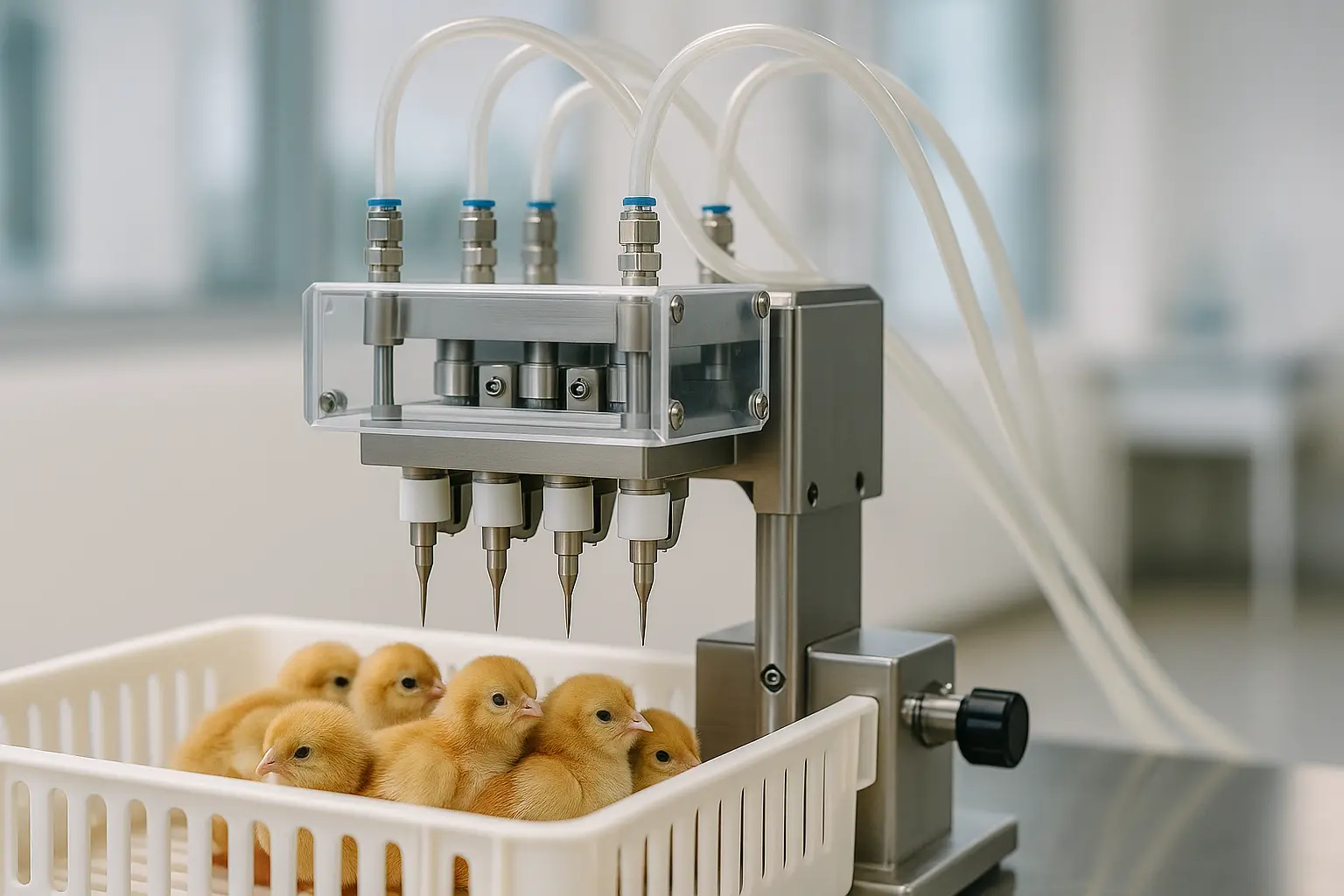
Machine comparisons in this sector usually open with throughput, because throughput is the number on the brochure. It is also the number least likely to decide whether the purchase was right. The question that comes first is which vaccination route your programme uses, because the route determines the family of machine, and only then does it make sense to compare models inside that family.
Key takeaways
- Choose the family from the vaccination route, then compare models on peak hourly capacity rather than on nominal capacity.
- In ovo accuracy depends on incubation timing and injection geometry, and no machine compensates for a badly timed transfer.
- Ask for the needle sanitation cycle in writing. It is the single feature with the clearest biosecurity consequence.
- Spray systems live or die on droplet size, which sits in a narrow band and drifts as nozzles wear.
Why the incubation calendar comes before the catalogue
In ovo systems have to work inside a biological window, and that window is what constrains the equipment. Injection is performed at around the eighteenth day of incubation, in the final quarter of development, and the published rationale for that timing is precise: by that stage the embryo is sufficiently developed and differentiated to tolerate the inherent randomisation in the actual site of injection without a significant adverse effect on hatchability.
The accuracy figures from the literature give a sense of what is achievable rather than perfect. Injection midway along and perpendicular to the longitudinal axis at day 18 produces amnion penetration in the order of 80%, and one published study reported 84.8% of injections in the amnion and 15.3% in the embryo. Delivery into the amniotic fluid is what allows the vaccine to be taken up as the embryo consumes that fluid before hatch. A machine cannot recover accuracy that was lost by transferring a day early or by setting eggs of uneven age in the same batch.
The three families, and what each is for
In ovo injection systems
These treat eggs at transfer, in volume, and suit operations whose constraint is labour and whose programme calls for immunity established before hatch. Published manufacturer figures for the Zoetis Embrex Inovoject range indicate up to 70,000 eggs per hour for the full-size automated configuration, and between 12,000 and 20,000 eggs per hour for the smaller Inovoject m depending on the incubation system, which gives a useful sense of the two scales available in this family. The feature to interrogate is sanitation between injections: on those systems, sanitising fluid is pumped over the needle and punch assembly after each injection, which is what limits bacterial carryover from egg to egg.
Spray cabinets
Spray application covers a large number of chicks quickly and uniformly, in boxes, and is the route used for several live respiratory vaccines. Its critical parameter is not throughput but droplet size, with roughly 100 to 150 µm reported as the optimal band. Too fine and the droplets are inhaled deeper than intended or lost to evaporation, too coarse and coverage becomes patchy. Nozzles wear, and a cabinet that was correct at commissioning drifts unless droplet size is checked on a schedule.
Subcutaneous and intramuscular injectors
These deliver a measured dose per bird and are the route where individual dose accuracy is highest and throughput lowest. They earn their place where the programme requires a strong individually verified response, and where the flock size makes per-bird handling realistic. Needle change frequency and dose calibration are the two variables that decide whether the theoretical accuracy survives a full shift.
| Family | Applied at | Critical parameter | Main failure mode |
|---|---|---|---|
| In ovo injection | Around day 18 of incubation, at transfer | Timing and injection depth into the amnion | Uneven egg age in the batch, needle sanitation lapse |
| Spray cabinet | Day-old chicks in boxes | Droplet size, around 100 to 150 µm | Worn nozzles, uneven box loading |
| Subcutaneous or intramuscular | Day-old chicks, individually | Dose volume and injection site | Dose drift over a shift, blunt needles |
The five criteria that separate models inside a family
- Peak capacity, not nominal capacity. Size the machine against your busiest hour on your busiest day, including the setting pattern you expect in three years. Nominal figures are quoted for an ideal configuration, and the qualifier “depending on configuration” carries real weight.
- Versatility across vaccine types. Live and inactivated products behave differently in a delivery system. Confirm which of your current products the machine is validated for, by name, rather than accepting a general claim of compatibility.
- Dose accuracy and its verification. The relevant question is not whether the machine doses accurately, it is how you will know that it still does in six months. A model that lets you check delivered volume without dismantling it will be checked, and one that does not will not.
- Maintenance, spares and response time. Downtime during a transfer window is expensive in a way that downtime elsewhere is not. Ask for the spares list, the lead time on wear parts, and the guaranteed response time in your region, and treat vague answers as information.
- Total cost across the life of the machine. Consumables, needles, sanitising fluid and service contracts often outweigh the purchase price over a machine’s life. Build the comparison on annual running cost per thousand birds vaccinated, which is the figure that survives negotiation.
Two figures worth requesting in writing
Two commitments turn a sales conversation into a comparable specification. The first is the sanitation cycle: what exactly happens between one injection and the next, and what evidence supports the carryover reduction claimed. The second is throughput measured in your own configuration, with your incubator type and your tray format, rather than in the manufacturer’s reference setup.
A supplier who can answer both in writing has usually thought about the installation. Integrating any of this into an existing hatchery raises its own set of constraints, which we have looked at separately in our article on automation in poultry vaccination.
What the machine will not fix
Equipment removes variability from execution. It does not decide what to administer, and it does not compensate for a protocol that is wrong. Three things stay outside the machine’s scope whatever you buy. Which vaccines a flock receives, against which threats and on what schedule, is a veterinary decision for the flocks concerned. Whether the cold chain held between delivery and administration is a storage question. And whether operators run the machine as specified is a training and supervision question, which is why we would put the operator training plan in the same purchase file as the technical specification.
Record keeping deserves a line of its own here. A machine that logs batch, volume and time per run turns your vaccination records from a reconstruction into an extract, and that has a value at audit that rarely appears in the equipment business case.
Once the machine is chosen
The purchase decision is short. Keeping the equipment inside its accuracy specification for years is the longer job, and it runs on a maintenance plan rather than on a warranty.
Sources: peer-reviewed work on in ovo injection timing, injection site and amnion penetration rates at day 18 of incubation, and on the effect of embryo development stage on injection accuracy and hatchability; The Poultry Site technical articles on maximising in ovo vaccination success and on spray vaccination droplet size; manufacturer specifications published for the Zoetis Embrex Inovoject and Inovoject m systems, for throughput ranges and needle sanitation between injections. Consulted August 2026. Manufacturer performance figures are stated for reference configurations and should be confirmed for your own installation.
Published previously, fully revised on 7 August 2026. General technical guidance on equipment selection for hatchery professionals. Vaccine choice, strain selection and vaccination schedules are veterinary decisions for the flocks concerned and fall outside the scope of this article.