
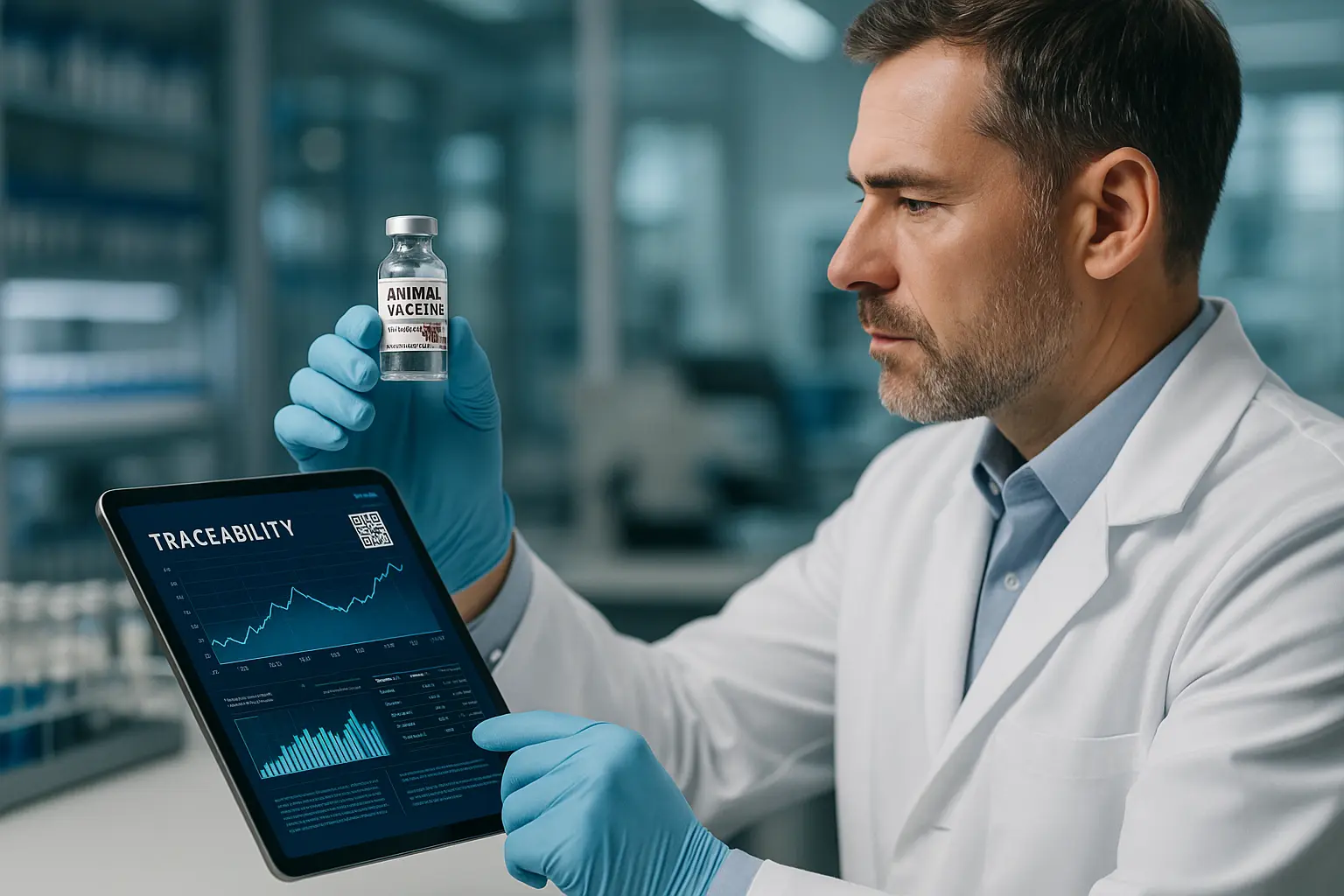
A traceability system is not really tested by an inspection. It is tested by the phone call that starts with a batch number and a question: which birds received this, on which day, and where are they now. Operations that can answer in twenty minutes and operations that need three days often use the same software. What separates them is what got written down at the point of administration.
Key takeaways
- The legal minimum is a record set, not a platform. Get the nine fields of Article 108 right before evaluating software.
- Medicine records and establishment records are two separate obligations that live in two different regulations. Merging them is where audits go wrong.
- The vaccine batch number is the pivot of the whole system, and for immunological products it is already an officially released, controlled identifier.
- Each identification technology solves one narrow problem. None of them solves an incomplete entry made on the hatchery floor.
The record set that has to exist before any technology
The starting point of vaccine traceability is a written record of administration held by the keeper, and it is prescriptive. Article 108 of Regulation (EU) 2019/6 lists what has to be captured, and the list is short enough to audit against directly. A useful exercise, before any procurement discussion, is to take last month’s vaccination log and score it line by line against these fields.
| Field required at farm or hatchery level | What it does during an incident |
|---|---|
| Date of first administration | Fixes the exposure window and the start of the withdrawal period |
| Product name and quantity administered | Distinguishes a dosing problem from a product problem |
| Supplier name and permanent address | Reconnects your record to the distribution chain upstream |
| Identification of the animal or group treated | The single field that makes forward tracing possible at all |
| Prescribing veterinarian, where applicable | Establishes who carries the clinical decision |
| Duration of treatment and withdrawal period | Governs release of eggs or meat into the food chain |
Two details are worth flagging because they are the ones most often missed. The withdrawal period has to be recorded even when it is zero, which surprises teams who assume a nil value needs no entry. And where the information already appears on the veterinary prescription or in existing farm records, it does not have to be duplicated, so a well designed system points at documents rather than retyping them.
Two registers that get merged, and should not be
Vaccine traceability and animal traceability are separate legal objects, and conflating them is a common audit finding. The medicine record sits under Regulation (EU) 2019/6. The establishment side sits under the Animal Health Law, Regulation (EU) 2016/429, and its Commission Delegated Regulation (EU) 2019/2035, which sets the rules for establishments keeping terrestrial animals and for hatcheries, including the record keeping obligations of operators and the traceability of hatching eggs.
The practical consequence for a hatchery is that registration or approval by the competent authority is the precondition for movement, not a formality. Poultry and hatching eggs moved to another Member State have to originate from a registered or approved establishment, which is why the approval number, the flock of origin and the setting date belong in the same searchable record as the vaccine batch. When those two chains are held in separate spreadsheets that nobody joins, the operation technically holds all the data and still cannot answer the question that matters.
Where the batch number comes from
The batch number is the pivot of a vaccine traceability system, and for immunological veterinary medicinal products it is a stronger identifier than most teams realise. Under Article 128 of Regulation (EU) 2019/6, immunological products can be subject to official batch release by an official control authority before being placed on the market, following a harmonised European administrative procedure operated with the EDQM. In other words, the number printed on that vial is already tied to a controlled dossier held outside your operation.
This is what makes a discipline of transcribing batch numbers accurately worth enforcing, including on partial vials and on doses drawn late in a shift. A batch number captured correctly gives you a route back to manufacturing and release data. A batch number captured as an approximation gives you nothing, and no downstream platform can reconstruct it.
What each identification technology actually solves
Each technology in this space answers one narrow question, and the mistake is buying it to answer a broader one. Reading the list below as a set of tools with defined perimeters, rather than as competing solutions, tends to shorten the procurement argument considerably.
Electronic identification and RFID
Radio frequency identification and implanted microchips solve the problem of identifying an individual animal reliably and repeatedly without handling paperwork. In poultry operations, individual electronic identification is generally reserved for breeder stock and for research flocks, because the unit of traceability in commercial production is the group: the flock, the batch of hatching eggs, the trolley, the placement. Group level identification is not a weaker form of traceability, it is the appropriate granularity, provided the group boundaries are defined and recorded.
Two-dimensional codes on the vial and the carton
Scanning a code at the point of use removes the single largest source of error in the whole chain, which is manual transcription of a batch number and an expiry date. This is the intervention with the best ratio of cost to risk removed, and it needs no infrastructure beyond a rugged scanner and a field on a form.
Distributed ledgers, on their real perimeter
A distributed ledger makes a record tamper evident once written, which is genuinely useful across organisations that do not share a database and have reason to distrust each other’s edits. It does not verify that the entry was true when it was made. A wrong batch number written to an immutable ledger is a wrong batch number that can no longer be corrected quietly, which is an improvement in accountability and not an improvement in data quality.
The platform question
Centralised digital platforms earn their cost when they let a veterinarian and a production manager look at the same vaccination history in real time, and when they export the Article 108 fields without manual reformatting. That second criterion is the one we would put in a tender document. A platform that stores the data beautifully and cannot produce a regulator ready extract has moved the problem rather than solved it.

The same reasoning applies to the storage conditions attached to each batch, since a vaccine record that cannot be cross referenced against a temperature excursion is incomplete in practice even when it is complete on paper. That side of the chain has its own constraints, set out in our review of cold chain management for vaccines in livestock farming.
If your operation ships to the United States or is audited against its standards
The American framework runs on a different logic, and it is worth understanding rather than assuming equivalence. The USDA and its Animal and Plant Health Inspection Service, APHIS, administer the National Poultry Improvement Plan, whose provisions sit in the Code of Federal Regulations, 9 CFR parts 56, 145, 146 and 147, with the associated testing and sanitation procedures published in the NPIP Program Standards. Participation is organised around flock classifications, each carrying its own testing requirements, and dealers in hatching eggs, newly hatched poultry and started poultry fall under those provisions.
For a European hatchery, the takeaway is narrow: the fields you already keep for Article 108 will largely cover an NPIP style audit trail, but the classification logic and the testing evidence are additional obligations, not a reformatting of what you hold.
The three failure modes we see in implementation
- Cost concentrated in the wrong place. Budgets tend to go to the platform licence and not to the scanners, the training hours and the label stock at the point of administration. The expensive part of traceability is capture, not storage.
- Integration debt. A traceability layer that does not talk to the incubation and placement records forces double entry, and double entry decays within a season. Ask what the system reads automatically before asking what it displays.
- Adoption without a reason. Teams comply with a protocol they understand the purpose of. Showing crews the recall scenario the record is designed to answer changes completion rates more reliably than adding mandatory fields.
Questions we get when a system goes in
Is group level traceability enough for poultry, or is individual identification expected?
Group level identification is the normal unit in commercial poultry production, and Article 108 explicitly allows the identification of a group of animals rather than an individual. What matters is that the group is defined unambiguously and that its boundaries are recorded, so that a batch can be resolved to a known population.
How long do vaccination records have to be kept?
Regulation (EU) 2019/6 sets a minimum of five years for records held by keepers of food-producing animals, available for inspection by the competent authority. National provisions and customer specifications can require longer, so treat five years as a floor rather than a target.
Do we need blockchain to satisfy a regulator?
No European provision requires a distributed ledger. A conventional database with controlled access, audit logging and a tested export will satisfy an inspection if the underlying entries are complete. Vaccine selection and scheduling, for their part, remain veterinary decisions for the flocks concerned.
Where we would start, on a site with no structured system today, is a single week of parallel recording: keep the existing paper log, and alongside it capture the Article 108 fields against each group vaccinated. The gap that exercise reveals is usually the honest scope of the project.
The wider stake behind the record
Vaccine and animal traceability is not only a compliance exercise. It is one of the points where a poultry operation connects to food safety expectations it does not control, and that context is worth reading in full before designing a system.
Traceability of vaccines and animals as a food safety challenge
Sources: Regulation (EU) 2019/6 on veterinary medicinal products, Article 108 (record keeping by keepers of food-producing animals) and Article 128 (official batch release of immunological veterinary medicinal products, EU administrative procedure operated with the EDQM); Regulation (EU) 2016/429 (Animal Health Law) and Commission Delegated Regulation (EU) 2019/2035 on establishments keeping terrestrial animals, hatcheries and the traceability of hatching eggs; USDA APHIS National Poultry Improvement Plan, 9 CFR parts 56, 145, 146 and 147, and the NPIP Program Standards. Consulted August 2026. National transposition and current regulatory text prevail over this summary.
Published previously, fully revised on 7 August 2026. General operational guidance for hatchery and poultry professionals. It is not legal advice on your compliance position, and it does not replace an assessment by your competent authority or by the veterinarian responsible for your flocks.