
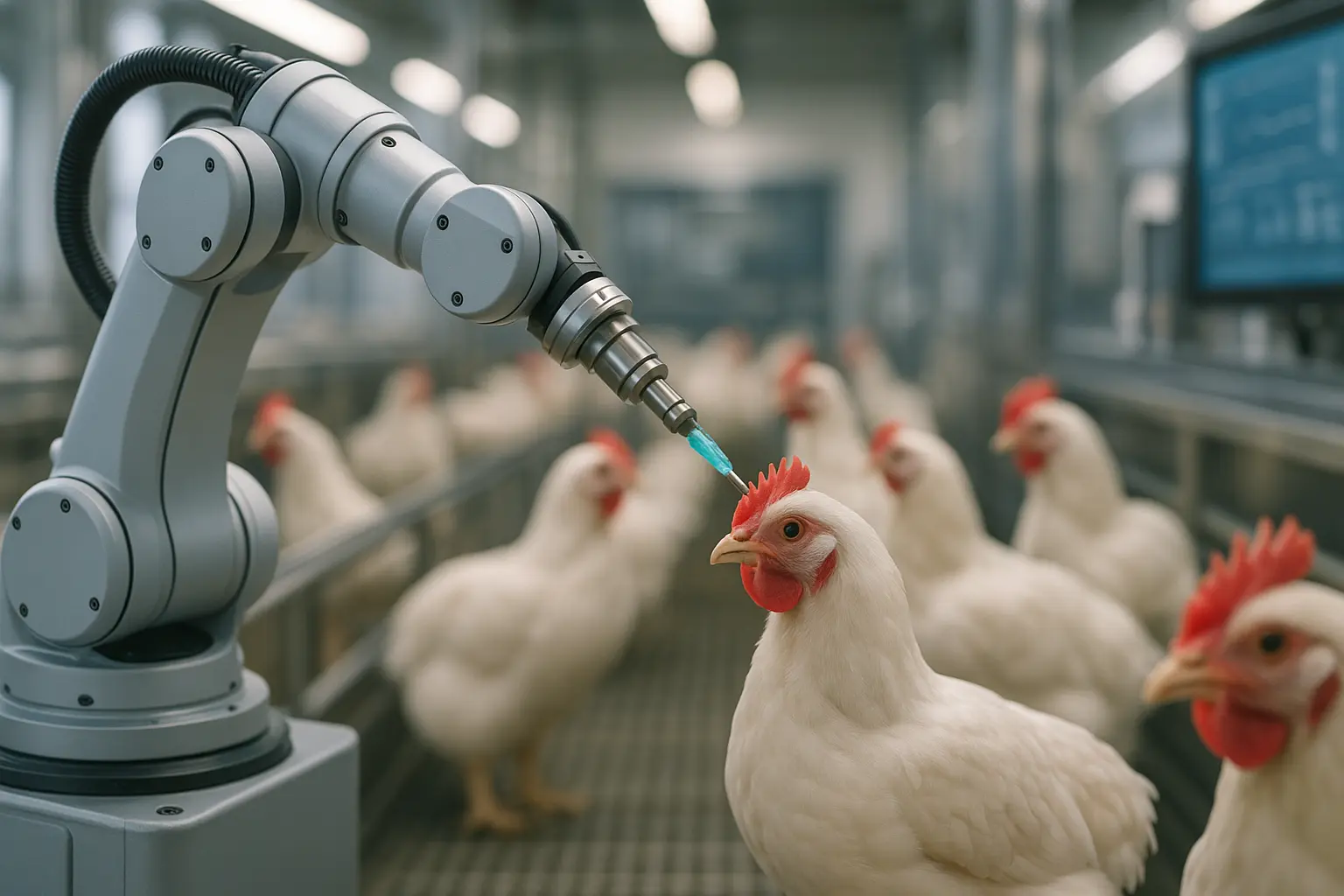
The question in the title deserves a straight answer rather than a diplomatic one, so here it is. At the needle, automation is an evolution. It does the same job faster and more evenly than a tired crew at four in the morning, and that is worth paying for, but it is a difference of degree. The genuine break with the past is somewhere else entirely, and it has nothing to do with the injection.
Key takeaways
- Improper administration is the most common cause of vaccine failure in poultry, and individual injection can miss 10% to 15% of birds.
- Automated subcutaneous machines run at around 2,500 chicks per hour, against 1,600 to 2,000 for a skilled operator with semi-automatic equipment.
- On the egg side the scale is different: a full-size in ovo machine handles up to 70,000 eggs per hour, compact models 12,000 to 20,000.
- Automation applies a badly prepared vaccine with the same precision as a good one. The preparation bench is not automated on most sites.
The arithmetic a manual crew cannot escape
Start with the failure that automation is bought to solve. Extension work on vaccination failure in poultry flocks is blunt about the cause: improper administration of the vaccine is the most common reason a program does not protect. The quantified version is harder to argue with. With individual injection vaccination, in many cases 10% to 15% of the birds may be missed.
That number is not an indictment of vaccination crews. It is a description of what happens when people are asked to perform a precise manual task thousands of times an hour, at pace, in a hot and noisy room. Fatigue is not a training problem. It is a property of the task.
The consequence in the field is a flock with uneven protection rather than an unprotected flock, which is exactly the outcome that is hardest to detect. Nothing looks wrong at placement. The gap shows up later, as a slower or patchier serological response, or as a disease event in a flock that was on paper fully vaccinated.
What the throughput figures actually say
Here is where the revolution language runs into the data. Automated subcutaneous vaccination machines for day-old chicks operate at an average of about 2,500 chicks per hour. A skilled operator using semi-automatic equipment manages roughly 1,600 to 2,000. That is a meaningful uplift, on the order of a quarter to a half, and it comes with consistency of dose and depth that a human hand cannot match through a full session. It is not, however, a change of category.
The picture changes completely one step upstream. In ovo equipment works on trays rather than individuals, and a full-size machine vaccinates up to 70,000 eggs per hour depending on configuration, with compact units built for smaller hatcheries running at 12,000 to 20,000. The first commercial in ovo system appeared in 1992, so this is a mature technology rather than a novelty. If you are looking for the discontinuity, it is there, in the decision to treat the egg rather than the bird.
| Criterion | Manual and semi-automatic, chicks | Automated, chicks | In ovo, eggs |
|---|---|---|---|
| Indicative rate | 1,600 to 2,000 per hour | around 2,500 per hour | 12,000 to 70,000 per hour |
| Coverage risk | Missed birds, drifting with fatigue | Presentation errors at the feed point | Wrong compartment, mispositioned eggs |
| Dose consistency | Operator dependent | Mechanical, needs calibration | Mechanical, verify per head |
| Verification method | Sampling birds behind the crew | Dose reconciliation and machine log | Residue breakout and volume checks |
| Failure when it goes wrong | Gradual, individual | Systematic, affects a whole session | Systematic, affects a whole setting |
The part that deserves the word revolution
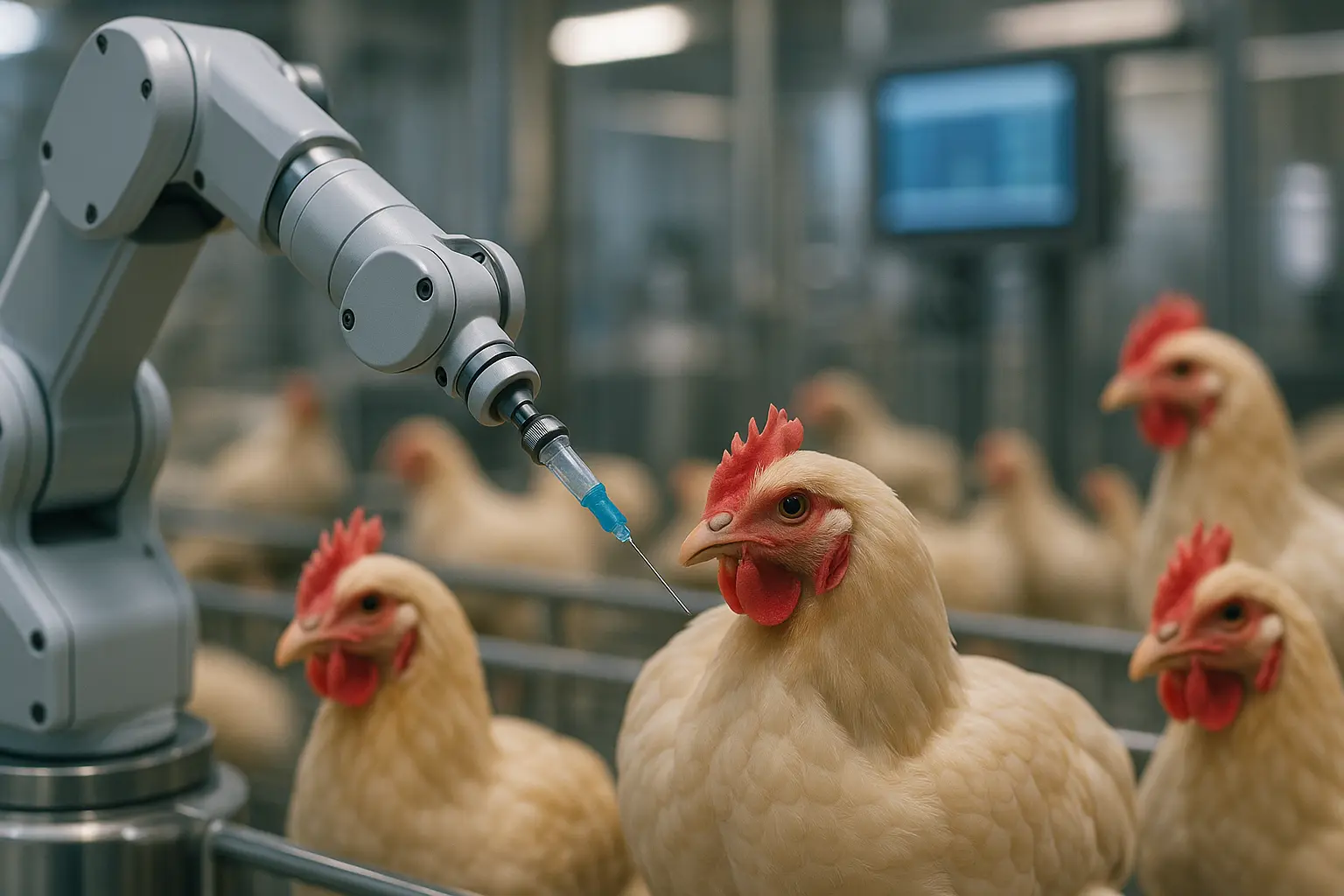
What automation changes structurally is not the needle, it is the record. A manual session leaves you an estimate: number of doses drawn, number of birds through the room, a crew’s word on how it went. An instrumented line leaves you reconcilable data, doses delivered against birds processed, per session, per head, per batch.
That record is what turns vaccination from a task into a controllable process. It makes dose drift visible while it is happening rather than after a field failure. It supports a traceability chain that customers and auditors increasingly ask for by batch rather than by farm. And it changes the maintenance conversation, because a head that is under-delivering is a data point rather than an argument, which is the basis of any serious preventive maintenance plan for vaccination machines.
Where automation does not pay
Automation rewards volume and regularity, and penalizes the opposite. Small batches, frequent changes of vaccine or species, and irregular hatch scheduling all erode the throughput advantage, because setup and cleaning time is fixed while the run is short.
Two questions decide more purchases than the price does. Can the site perform daily cleaning and routine calibration to specification, in a hatchery atmosphere of high humidity and fluff that is hostile to equipment? And what is the realistic lead time for a spare part and an engineer? A machine that stops on a hatch day with a three-day parts lead time hands you a worse problem than the one it was bought to solve.
What no machine will fix
Automation acts at the point of delivery. Everything upstream of that point remains manual, and it is where most of the loss occurs. A vaccine reconstituted too early, held too warm or thawed outside its window arrives at the injector already degraded, and the machine will administer it with perfect consistency.
The margins are tighter than people expect. Infectious bronchitis virus vaccine is reported to lose roughly half its potency in warm conditions less than an hour after reconstitution. Cell-associated products stored in liquid nitrogen have thaw and dilution windows measured in seconds. No automated line monitors any of that. It is a bench discipline, and it stays a human responsibility.
How to read a throughput claim
Supplier figures are nominal rates under favorable conditions. The number you need is different: sustained rate across a full working session, including changeovers, cleaning and the interruptions your site actually experiences. Ask for it in those terms, and ask for a reference site with a comparable batch profile.
Independent literature helps, with one caveat about method. Google Scholar is a search index, not a source, and citing it says nothing. What counts is the study behind the result: which equipment, which flock size, which measured endpoint, and whether coverage was verified in the birds or inferred from doses drawn. If a claim cannot be traced to a document you can read and assess, treat it as marketing.
Two questions that come up in every buying discussion
Does automation improve animal welfare?
It reduces handling time per bird and removes the variability that comes with operator fatigue, which are genuine welfare arguments. It also concentrates risk, since a badly set machine affects every bird identically. The welfare gain is conditional on calibration and monitoring, not automatic.
Should a mid-sized hatchery automate the chick line or the egg line first?
The throughput figures point to the egg line, where the difference between manual work and machine work is an order of magnitude rather than a percentage. That said, this is a site-specific calculation involving batch size, hatch scheduling, vaccine program and available technical support, and it deserves a proper appraisal rather than a rule of thumb.
Before comparing machines, compare criteria
Throughput is the number suppliers lead with and rarely the one that decides the outcome on a real hatch day.
See our comparison of poultry vaccination machines and the criteria that matter
Sources: Butcher and Yegani, Investigating Vaccination Failure in Poultry Flocks, University of Florida IFAS Extension; Poultry World, on vaccination standards and equipment for day-old chicks in the hatchery; manufacturer and industry documentation on in ovo equipment throughput and history; published guidance on handling of cell-associated Marek’s disease vaccines. Consulted August 2026.
Vaccine choice, schedule and the veterinary supervision of a vaccination program fall outside the scope of this article, which deals with delivery equipment and process control.