
Every time feed prices move, someone asks us the same question in a slightly different shape: what can be taken out of the ration without the birds noticing. It is the wrong question, and the flocks answer it faster than the spreadsheet does. The ration that costs least per tonne is almost never the ration that costs least per egg or per kilo of live weight.
Key takeaways
- Feed is the dominant cost line in poultry production, which is exactly why cutting the price per tonne is the wrong first move.
- Crude protein tells you almost nothing on its own. Digestible amino acid content, lysine first, is what the bird actually converts.
- Layers need calcium available at night: particle size governs when it reaches the shell gland, not just how much arrives.
- A farm-mixed ration can work, but only with a mineral and vitamin premix and a real weighing routine behind it.
Why cheaper feed usually costs more
Feed is the single largest cost line in poultry production, in a range most commonly quoted across the sector at 60 to 70 % of total production cost. That share is why it attracts the first cut when margins tighten, and why the cut so often backfires: a 4 % saving on the ration disappears the moment feed conversion drifts by a few points or shell breakage climbs at grading.
The useful frame is cost per unit of output, not cost per tonne of feed. A ration is doing its job when the feed conversion ratio, the mass of feed consumed per unit of live weight or per dozen eggs, holds steady across a cycle. Anything that improves feed conversion pays twice, because it lowers both the feed bill and the volume of litter and nitrogen leaving the house.
This is also the honest limit of any article on feeding. Nobody can formulate your ration from a distance: it depends on the ingredients actually available to you, their analysis, and the genetic line you run.
Protein: formulate on digestible amino acids, not on the crude protein figure
Crude protein is a nitrogen measurement, not a nutritional one. Two rations declaring the same crude protein can perform very differently, because the bird does not use protein, it uses individual amino acids, and only the fraction it can digest. Formulating on digestible lysine first, then expressing methionine, threonine and tryptophan as a ratio to it, is the practice that separates a modern ration from a farm recipe built on percentages.
That approach also explains why excess protein is not a safety margin. Amino acids supplied beyond requirement are deaminated, the nitrogen is excreted, litter moisture and ammonia rise, and the extra protein has been paid for twice: once at purchase, once in ventilation.
Ingredient choice follows from this. Soybean meal remains the reference protein source in most European rations. Fish meal supplies a favourable amino acid profile and is used mainly in early starter diets, at modest inclusion rates because of cost and, in laying stock, because of the risk of taint. Insect-derived protein became a legal option in August 2021, when processed animal protein from farmed insects was authorised for poultry and pig rations in the EU. Availability and price, not legality, now limit its use.
Calcium for layers: particle size does as much work as the inclusion rate
A laying hen needs roughly 4 to 4.5 g of calcium per day, and the timing of its arrival matters as much as the total. Shell calcification happens largely overnight, hours after the last feed intake, so a ration built only on finely ground limestone leaves the hen drawing on her own skeleton to finish the shell.
Coarse particles solve this by sitting in the gizzard and dissolving slowly, releasing calcium through the night. Published work on aged layers, including a 2021 trial in Scientific Reports comparing coarse eggshell, limestone, cockle shell and oyster shell, consistently finds particle size and solubility to be decisive for shell quality in older flocks, where the same intake of fine limestone no longer holds shell strength.
| Calcium source | Typical form | What it is good for |
|---|---|---|
| Fine limestone | Ground, blended into the mash | Base calcium supply during the day, cheap and easy to mix evenly |
| Coarse limestone | Granules retained in the gizzard | Overnight release during shell calcification, the fraction most often missing |
| Oyster shell | Crushed, fed free choice | Letting individual hens self-correct, useful in mixed-age or small flocks |
| Insoluble grit | Flint or granite chips | Gizzard grinding only, contributes no calcium and should never be counted as such |
The last line of that table is worth stating plainly, because the confusion is common on farm: grit is not a calcium source. Offering the two from the same hopper leaves you unable to say what the hens are actually eating.
Calcium also has jobs outside the shell. It is involved in muscle function and blood clotting, and a chronic deficit shows up as poor bone strength and reduced mobility well before it shows up as broken eggs. Any suspicion of a metabolic bone problem in a flock is a veterinary matter, not a formulation adjustment.
The base blend, and what a farm mix can honestly deliver
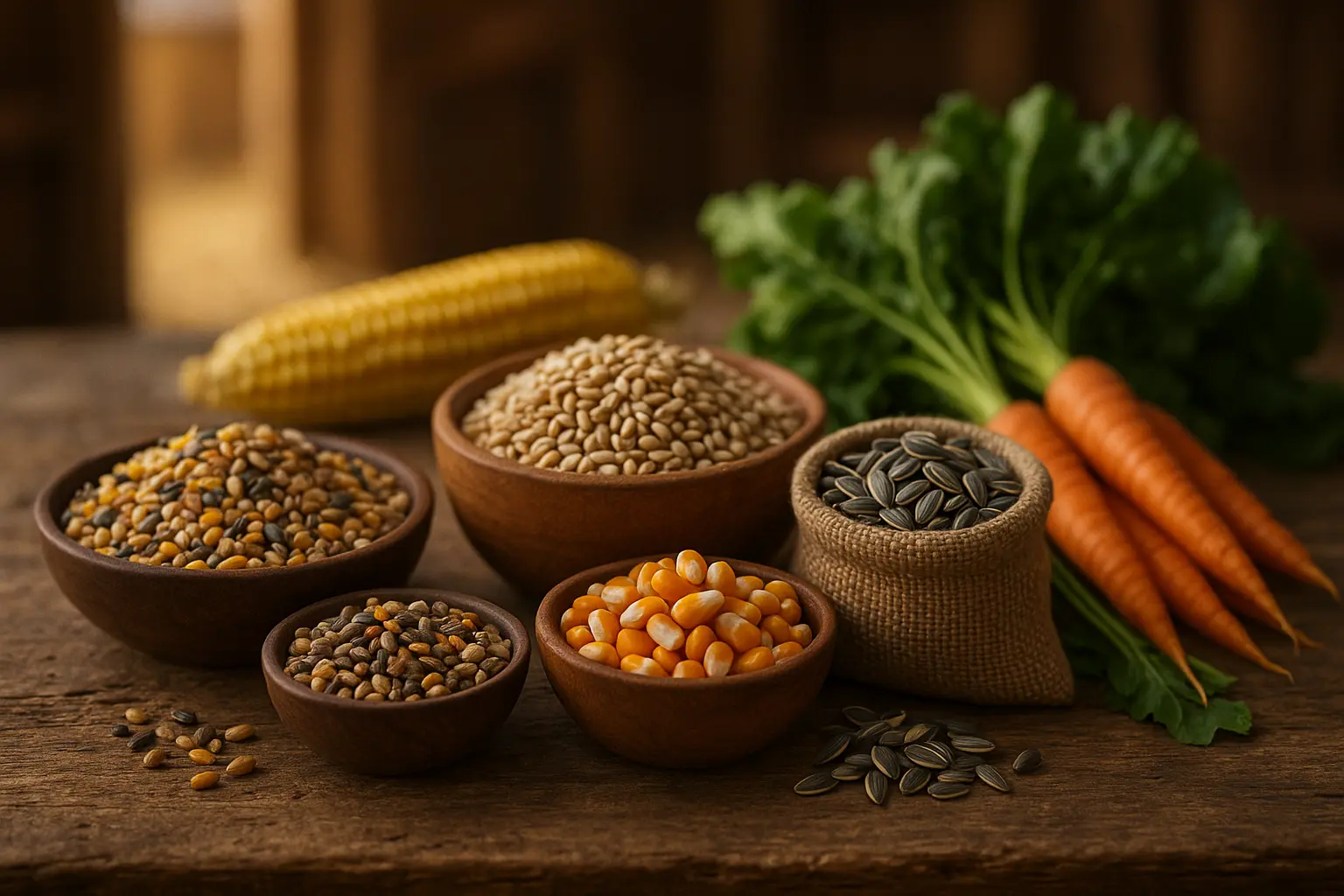
A farm-mixed ration is a legitimate choice when you have your own cereals, a reliable mixer and a scale you trust. The blend below is the kind of starting structure used as a reference before adjustment, and it is only a starting structure:
- 50 % maize or wheat, as the energy base
- 20 % soybean meal or fish meal, as the protein base
- 10 % oats or barley, contributing fibre and structure
- 10 % alfalfa meal
- 5 % ground limestone
- 5 % mineral and vitamin premix
Two things decide whether that mix works. The first is the premix: without a properly formulated vitamin and trace mineral supplement, a home blend runs into deficiencies that appear weeks later as leg problems, poor feathering or falling persistency. The second is mixing accuracy. Ingredients of different particle size separate during transport and in the hopper, and birds sort what they can see, which means the analysis on paper and the ration in the beak stop matching.
Water belongs in this conversation too, and it is the input most often left out of a feeding review. Intake, temperature and line hygiene all change how much feed a bird consumes, which is why we treat drinking water as part of the feeding system rather than a separate topic.
Additives, herbs and probiotics: what may be claimed, and by whom
Feed additives in the EU are not a free-form category. Under Regulation (EC) No 1831/2003, an additive must be authorised for the species and function concerned before it can be placed on the market, and the same regulation is the instrument that withdrew antibiotic growth promoters from EU feed at the start of 2006.
Two later texts changed daily practice more than most producers expected. Regulation (EU) 2019/6 on veterinary medicinal products and Regulation (EU) 2019/4 on medicated feed both applied from 28 January 2022. Together they end routine preventive group treatment with antimicrobials: prophylactic use is restricted to exceptional situations, and medicated feed can no longer be used as a standing management tool. If your health programme still leans on a routine in-feed treatment, that is a conversation to have with your veterinarian rather than with your feed supplier.
Oregano, garlic, thyme, fermented grains and probiotic preparations sit in this same regulatory space. Several are used commercially and some carry supporting trial data on gut health, but the claim you may make about them is fixed by their authorisation, and the effect size in a working house is usually smaller than the marketing suggests. Test them one variable at a time.
A three-cycle check before changing anything
When operators ask us where to start, our answer is deliberately unglamorous: measure before formulating. Over three production cycles, record feed consumed per bird per day, feed conversion, and one output measure that matters to you, shell breakage at grading for layers or uniformity at weighing for broilers. Then change one thing.
The most common finding is not a nutritional gap at all. It is feeder space, wastage from over-filled pans, or a ration that separated in the hopper. Fixing those costs nothing per tonne and shows within a fortnight, whereas a reformulation takes a full cycle to evaluate and is easy to credit for improvements it did not cause.
Questions operators send us
How do I know the ration matches my birds’ needs?
By reading the birds, not the bag. Daily intake, growth or laying persistency, litter condition and shell quality are your instruments. A deviation in any of them lasting more than a few days is worth investigating before it becomes a cycle-long loss.
When should the ration composition change?
At the transitions the bird’s physiology imposes: starter to grower, grower to finisher or pre-lay, and then across the laying period as calcium requirement rises with hen age. Changing outside those transitions should be driven by a measured problem, not by a price offer.
Are natural additives a substitute for a veterinary programme?
No. Plant extracts and probiotics are managed as nutritional tools within their authorisation. Diagnosis and treatment of a health problem in a flock remain the responsibility of the veterinarian who knows your site.
Where can a farm mix genuinely save money?
In using cereals you already grow and avoiding the transport cost of a bulky finished feed. The saving is real, and it is conditional on a premix, a calibrated scale and a mixing routine that does not vary with whoever is on shift.
Feeding follows the bird you chose
Amino acid targets, calcium curves and phase transitions all depend on whether you are running a meat line, a laying line or a dual-purpose bird. If that decision is still open on your site, it is the one to settle first.
Sources: Regulation (EC) No 1831/2003 on additives for use in animal nutrition; Regulation (EU) 2019/6 on veterinary medicinal products and Regulation (EU) 2019/4 on medicated feed, applicable from 28 January 2022; Commission Regulation (EU) 2021/1372 authorising insect processed animal protein in poultry feed; Kim et al., Scientific Reports, 2021, on calcium sources and eggshell quality in aged laying hens. Consulted August 2026.
Published previously, fully revised on 8 August 2026. This article is general technical guidance for poultry professionals. Ration formulation and any health intervention should be validated with your own nutritionist and the veterinarian responsible for your flock. Regulatory references given here apply to the European Union and should be checked against the rules in force in your own market.