
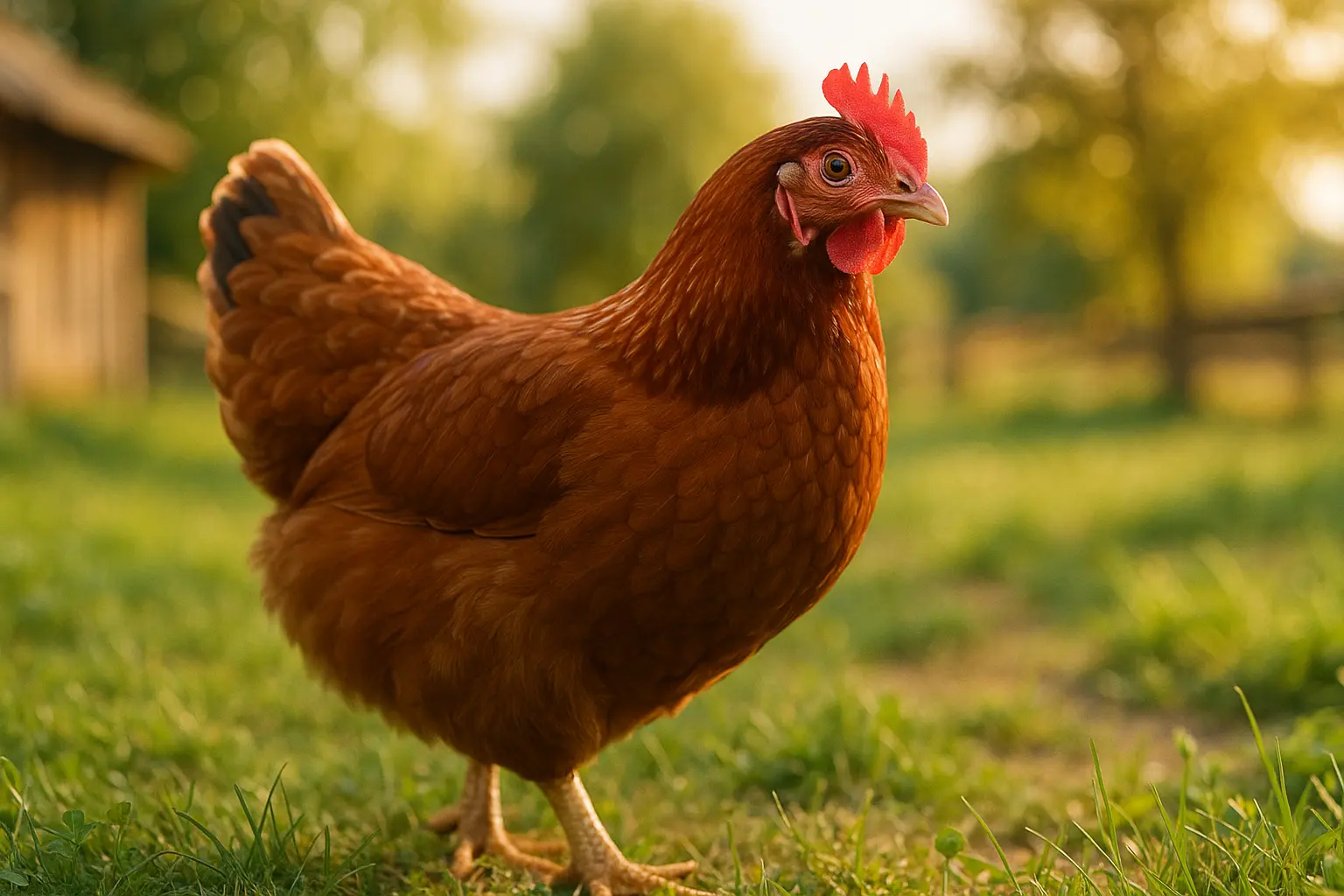
By the time a stress problem shows up in egg output, it has usually been running for several days. The signs that arrive first are quieter, and most of them are visible from the doorway or already sitting in the daily records nobody reads back. Learning to read those seven, in the order they appear, buys back most of the losses.
Key takeaways
- Water intake moves first. A daily water to feed ratio is the cheapest stress detector on any site.
- Production figures are lagging indicators. Reacting to them alone means reacting late.
- Panting has a temperature threshold you can design ventilation against, not just a subjective one.
- Feather damage and injurious pecking are welfare outcomes with serious consequences, and they respond to housing and management before they respond to anything else.
Reading a sign instead of reacting to it
A sign of stress tells you that something in the environment has changed, and almost never tells you what. The useful discipline is to treat each observation as a prompt to check two or three specific figures, rather than as a diagnosis in itself. Stress responses in birds are physiologically real: heat exposure activates the hypothalamic-pituitary-adrenal axis, raising circulating corticosterone and suppressing immune function, which is why a flock under sustained stress becomes more vulnerable to problems that had been sitting harmlessly in the background.
That is also the reason the boundary with clinical work matters. Stress makes disease more likely and more damaging. Distinguishing one from the other is a veterinary judgement, and this article stops at the point where that judgement begins.
The seven signs, roughly in the order they appear
1. A shift in water intake
Water moves before anything else, upwards under heat and downwards under most other stressors. Birds normally drink around 1.8 to 2 times as much water as they eat by weight in ordinary conditions at about 21 °C, and any sudden dip or downward trend in daily consumption is a recognised early signal of a flock problem. Excess intake matters too, since it drives wet litter and raises the ventilation demand.
2. Panting and raised wings
Panting and the exposure of low-feathered body areas by lifting the wings are the two main mechanisms birds use to shed heat, so their appearance is a thermal statement rather than a mood. In laying hens, panting has been reported as absent below about 25 °C, highly variable around 30 °C, and universal at 34 °C. Read against the thermoneutral range of roughly 19 to 22 °C and the comfort range of 20 to 25 °C summarised by the EFSA panel on animal health and welfare, that gives a usable ladder rather than a vague impression.
3. A change in feeding behaviour
Heat-stressed birds spend less time at the feeder and more time drinking and panting, which shows up as intake falling faster than the temperature curve alone would explain. Under crowding or disturbance the pattern differs: total intake may hold while feeding becomes concentrated into short competitive bursts, which is worth watching for directly because it does not appear in a daily total.
4. Feather damage and injurious pecking
Plumage damage and wounds are among the animal-based measures EFSA identifies as most promising for monitoring laying hen welfare, and injurious pecking carries serious welfare consequences once it establishes. It responds to housing and management first. EFSA notes that systems providing daylight, outdoor access or covered verandas have positive effects on behaviour and help prevent feather damage, and that beak trimming should not be necessary where good management practices are in place.
5. Altered vocalisation and distribution
A flock that becomes noticeably louder or noticeably quieter has usually responded to something specific: a new noise source, a draught, a predator outside the wall. Distribution is the more informative half of this sign. Birds avoiding a zone, or crowding into one, are telling you about a gradient in temperature, light or airflow that a single sensor reading will not show.
6. Reduced activity
Birds under heat load spend less time moving or walking and more time resting, and a flock that is unusually still at a normally active hour is worth a closer look before it becomes a production figure. Because reluctance to move also accompanies lameness and several clinical conditions, this is one of the signs that most often needs veterinary input rather than an environmental adjustment.
7. Egg output and shell quality
Output is the sign everyone notices and the one that arrives last. A sudden fall in lay rate, or a rise in thin or misshapen shells, confirms a stress episode that started earlier, so its practical value lies in dating the event and cross-referencing it against the environmental records for those days.
Triage: sign, likely driver, first check
| Sign | Most common driver | Check first |
|---|---|---|
| Water intake down | Supply fault or drinker access | Line pressure, nipple function, drinker height |
| Panting, wings raised | Heat load | House temperature at bird height, air speed |
| Feather damage | Density, light, enrichment, diet | Birds per m², light intensity, foraging substrate |
| Uneven distribution | Environmental gradient | Temperature and airflow at several points, not one |
| Reduced activity | Heat, or a clinical cause | Mortality trend, gait, then call the veterinarian |
The two records that catch most of this early
Two measurements, recorded daily and read as a trend rather than as a value, will detect most stress episodes before they are visible. The first is the water to feed ratio, which is routine on many broiler sites precisely because it works as a general health and performance indicator. The second is temperature measured at bird height at more than one point in the house, since the average reading on the controller is not the figure the birds experience.
Neither requires investment beyond the discipline of writing the numbers down and comparing them with the previous week. The production consequences that follow when nobody does are set out in our article on the impact of stress on egg production.
Where the line with the veterinarian sits
One rule keeps this simple. Environmental signs with no mortality, no wounds and no respiratory involvement belong to management, and can be addressed by adjusting temperature, density, water access, light and enrichment. Any sign accompanied by rising mortality, visible injury, respiratory noise or a sudden change across the whole house should go to a qualified poultry veterinarian the same day. Stress and disease overlap, and telling them apart is not a job for a checklist.
https://www.youtube.com/watch?v=ZRlJp1PHD-o
The seasonal case that produces most of these signs
Moulting changes feathering, intake and output at the same time, and it is regularly mistaken for a stress episode. Knowing what belongs to the natural cycle saves a lot of unnecessary intervention.
Sources: EFSA Panel on Animal Health and Animal Welfare, Welfare of laying hens on farm (EFSA Journal, 2023) for animal-based measures, injurious pecking and housing effects, and for the thermoneutral and comfort temperature ranges; peer-reviewed work on temperature-humidity index and panting frequency in laying hens; published reviews of heat stress in poultry for the HPA axis and corticosterone response and for behavioural changes under heat load; broiler water consumption references for the water to feed ratio and its use as an early indicator. Consulted August 2026.
Published previously, fully revised on 7 August 2026. General management guidance for poultry professionals. It is not a diagnostic tool and does not replace examination by a qualified poultry veterinarian, who should be consulted for any suspected disease, injury or rise in mortality.