
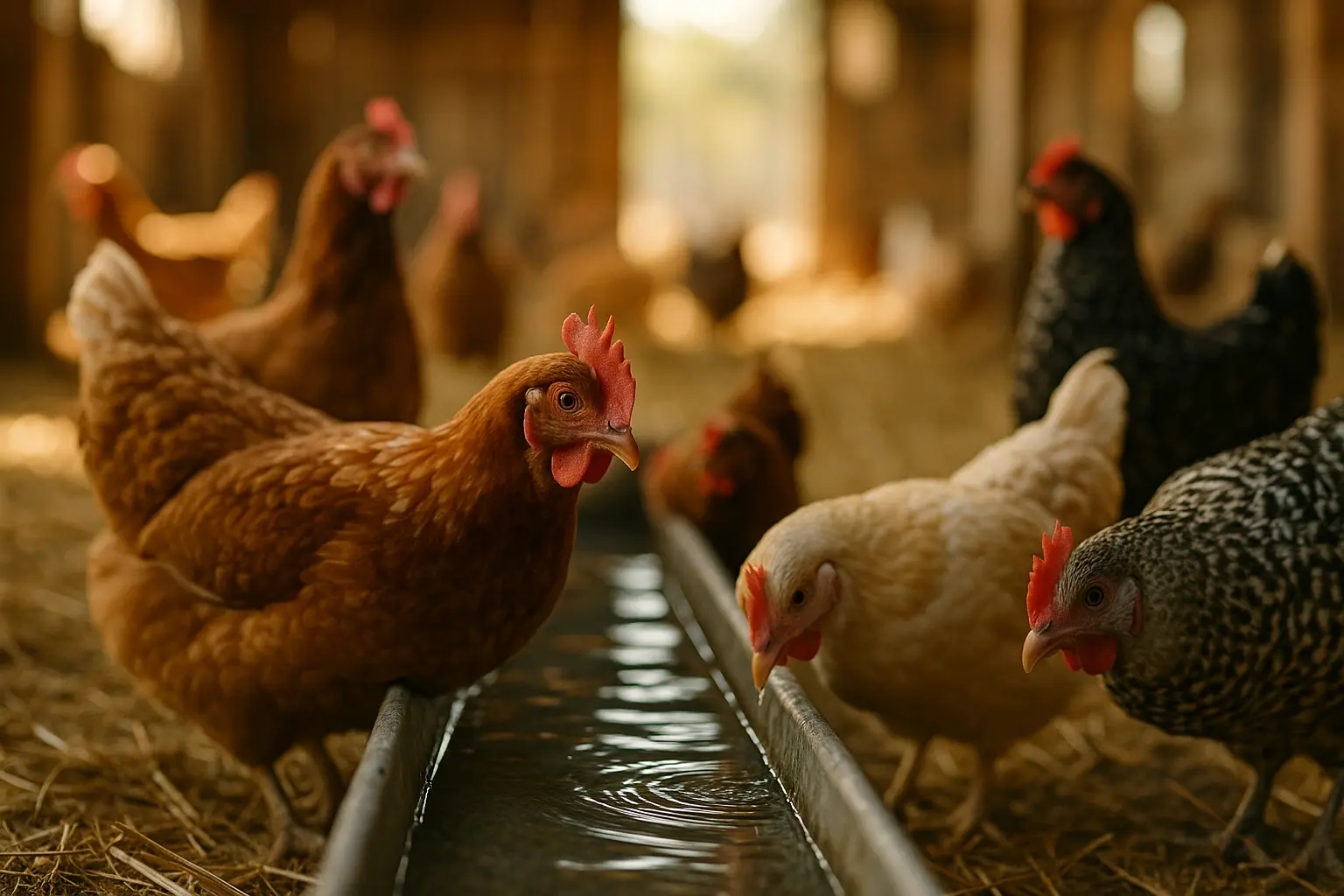
On most units the water meter is the cheapest diagnostic instrument in the building, and it gets read once a week. Feed is weighed, costed and argued over at length. Water arrives through a pipe and is treated as a utility. That asymmetry is where a surprising amount of avoidable performance goes.
Key takeaways
- At around 21 °C, broilers drink roughly 1.6 to 1.8 times their feed intake by weight, and consumption rises about 7 % for each degree above that.
- Some water quality limits exist to protect the bird. Others exist to protect the plumbing. Iron and manganese belong firmly to the second group.
- Nipple flow rate has to track bird age. The estimate the industry converged on is 7 ml per week of age, plus 20, in ml per minute.
- EU welfare law requires access to a suitable water supply but sets no numeric quality limits for livestock water. The specification is yours to write and yours to defend at audit.
What the daily reading actually tells you
A daily water figure is a flock health instrument, and it is more sensitive than anything else you can read without entering the house. Disease, ventilation faults, feed problems and equipment failures almost all show up in the water curve first, because a bird that feels unwell stops drinking before it stops eating.
The reference ratio is worth committing to memory. Mississippi State University Extension puts lifetime consumption for a 5-pound broiler at about 18 pounds of water against roughly 10 pounds of feed, and industry management guidance places the working water to feed ratio between 1.6 and 1.8 to 1 at about 21 °C, varying with drinker type and house conditions. The same extension work gives the temperature coefficient: consumption rises by roughly 7 % per degree of increase.
Those two numbers turn a raw meter reading into a judgement. If the ratio is holding and the house is warm, a rising water figure is thermoregulation doing its job. If the ratio is drifting up while feed intake stalls, something is wrong with the feed or the birds. If the figure falls at all, on a day when nothing else changed, that is the alarm. The practical threshold used on most units is a drop of 10 to 20 % against the previous day, investigated the same morning, even when the birds look normal on walk-through.
Which quality limits protect the bird, and which protect the pipework
Both categories matter, but confusing them leads to money spent in the wrong place. The University of Georgia Extension drinking water reference (bulletin B1301) sets out the commonly used working maxima for poultry.
| Parameter | Working maximum | What it protects |
|---|---|---|
| Total heterotrophic bacteria | 100 CFU / 100 ml | The bird |
| Coliform bacteria | 50 CFU / 100 ml | The bird |
| pH | 5.0 to 6.8 | Both, and sanitiser efficacy |
| Nitrate | 25 ppm | The bird |
| Sulfate | 250 ppm | The bird, and litter condition |
| Iron | 0.3 ppm | The pipework |
| Manganese | 0.05 ppm | The pipework |
| Hardness | 110 ppm | The pipework and dosing lines |
The iron line deserves an explanation, because it is the one that gets misread most often. The same source notes that research found iron as high as 660 ppm and manganese up to 20 ppm did no harm to bird health, while causing real damage to water lines and fogging systems. A borehole at 2 ppm of iron is therefore not a bird problem. It is a leaking nipple problem, a clogged nozzle problem and, indirectly, a biofilm problem, because iron bacteria feed the film that shelters everything else.
Sulfate is the mirror image. It is unremarkable for the pipework and a direct operational cost for the flock, because sulfate combining with magnesium or sodium produces a laxative effect that lands on the litter, and wet litter is expensive in a way that shows up in the culls rather than in the water budget.
Flow rate: the specification the lab report cannot see
Water quality analysis says nothing about whether a bird can physically get the water. That is a mechanical question, and it is set by nipple flow rate, bird allowance per nipple and drinker height.
The working estimate, from Lott and colleagues and reproduced in extension guidance since, is that an adequate flow rate in millilitres per minute is 7 multiplied by bird age in weeks, plus 20. A four-week bird therefore needs about 48 ml per minute and an eight-week bird about 76. Allowance sits at one nipple for every 10 to 12 birds.
Erring high is safer than erring low, but it is not free. Quilumba, Quijia, Gernat, Murillo and Grimes tested seven flow regimes on broilers to 42 days (Journal of Applied Poultry Research, 2015) at 50, 75, 100 and 120 ml per minute plus three stepped patterns. Higher flow produced only a trend toward heavier body weight at day 35, with no significant difference in feed consumption, feed conversion or mortality, while the 100 and 120 ml per minute treatments raised litter moisture under the drinker line early in the cycle. Read together with the Lott estimate, the message for a house team is straightforward: set flow to age, check it with a measuring cylinder and a stopwatch rather than by eye, and stop treating a permanently high setting as a safety margin.
Biofilm, and why the sampling point decides the result
A clean source and a dirty drinker are entirely compatible, and that combination is the most common water failure we see. Biofilm establishes inside the line, shelters bacteria from disinfectant, and makes a borehole sample taken at the tap look reassuring while the birds drink something else.
Two practices follow. First, sample where the bird drinks, at the far end of the line, and not only at the source. Second, treat the between-flock window as the only realistic opportunity for a full high pressure flush of the lines, which is exactly what the University of Georgia guidance recommends, alongside regular filter changes.
Where chlorine-based sanitation is used in production, pH is the variable that decides whether it works. Chlorine shifts toward hypochlorous acid, the active form, in slightly acidic conditions, and the range cited in the recent poultry water literature for maximising biocidal efficiency and biofilm control is a pH of 6.0 to 7.0. Dosing chlorine into alkaline water and measuring only the dose rate is a well-worn way to spend money on nothing. Where chlorination is not permitted or not suitable, chlorine dioxide, hydrogen peroxide, ozone, UV and certain organic acids are the alternatives generally described in the literature, each with its own compatibility constraints with the products you administer through the same line.
What the law asks, and what it leaves to you
EU welfare law is clear on access and silent on numbers. The Annex to Council Directive 98/58/EC requires at point 16 that all animals have access to a suitable water supply or can satisfy their fluid intake needs by other means, and at point 17 that feeding and watering equipment be designed, constructed and placed so that contamination of food and water, and the harmful effects of competition between animals, are minimised. For meat chickens, Annex I to Council Directive 2007/43/EC adds that drinkers shall be positioned and maintained in such a way that spillage is minimised.
What none of those texts contains is a numeric limit for bacteria, nitrate or hardness in livestock drinking water. The drinking water quality directive applies to water intended for human consumption, not to what goes down a poultry line. So the figures in the table above are industry and extension references rather than statutory thresholds, and an inspector will judge you on access, suitability, equipment condition and your own records. Writing your specification down, testing against it and keeping the results is what converts good practice into a defensible position.
The same logic runs through managing heat stress in poultry, where water becomes the primary cooling mechanism available to the bird and the daily figures move fast enough to be genuinely informative.
Questions we get asked on site
How often should water be tested, and for what?
Twice a year is the usual working rhythm for a mains supply and quarterly for a borehole, with additional sampling after heavy rain or drought, both of which change borehole chemistry. Test at the source and at the end of a drinker line, and cover bacteria, coliforms, pH, nitrate, sulfate, iron, manganese and hardness as a minimum panel.
Does water temperature really change intake?
Yes. Birds avoid water at or above their own body temperature, so a line lying in a hot house all afternoon suppresses intake precisely when the bird needs it most. Flushing lines during the hottest part of the day is a low-cost intervention with a measurable effect on consumption.
Can medication and vaccination through the water line be affected by water quality?
It can. Mineral load, pH and residual sanitiser all interact with what you administer, and live vaccines in particular are inactivated by disinfectant residue in the line. Any product administered in drinking water should be discussed with your veterinarian, including the question of whether the sanitiser has to be stopped and the line flushed beforehand.
Is a water meter per house worth the cost?
A single meter for a multi-house site averages away the very signal you are looking for, since one house going quiet is invisible against the total. Per house metering, read at a fixed time each day, is what makes the ratio usable.
The other input nobody meters
Water is the input with the fastest feedback loop. The one with the slowest, and the highest cost when it drifts, is the air the birds breathe all cycle long.
Air quality in poultry farming and its effect on performance
Sources: University of Georgia Extension, Poultry Drinking Water Primer (bulletin B1301); Mississippi State University Extension, Water-Related Factors in Broiler Production; Quilumba, Quijia, Gernat, Murillo and Grimes, Journal of Applied Poultry Research 24(1), 2015; Council Directive 98/58/EC, Annex; Council Directive 2007/43/EC, Annex I; recent peer-reviewed work on drinking water sanitation and biofilm control in poultry farms. Consulted August 2026.
Published previously, fully revised on 15 August 2026. General operational guidance for professional operations. Water treatment products, sanitisers and anything administered through the drinking line are subject to national authorisation rules, and any health event in the flock is a matter for a qualified poultry veterinarian.