
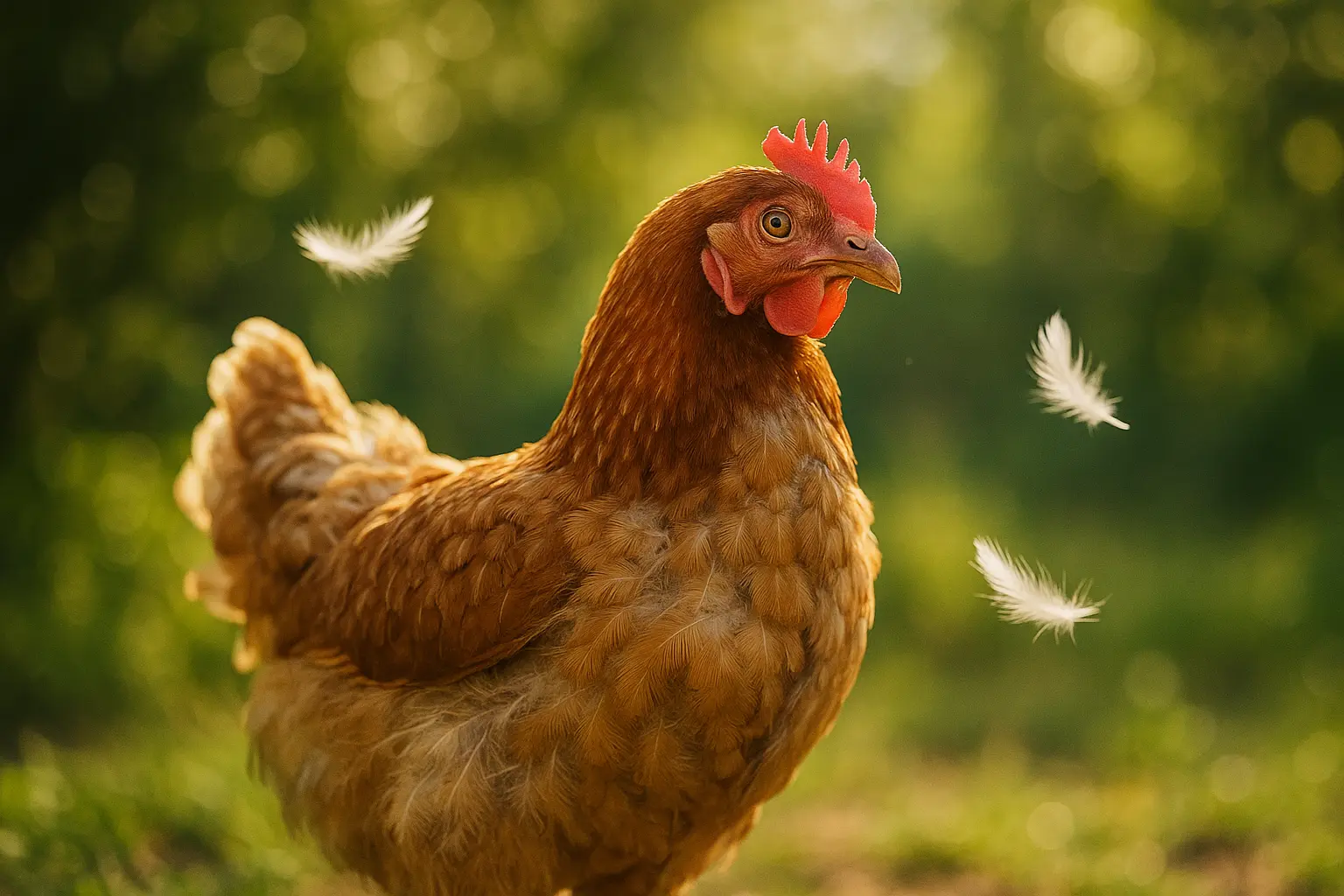
A floor covered in feathers tells you a moult has started. It tells you nothing useful about how far along it is, how long the house will stay out of lay, or whether the bird in your hand is a fast moulter or a slow one. The wing answers all three questions, and reading it takes about fifteen seconds per bird.
Key takeaways
- Feathers are 85 to 90 % keratin, which makes the sulphur amino acids methionine and cysteine the limiting nutrients, not crude protein on its own.
- The moult runs head and neck first, then saddle, breast and abdomen, then wings, then tail. It is finished when the ten primary flight feathers have been replaced.
- A fast moulter is not a bird whose feathers grow faster. It is a bird that drops more of them at the same time.
- Council Directive 98/58/EC requires feed at intervals appropriate to physiological needs and at least once a day, which rules out the feed withdrawal moult used historically.
What sets the moult off
The dominant trigger is photoperiod. As daylight shortens through late summer and autumn, reproductive output winds down and the bird redirects resources into replacing worn plumage. That is why a naturally lit flock moults on a fairly predictable calendar, and why a house held on a constant artificial day length moults less synchronously: the seasonal cue that pulls the whole flock into the same phase is weaker.
Age matters as well. A pullet does not moult during her first laying cycle; the first full adult moult follows it, on a date that depends on hatch date, rearing programme and lighting history. There is also a category of moult nobody plans: a water interruption, a heat episode or a disease event can push a flock into partial, out of season feather loss. A seasonal moult is a phase to manage, an unseasonal one is a symptom to investigate.
Reading the wing instead of the floor
The plumage is shed in a known order, which is what makes visual assessment worth doing. The first feathers lost come from the head and neck, then from the saddle, breast and abdomen, then from the wings, and last from the tail. Because the body feathers scatter and the wing feathers do not, the wing is the only part of the bird that keeps a readable record.
Each wing carries ten primaries, a small axial feather, and fourteen secondaries. The primaries are shed from the axial feather outwards towards the wing tip, in sequence, and the axial feather drops at the same time as the secondary beside it. The moult is complete when every primary has been replaced, which gives a far more reliable endpoint than an impression of how the flock looks.
| What the wing shows | Where the bird is | What to prioritise |
|---|---|---|
| All ten primaries old, head and neck bare | Opening phase | Confirm the ration and the water line before demand rises |
| One or two primaries dropped, one at a time | Slow moulter, long process ahead | Plan for an extended out of lay period |
| Several adjacent primaries dropped together | Fast moulter, shorter process | Expect a sharper dip and a quicker return |
| New primaries grown in, tail regrowing | Closing phase | Prepare the transition back to a layer ration |
The distinction between a fast and a slow moulter is often misread as a difference in feather growth rate. It is not. An individual feather grows at broadly the same speed in both birds; the fast moulter simply renews a greater number of feathers simultaneously, which compresses the whole event and shortens the interruption to lay.
The nutrition question is a sulphur amino acid question
Feather keratin is roughly 85 to 90 % protein, and its structure depends on cysteine, which the bird obtains largely by converting dietary methionine. Published work on plumage identifies methionine as the main nutritional factor affecting feather cover and feather length, which is why raising crude protein alone is a blunt response to a moult.
Two practical consequences follow. The specification that matters during a moult is the amino acid profile, not the headline protein figure on the bag. And the exact levels belong to your nutritionist and to the breeder guide for the strain in front of you, since requirements differ between a commercial layer, a breeder and a slow growing dual purpose bird. Any generic percentage circulated online is a starting point for a conversation, not a specification, which is why we treat balanced ration formulation for poultry as a year round subject rather than a seasonal correction.
Induced moulting is a regulatory subject in Europe, not a technical one
Historically, flocks were pushed into moult by withdrawing feed for days at a time in order to reset lay and extend the productive life of the house. That method is closed in the European Union. The Annex to Council Directive 98/58/EC requires that animals be fed a wholesome diet appropriate to their needs, at intervals appropriate to their physiological requirements and in any case at least once a day, except where a veterinarian directs otherwise.
The same shift happened in the United States through the industry route rather than the legislative one. The United Egg Producers amended their Animal Husbandry Guidelines to permit only non feed withdrawal moult methods after 1 January 2006, with moulting hens fed a nutritionally adequate and palatable diet suitable for non laying birds.
The alternative programmes developed since then change the composition of the ration rather than removing it: low protein, low energy diets built around wheat middlings and soybean hulls in combination with maize stop lay while keeping feed in front of the bird. Whether any of it applies to your operation depends on your national rules and your production model, and that is a decision to take with your veterinarian and your competent authority.
What we actually change on the floor during a moult
Three things carry most of the result, and none of them is a product.
- Disturbance. Emerging pin feathers carry a blood supply and are sensitive. Catching, moving and unnecessary handling during the peak of feather loss cost more than they usually gain, so routine interventions are better scheduled around the moult.
- Pecking risk. A broken pin feather bleeds, and the appearance of blood is a recognised trigger for further pecking in a group. Light intensity, density and prompt removal of an injured bird do more here than any additive.
- Parasites. A flock in moult is a flock being handled and inspected less, which is exactly when an external parasite population builds quietly. A moult is a good moment to schedule a proper check rather than to skip one.
Feed intake, water consumption and body weight are the instruments worth trusting here. Lay tells you nothing while the flock is out of production, so the metrics you normally read second become the ones you read first.
What we get asked when the feathers start dropping
How long should a flock stay out of lay during a moult?
Most hens complete feather replacement within 8 to 12 weeks, and older or slower birds can take up to about 16. Return to lay follows feather regrowth rather than the calendar, which is why counting replaced primaries gives a better forecast than counting days.
Is a heavy moult a sign that something is wrong?
Not by itself. A rapid, heavy moult in autumn is normal and is generally associated with a shorter interruption to lay. What warrants investigation is feather loss out of season, feather loss confined to one body area, or feather loss accompanied by a drop in feed and water intake.
Can a moult be distinguished from feather loss caused by parasites or pecking?
Usually, yes, and the pattern is what separates them. A true moult follows the head to tail sequence and produces regrowing pin feathers. Damage from pecking or from external parasites tends to be localised, asymmetric between birds, and unaccompanied by new feather growth. Any doubt about the cause is a question for the veterinarian responsible for the flock.
Does moulting reduce egg quality after the flock returns to lay?
Practice varies with strain, age and the moult programme used, and published results differ enough that we would not give a single figure here. The honest answer is that post moult performance is measured on your own flock records rather than predicted from a general rule.
The same drop in output, a different cause
A moult is a planned interruption to lay. An unplanned one usually has a stressor behind it, and the feed bin normally records it before the egg count does.
Sources: Council Directive 98/58/EC concerning the protection of animals kept for farming purposes, Annex; United Egg Producers Animal Husbandry Guidelines for U.S. Egg Laying Flocks, non feed withdrawal moult requirement applicable from 1 January 2006; published reviews of feed withdrawal and non feed withdrawal moult, World’s Poultry Science Journal; technical literature on feather keratin composition and on methionine as the limiting nutrient for feather cover. Consulted August 2026.
Published previously, fully revised on 17 August 2026. General operational guidance for poultry professionals. It does not replace the assessment of the veterinarian responsible for your flock, nor the specifications of your breeder guide and nutritionist.