
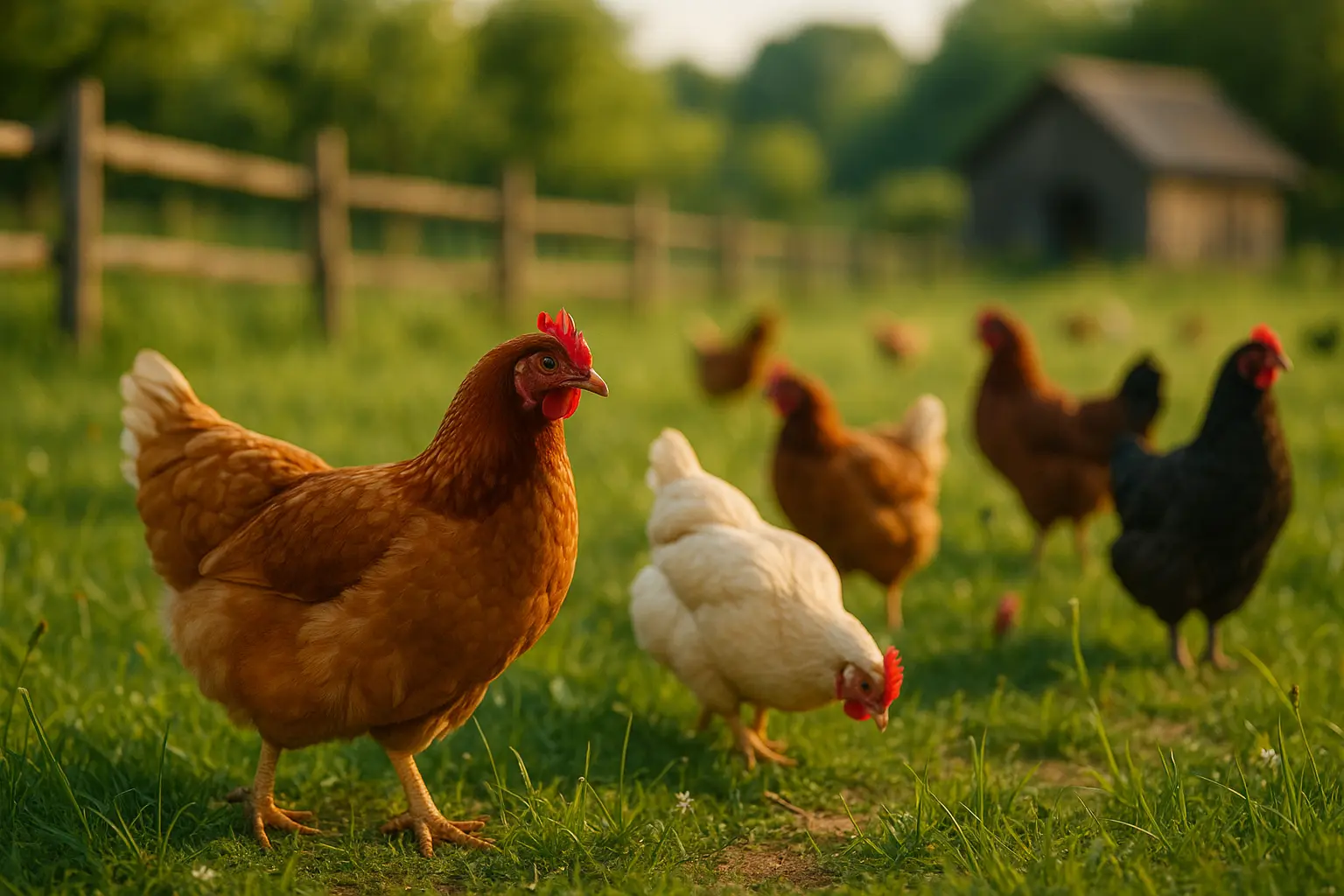
Conversations about organic poultry tend to open on values and close on arithmetic. That order is backwards. The organic rulebook is a set of numbers before it is a philosophy, and almost every challenge and every opportunity in the sector traces back to one of them: a slaughter age, a flock ceiling, a metre of pop-hole, a percentage of feed.
Key takeaways
- Chickens that are not of slow-growing strains cannot be slaughtered before 81 days, which roughly doubles the growing period against a conventional broiler cycle.
- Flock ceilings are set per compartment: 4,800 fattening chickens, 10,000 pullets, 3,000 parent birds, 2,500 turkeys or geese.
- Pop-holes must total at least 4 m per 100 m² of house area, and the range is defined by a 150 m radius from the nearest exit, extendable to 350 m with shelters.
- The feed rules are the moving part. Confirm the current position on non-organic protein feed with your control body before you build it into a budget.
The constraints, and what each one actually costs
Every organic requirement converts into either time, space or feed, and those are the three largest cost lines in poultry production. Setting them out plainly is more useful than a general argument about sustainability.
Time. Under the EU organic framework, poultry for meat production that are not of slow-growing strains cannot be slaughtered before 81 days of age. Against a conventional broiler slaughtered in the high thirties of days, that is a growing period roughly doubled, with feed, labour, heating and mortality risk all accruing over the longer window. The alternative route, using recognised slow-growing strains, removes the fixed minimum age but brings a lower daily gain with it. Either way, the cost of the extra time is real and it is the single largest structural difference from conventional production.
Space. Article 15 of Implementing Regulation (EU) 2020/464 sets maximum flock sizes per compartment: 4,800 fattening Gallus gallus, 10,000 pullets, 3,000 parent birds, 2,500 capons, 4,000 poulardes, 2,500 turkeys, 2,500 geese and 5,200 guinea fowl. Mobile houses are capped at a ground floor of 150 m² and must be moved at least between each batch. Indoor stocking density under the organic rules sits at 21 kg of liveweight per m² for meat poultry and 6 birds per m² for laying hens, against a conventional broiler baseline of 33 kg per m². Fewer birds under the same roof is the whole point, and it is also the whole cost.
Access. The same article requires openings between the house and the open air with a combined length of at least 4 m per 100 m² of house area. Where a veranda is used, at least 2 m per 100 m² connects house to veranda and at least 4 m per 100 m² connects veranda to the outdoors. Article 16 defines the range in terms the birds will actually use: within a radius of 150 m from the nearest exit, extendable to 350 m where shelters are provided at a minimum of four per hectare.
Feed: the part of the rulebook that is still moving
Organic feed is the defining input constraint, and it is also the provision we advise operators to verify rather than assume. The principle is that livestock be fed organic feed. Alongside it, EU rules have carried a time-limited authorisation allowing a small share, up to 5 %, of non-organic protein feed for young poultry, on the stated grounds that organic protein feed has not been available in sufficient quantity and quality on the Union market.
That authorisation has been repeatedly extended and progressively narrowed, both in the categories of animals it covers and in its end date, and national implementations have diverged. The UK, for example, moved separately in 2025 to restrict its own version to poultry of no more than 30 weeks of age from 1 January 2026. The honest position for a business plan is that this figure is a variable, not a constant. Before budgeting a ration on the assumption that a share of non-organic protein remains available, confirm the current position with your control body and, if you export, with the control body in the destination market.
What is stable is the direction of travel. Organic protein supply, not organic cereal supply, is the binding constraint on the sector, and the operations that have handled it best have either secured multi-year contracts with organic protein growers or restructured the ration around locally available crops rather than imported soya equivalents. The general principles of ration construction still apply here, and our guidance on optimising poultry feed for production covers the balancing logic that an organic ration has to satisfy with a shorter list of permitted ingredients.
Health management without the conventional toolbox
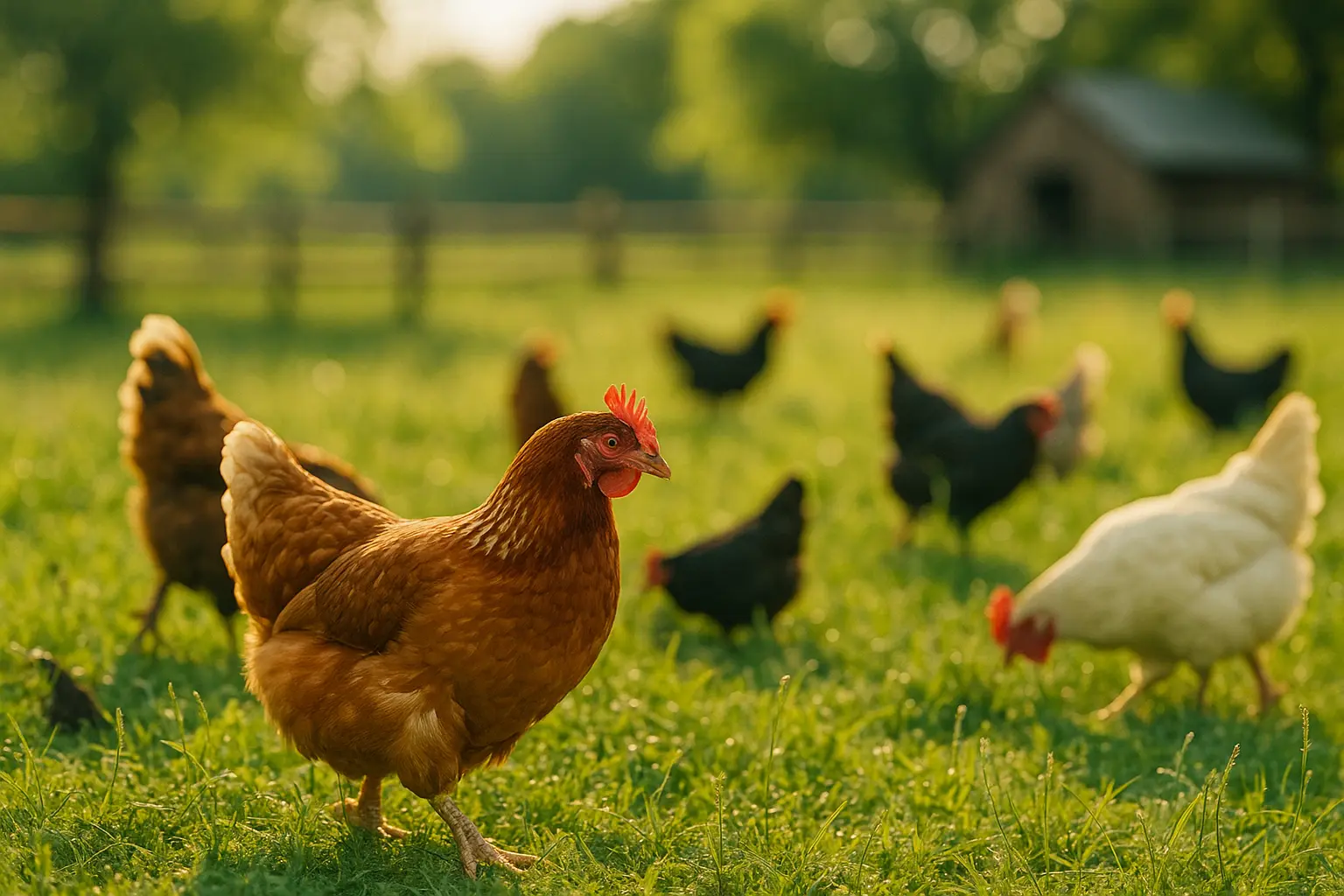
The clinical challenge of organic production is not that treatment is forbidden, because it is not. It is that the margin for late intervention is thinner, so prevention has to carry more of the load: longer rest periods between batches, range rotation, parasite monitoring rather than routine treatment, and genetics selected for robustness rather than for feed conversion alone.
This is the area where we would caution most strongly against simplification. Outdoor access raises exposure to wild birds and to soil-borne parasites at the same time as it delivers the welfare outcomes the label is sold on, and managing that trade-off is a veterinary question specific to your site, your region and your season. Any organic health plan should be built with a poultry veterinarian who knows the certification constraints, not adapted from a conventional protocol by removing lines from it.
How to read a claim about organic performance
The organic sector attracts strong performance claims, and the sourcing behind them is frequently thinner than the claim. A recurring pattern in this literature is a citation to a database rather than to a study. PubMed is an index, not a source, and the same is true of Google Scholar and of a bare DOI. None of them says anything; the paper behind them does.
When a supplier or a consultant offers a figure for organic feed conversion, mortality or an additive effect, four questions usually settle whether it transfers to your operation:
- What was the housing system and the stocking density in the trial, and does it match yours?
- What genetics were used, and were they slow-growing or conventional strains?
- What was the batch size, and over how many replicates and how many seasons?
- Who funded the work, and is the full paper available rather than a summary slide?
A figure that survives those four questions is worth building on. A figure attached only to the name of a database is worth nothing, however impressive the database.
Where the opportunities actually sit, including in Thailand
The commercial case for organic poultry is a premium case, and premium markets reward differentiation that can be verified. Three openings are consistently visible.
Value-added rather than raw carcass. The gap between an organic whole bird and an organic prepared product is wider than the equivalent gap in conventional lines, because the buyer segments overlap with those willing to pay for convenience. That is where the longer growing period is easiest to recover.
Verifiable welfare. The organic rulebook already imposes lower density, outdoor access and, in most cases, slower-growing genetics. Those are the same attributes that welfare-led retail commitments are built on, which means an organic operation can often serve two premium specifications from one production system. The wider debate on how far those attributes translate into measurable welfare outcomes is covered in our piece on broiler welfare beyond the standards.
Export positioning from established poultry economies. Thailand is the clearest example of why this matters. It is one of the world’s major chicken meat exporters, with export volume projected at around 0.81 million tonnes in 2025 and an export value near USD 3.05 billion according to Krungsri Research industry analysis, and cooked chicken to the EU, Japan and the UK is the growth engine. An organic or certified-differentiated line built on that logistics base does not have to solve the export problem from scratch, only the certification problem. The constraint is that organic status is not portable by assertion: selling as organic into the EU requires production and control arrangements recognised under the EU framework, verified by a recognised control body, and that recognition is the real project, not the husbandry.
Questions we are asked before a conversion decision
How long does conversion take?
Conversion periods differ for land, for poultry brought onto the unit and for the products themselves, and they run in parallel rather than in sequence. The binding period on most units is the land, since range and any home-grown feed have to complete their own conversion. Your control body will set out the applicable periods for your situation before you commit.
Are slow-growing strains compulsory?
No. The rules present two routes: reach the minimum slaughter age of 81 days, or use strains recognised as slow-growing. The choice is economic rather than regulatory, and it interacts with your customer specification, since some welfare-led buyers require slow-growing genetics regardless of the organic route taken.
Can an organic flock be treated with conventional medicines?
Treatment of a sick bird is never prohibited, and withholding necessary treatment would itself be a welfare breach. What the rules constrain is routine and preventive use, the number of treatment courses, and extended withdrawal periods. The specifics attach to the product and to your certification, so this is a conversation with your veterinarian and your control body together.
Is the price premium reliable enough to plan on?
Premiums move with retail demand and with input costs, and organic feed prices are more volatile than conventional ones because the supply base is narrower. Operations that plan on a fixed premium are exposed twice, on price and on input cost, in the same market conditions. Contracted volume is worth more than a headline premium.
The ration is where the plan succeeds or fails
Every organic constraint eventually lands on the feed budget. Getting the nutritional logic right, with a shorter list of permitted ingredients, is the highest-leverage work in a conversion.
Sources: Regulation (EU) 2018/848 on organic production and labelling; Commission Implementing Regulation (EU) 2020/464, Articles 15 and 16; UK Department for Environment, Food and Rural Affairs changes to organic pig and poultry feed rules, 2025; Krungsri Research, Industry Outlook, chilled, frozen and processed chicken, Thailand; USDA Foreign Agricultural Service, Thailand Poultry and Products Annual. Consulted August 2026. Feed derogation provisions are subject to change and national divergence.
Published previously, fully revised on 15 August 2026. General regulatory and operational guidance for professional operations. Organic certification requirements are set and verified by your control body, and any health plan or treatment decision is a matter for a qualified poultry veterinarian.