
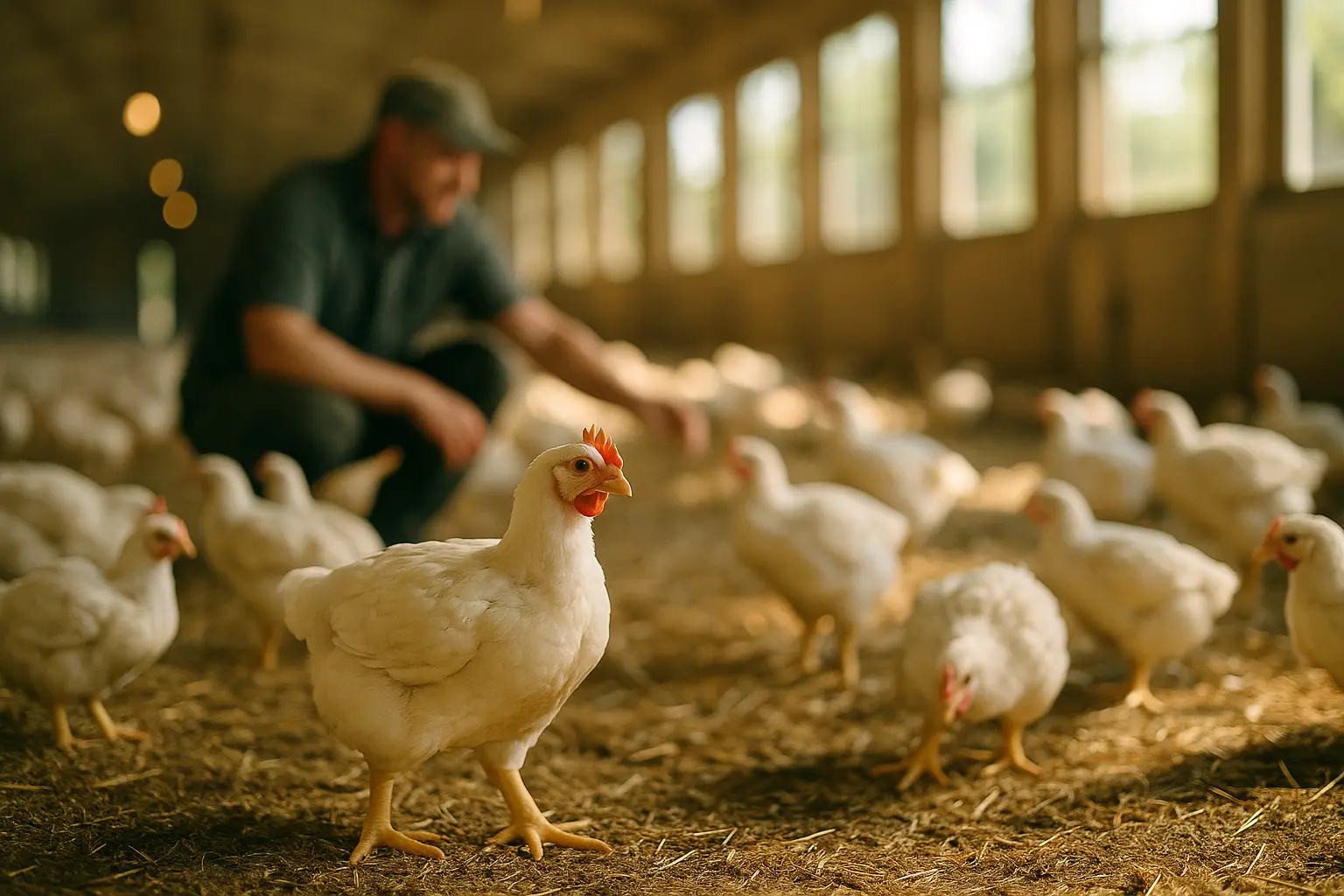
“Beyond standards” is a phrase that only carries weight if you can say precisely where the standard stops. Most site notes we read quote one figure, 33 kg per square metre, and go quiet after that. The directive behind that figure runs to five annexes, and almost everything interesting about broiler welfare sits in the parts nobody quotes.
Key takeaways
- The legal floor in the EU is 33 kg/m2; 39 kg/m2 requires documented environmental control, and 42 kg/m2 requires a mortality record over seven consecutive checked flocks.
- The European Chicken Commitment sets 30 kg/m2, approved slower-growing breeds, perch space and pecking substrate, and third-party audit, with 2026 as the reference deadline for early signatories.
- Breed choice moves mortality and gait score; it does not, on its own, move footpad lesions, which track litter moisture.
- Any welfare claim you are asked to believe should come with the density, breed, house type and scoring method behind it.
The legal floor is more precise than most site notes admit
Council Directive 2007/43/EC sets a default maximum stocking density of 33 kg per square metre. Two derogations sit above it. A holding may work at up to 39 kg/m2 if it keeps documentation in the house describing the production system and meets the environmental conditions of Annex II. It may go above 39 kg/m2, to a maximum of 42, only where inspections over the previous two years found no deficiency and where, in at least seven consecutive checked flocks, the cumulative daily mortality rate stayed below 1 % plus 0.06 % multiplied by the slaughter age of the flock in days.
That formula is the part worth internalising. It makes the right to the highest density conditional on a rolling performance record, not on a one-off inspection. A single bad flock does not remove the entitlement outright, but the seven-flock window is unforgiving of a site that runs at the edge.
Annex I sets the husbandry floor that applies to every holding regardless of density: permanent access to litter that is dry and friable on the surface, lighting of at least 20 lux at bird eye level illuminating at least 80 % of the usable area, and a lighting rhythm that includes at least six hours of darkness in total with one uninterrupted period of at least four hours, applied from seven days after placement until three days before slaughter. Birds are inspected at least twice a day, records are kept for three years, and feed is not withdrawn more than twelve hours before expected slaughter.
| Parameter | EU legal floor (2007/43/EC) | European Chicken Commitment |
|---|---|---|
| Stocking density | 33 kg/m2, up to 39 or 42 under conditions | 30 kg/m2 or less, thinning once per flock |
| Breed | No restriction | Named slower-growing breeds, or a breed passing the RSPCA welfare assessment protocol |
| Light | At least 20 lux, 6 h dark including 4 h uninterrupted | At least 50 lux, including natural light |
| Enrichment | Not quantified | 2 m of usable perch space and 2 pecking substrates per 1,000 birds |
| Verification | Competent authority inspection | Third-party audit and annual public reporting |
The specification that actually moved the goalposts
The European Chicken Commitment is a private buyer standard, not legislation, and that is exactly why it changed procurement conversations faster than any revision of the directive. Beyond the criteria in the table, it requires controlled atmosphere stunning using inert gas or multi-phase systems, or effective electrical stunning without live inversion. Companies that signed before 31 December 2023 committed to 2026; later signatories can negotiate extended timelines with published milestones.
The cost side has been quantified from the industry’s own side of the table. A March 2024 report produced by ADAS for AVEC, the association representing the EU poultry meat sector, put the increase at 21.9 % per bird and 37.5 % per kilogram of meat, with feed and water use rising by roughly 34.5 % and 34.6 % per kilogram. Those figures come from a commissioned industry study, so read them as one party’s estimate rather than a neutral audit. They are still the most useful order of magnitude available when a customer asks what the switch would cost.
Outcome measures say what the resource rules cannot
The clearest commercial-scale comparison we have found is Baxter, Richmond, Lavery and O’Connell, published in PLoS ONE in 2021, which followed fast-growing Ross 308 and slower-growing Hubbard Redbro flocks on higher-welfare commercial farms all held at 30 kg/m2. Growth ran at 65 g per day for Ross 308 against 53 g per day for Redbro. Total mortality was 3.76 % against 2.18 %, and culls 1.39 % against 0.74 %. Mean gait score at week six was 1.16 against 0.57.
The interesting result is the one that did not move. Hock burn came out at 7.17 % and 7.39 %, pododermatitis at 38.09 % and 29.19 %, and neither difference reached significance. Changing the bird changed how it walks and how many survive. It did not clean up contact dermatitis, because contact dermatitis is a litter problem wearing a welfare label.
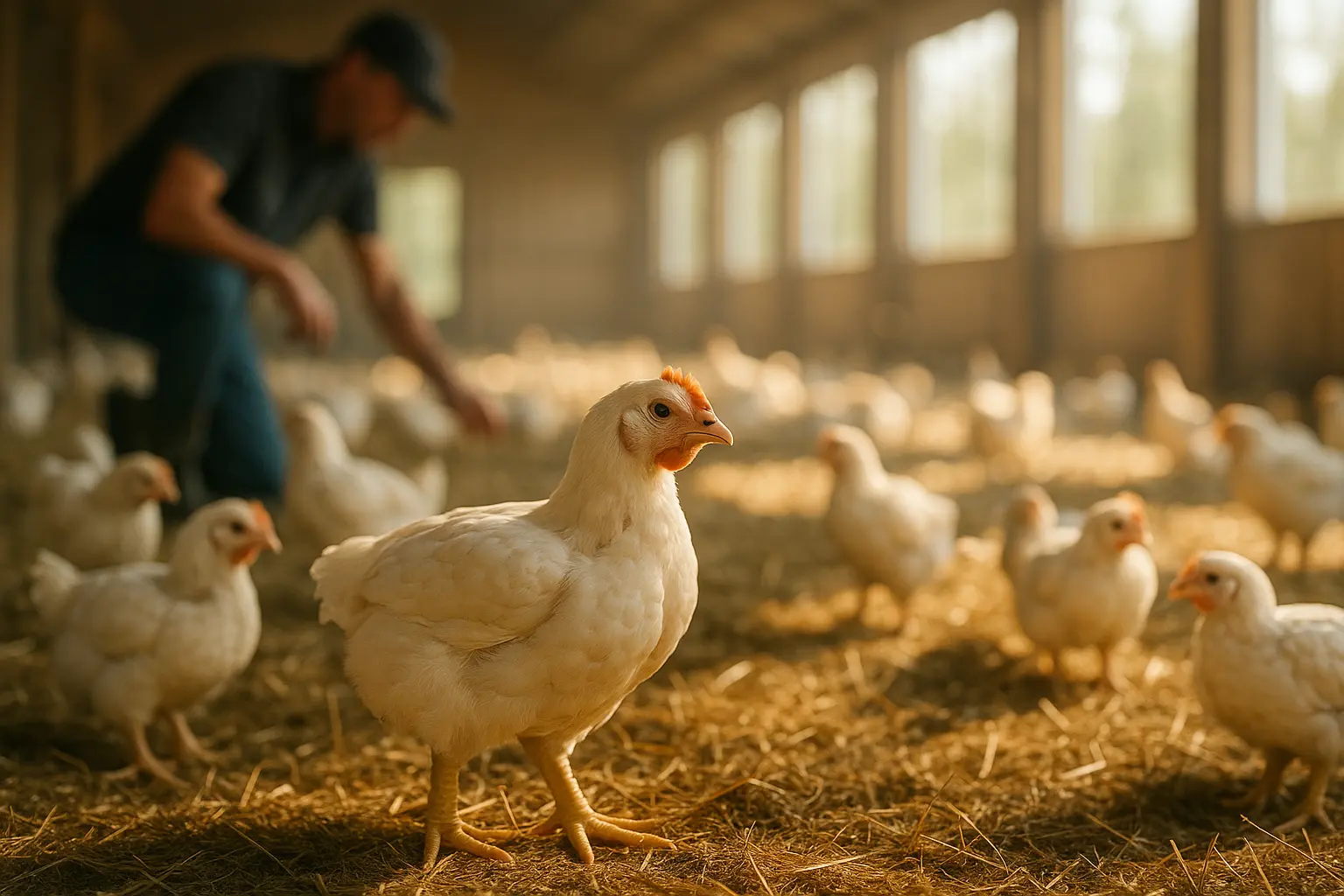
Taira, Nagai, Obi and Takase, writing in the Journal of Veterinary Medical Science in 2014, tracked that directly. In a house where litter moisture climbed from 30.9 % to 56.5 %, footpad dermatitis appeared at 14 days of age and reached a mean score of 2.92 by day 42. In a comparable house held between 15.4 % and 40.0 %, lesions appeared at 28 days and reached only 0.70. Birds moved from wet litter to dry saw their lesions stop progressing.
Enrichment that gets used, not enrichment that gets installed
Two metres of perch per 1,000 birds is a purchasing instruction, not a welfare outcome. The same 2021 study counted an average of 16.43 Redbro birds perching during observations against 3.70 Ross 308 birds, on farms fitted identically. Same equipment, very different uptake. An auditor can verify that perches exist; only the site can verify that birds are on them.
That distinction is what we would put at the centre of any innovation programme, and it applies just as much to outdoor run enhancements as to fittings inside the house. Record uptake, not installation: how many birds are on the perches at a fixed time of day, whether the dust-bathing substrate is still friable at day 28, whether the pecking objects have visibly been worked. It costs nothing beyond a repeatable observation slot, and it is the only evidence that survives a sceptical customer audit. The World Organisation for Animal Health maintains the international welfare framework that most national rules build on, but no international text can tell you whether the enrichment in your house is doing anything.
Reading the evidence behind a welfare claim
Suppliers and certification bodies increasingly arrive with studies attached. A practical filter helps. Google Scholar is a search index, not a source, and a DOI is a permanent address for a document, not a quality mark. Neither tells you anything about the strength of the result behind the citation.
Five questions usually settle it: which breed and target weight, at what stocking density, in what house type and season, how the outcome was scored and by whom, and who paid for the work. A welfare claim that survives those five is worth putting in front of a customer. One that cannot answer the density question is not a welfare claim at all.
Questions producers ask before committing
Does reducing density automatically improve welfare?
Not on its own. Lower density reduces competition for feed, water and lying space and lowers the heat and moisture load per square metre, which helps litter stay friable. But a low-density house with a leaking drinker line will still produce footpad lesions. Density sets the ceiling on what good management can achieve; it does not replace the management.
Is a slower-growing breed the only route to a higher welfare specification?
It is the route most buyer specifications name, because breed is verifiable at placement and does not depend on daily discipline. The published outcome differences are real for mortality and gait. For contact dermatitis, litter management does the work regardless of breed.
What should be measured on the birds themselves?
Gait scoring on a defined sample, footpad and hock scoring at depletion, cumulative daily mortality against the Annex V formula, and litter moisture. Those four cover most of what an auditor will ask about and most of what predicts a bad flock.
How is the cumulative daily mortality threshold calculated in practice?
It is 1 % plus 0.06 % multiplied by the slaughter age in days. For a flock slaughtered at 42 days, that gives a threshold of 3.52 %. The entitlement to the top density band depends on staying below it across seven consecutive checked flocks.
Who should be consulted when lesion scores rise suddenly?
A poultry veterinarian, without waiting for the end of the flock. A sharp rise in footpad scoring is usually an environmental signal, but enteric disease produces the same picture through wet droppings, and the two need different corrections.
From measurement to daily practice
Outcome scoring only changes anything if it feeds back into the routine that the team actually runs each morning.
Animal welfare in poultry farming: best practices that are easy to implement
Sources: Council Directive 2007/43/EC laying down minimum rules for the protection of chickens kept for meat production, Annex I (litter, lighting, inspection, records), Annex II (documentation and environmental parameters for densities up to 39 kg/m2) and Annex V (criteria for densities above 39 kg/m2, including the cumulative daily mortality formula); European Chicken Commitment published policy criteria (density, approved breeds, perch and pecking substrate, 50 lux, stunning methods, audit and 2026 deadline); ADAS report for AVEC, March 2024, for the cost estimates; Baxter M., Richmond A., Lavery U., O’Connell N. E., “A comparison of fast growing broiler chickens with a slower-growing breed type reared on Higher Welfare commercial farms”, PLoS ONE, 16(11), 2021, for growth rate, mortality, culls, gait score, contact dermatitis and perching figures; Taira K., Nagai T., Obi T., Takase K., “Effect of litter moisture on the development of footpad dermatitis in broiler chickens”, Journal of Veterinary Medical Science, 2014. Consulted August 2026.
Published previously, fully revised on 14 August 2026. General technical guidance for poultry professionals. It does not replace veterinary diagnosis or prescription, and welfare requirements must be verified against the rules in force in the country of production.