
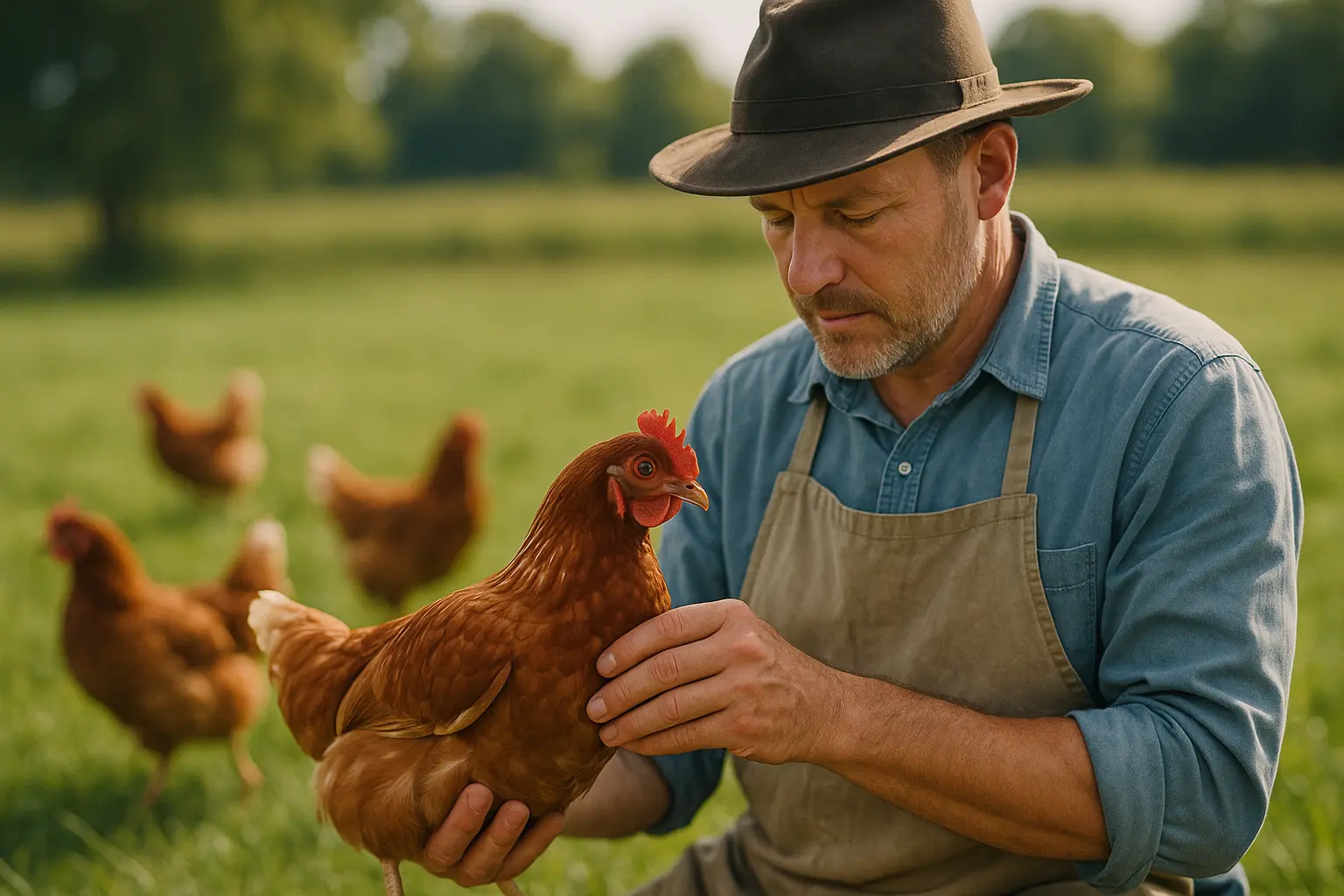
On a commercial holding, first aid for poultry is far less a question of what you do to the bird than of what happens in the next twenty minutes. Isolate or leave in place. Call or do not call. Record or forget. Those decisions are what separate an incident from an outbreak, and none of them requires a syringe.
Key takeaways
- Article 18 of Regulation (EU) 2016/429 obliges operators to notify the competent authority immediately where a category A disease is suspected, and to notify a veterinarian of abnormal mortality or unexplained production drops.
- Sudden death with no prior signs, swelling and purple discolouration of the head, comb and legs, and a collapse in feed and water intake are the signs that stop the routine and start a phone call.
- Blood in a group is self reinforcing. The appearance of blood induces further pecking, which is why isolation comes before wound care.
- Where a medicine is used under the cascade, the minimum withdrawal period is 7 days for eggs and 28 days for poultry meat under Regulation (EU) 2019/6.
The first decision on a sick bird is a regulatory one
Before anything clinical happens, the question is whether what you are looking at is a reportable event. Article 18 of Regulation (EU) 2016/429, the Animal Health Law, places the obligation directly on operators and other relevant persons: immediate notification to the competent authority where a category A listed disease is suspected or detected, prompt notification for other listed categories, and notification to a veterinarian of abnormal mortalities, other signs of serious disease, or a significant drop in production with an undetermined cause.
High pathogenicity avian influenza is the case that makes this concrete. The presentation that should trigger the call includes sudden death without prior signs, marked depression with ruffled feathers, a sharp fall in feed and water intake, a collapse in egg production or soft shelled eggs, swelling and cyanosis of the comb, wattles, head or legs, respiratory distress, and neurological signs such as incoordination or tremors. Birds can also die with no signs at all, which is why unexplained mortality is itself a notifiable observation rather than a puzzle to solve alone.
We put this section first deliberately. A holding that treats a suspicion as a management problem for a day loses the only advantage it had, which was time.
A triage sequence that fits on a laminated card
For everything that is not a suspected listed disease, a short and fixed sequence beats improvisation under pressure.
- Stop and look at the group, not only the bird. One affected bird is a case. Three in the same pen on the same day is a pattern, and a pattern changes who you call.
- Isolate. Move the affected bird to a clean, quiet, dry pen with its own feed and water, and with equipment that does not travel back into the house.
- Stabilise the environment. Warmth, dim light, and undisturbed access to water do more in the first hour than any intervention you could improvise.
- Describe, do not diagnose. Record what you observed, when, in which house, and how many birds. A precise description is what allows a veterinarian to act quickly at a distance.
- Escalate. Any treatment decision, including whether to treat at all, belongs to the veterinarian responsible for the flock.
| What you see | Immediate action | Who decides what happens next |
|---|---|---|
| Sudden deaths, head and leg discolouration, intake collapse | Stop movements on and off the site, secure the house | Competent authority, immediately |
| Rising mortality or an unexplained production drop | Document the curve, sample nothing on your own initiative | Flock veterinarian, same day |
| Open wound, visible blood on a bird in the group | Remove the bird from the group first, then examine | Stockperson, then veterinarian if tissue is torn |
| Tissue protruding from the vent | Isolate without delay, keep the bird in the dark and calm | Veterinarian, urgent |
| Straining hen, off feed, standing apart | Isolate, warmth, water within reach, no manipulation | Veterinarian, urgent |
Blood is a group problem before it is a wound
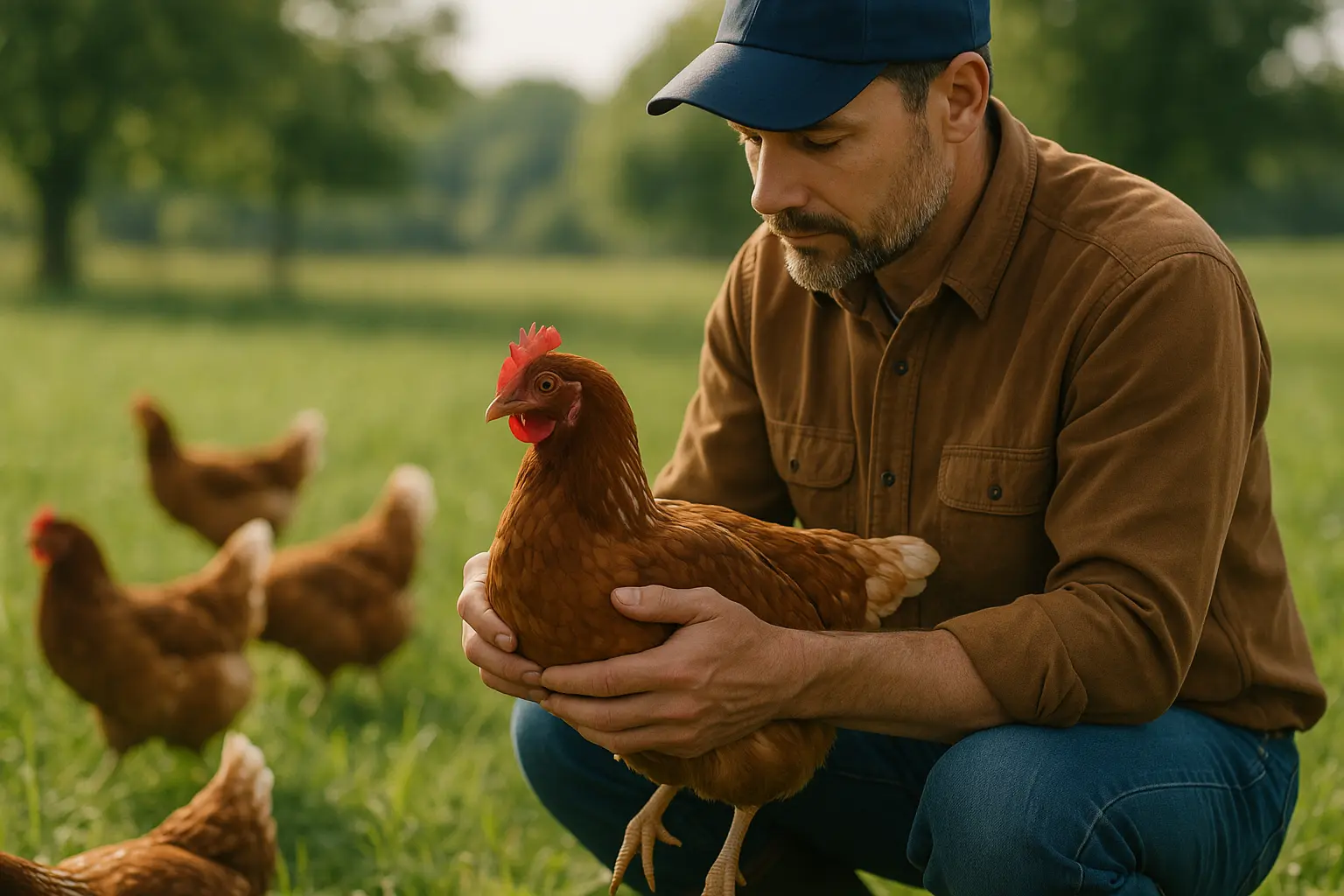
The reflex to clean a wound where the bird stands is the wrong one. Cannibalism in poultry has no single cause, but genetics, crowding, high light intensity and nutritional imbalance are all correlated with its occurrence, and the appearance of blood induces further pecking that can kill an otherwise recoverable bird. Removal from the group comes first, examination second.
Vent pecking is a distinct form of the same problem and it can occur in well feathered birds, immediately after an egg is laid, when the exposed mucous membrane attracts pecking by others. That is a management signal about light, density and layout, not simply an individual accident, and it is worth logging as such.
Two reproductive emergencies that look similar and are not
Prolapse of the oviduct occurs when the vagina fails to retract after laying, often after injury from an oversized or double yolked egg, or in an overweight hen. The risk is immediate: once pecked, the oviduct and parts of adjacent intestinal tract can be pulled out of the abdominal cavity. Isolation in a dark, quiet space is the only useful thing to do before a veterinarian sees the bird.
Egg binding is a different mechanism with a similar look. A fully formed egg lodges in the shell gland or vagina, either because it is too large or because of hypocalcaemia, calcium tetany, or previous trauma to the vent or vagina that obstructs oviposition. Because a calcium disorder can be behind it, this is a case where flock nutrition and a clinical assessment need to be considered together rather than sequentially. Recurrence across several birds points to a herd level cause, which is where our guide to preventing and managing common poultry diseases is more useful than an individual intervention.
What belongs in the kit, and what the kit does not authorise
A first aid station on a poultry unit is stocked for containment and hygiene, not for therapy: sterile dressings, a saline wound irrigation solution, clean gloves, scissors and tweezers kept clean, a dedicated isolation crate, a thermometer for the isolation pen, and the written contact details of the flock veterinarian and the competent authority where every operator can see them.
What the kit does not do is authorise a treatment. In food producing animals, any veterinary medicinal product used outside the terms of its marketing authorisation falls under the cascade of Regulation (EU) 2019/6, and where no withdrawal period is set for the species, the minimum applied is 7 days for eggs and 28 days for poultry meat. Antibiotics may not be used to promote growth, and prophylactic use is restricted to exceptional, veterinary justified cases. Treatments administered to food producing animals must also be recorded, and those records kept available for inspection for at least five years.
Questions we are asked after an incident
When does an individual case become a flock event?
When the same picture appears in more than one bird within a short window, or when mortality, feed intake or production moves outside its normal range without an identified cause. At that point the correct action is notification, not further observation.
Should a sick bird ever be returned to the group?
Only after recovery is complete and any visible wound has fully closed, since residual damage is an invitation to renewed pecking. The decision is best made with the veterinarian following the case rather than on appearance alone.
Can we administer a treatment we already hold on site to a bird that is clearly suffering?
Not on your own initiative. Beyond the legal position, using a product left over from a previous prescription risks the wrong molecule, the wrong dose and an undeclared withdrawal period on eggs or meat already leaving the holding.
Does a first aid protocol replace a health plan?
No. First aid handles the exception; the health plan is what determines how often the exception occurs. If your first aid log is busy, the useful work is upstream, in density, light, litter, water and biosecurity.
Where first aid ends and routine care begins
Most of what reaches an emergency pen would have been visible earlier during a structured health check. Knowing when to intervene, and when to wait, is the harder skill.
Sources: Regulation (EU) 2016/429 on transmissible animal diseases (Animal Health Law), Article 18 on notification within Member States; Regulation (EU) 2019/6 on veterinary medicinal products, cascade provisions and record keeping obligations; WOAH and Merck Veterinary Manual descriptions of clinical signs of high pathogenicity avian influenza in poultry; MSD Veterinary Manual entries on cannibalism in poultry, prolapse of the oviduct and egg bound or impacted oviducts. Consulted August 2026.
Published previously, fully revised on 17 August 2026. General operational guidance for poultry professionals. It is not veterinary advice, does not describe a treatment protocol, and does not replace the assessment of the veterinarian responsible for your flock or the instructions of your competent authority.