
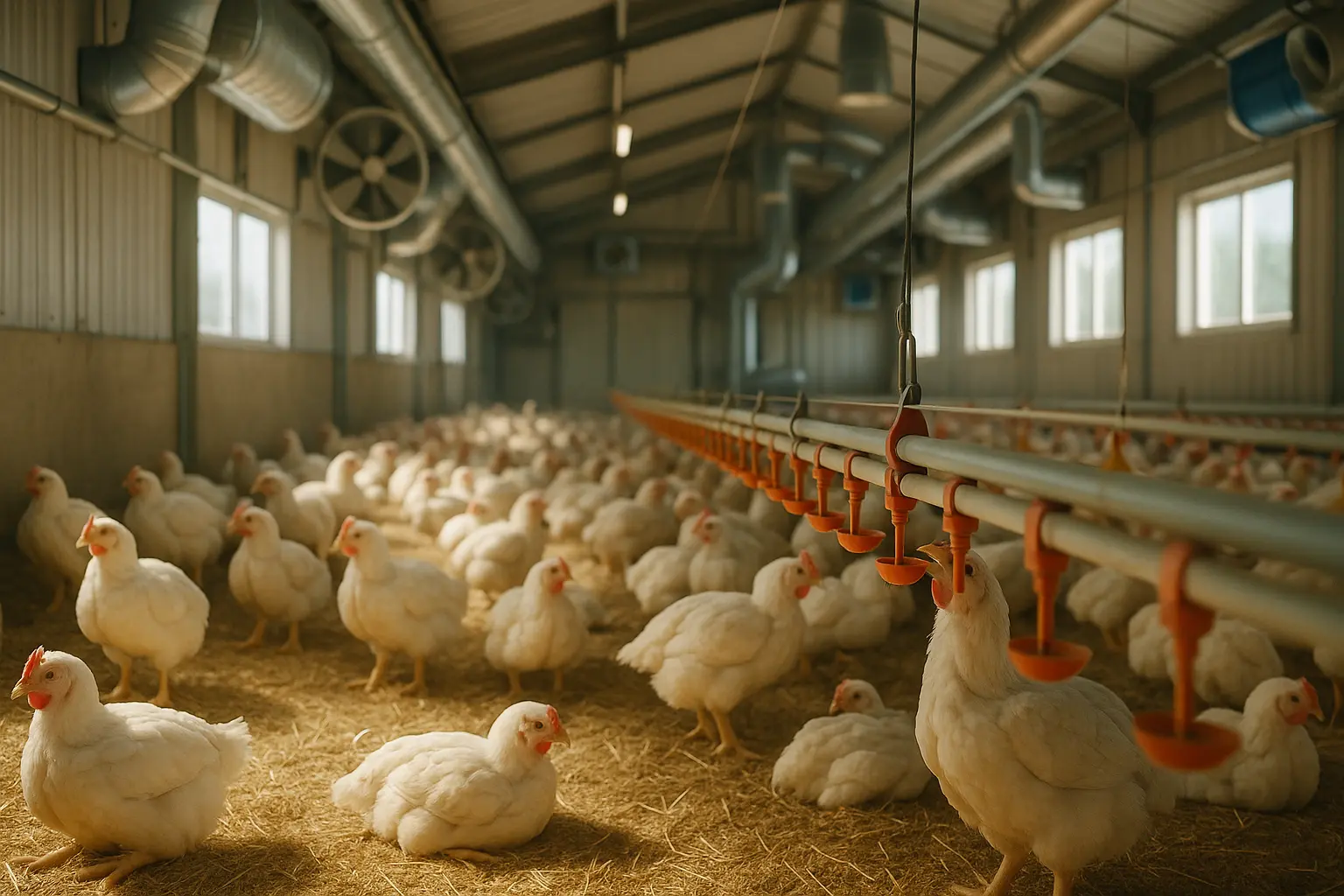
The house sensor says the air is fine. The birds say otherwise: they have moved off the feeders, spread their wings away from the body, and settled along the coolest wall. On a hot afternoon the flock is usually right, because what a bird experiences is not air temperature but the combination of temperature, humidity and air speed at bird level.
Key takeaways
- Bird behaviour is the earliest sensor you own, and it reacts before the controller graph does.
- Humidity decides how much of your ventilation capacity actually removes heat from the bird.
- Cutting ventilation to save heat in winter trades a thermal problem for an air quality problem.
- Target temperatures belong to your breed’s management guide and your veterinarian, not to a generic figure found online.
What the birds show before the data does
Birds signal thermal discomfort through posture, distribution and behaviour, and those signals appear well before a production drop shows in the weekly figures. Reading them takes thirty seconds of standing still inside the house, which is why we ask farm staff to walk in and simply stop before touching anything.
Under heat load, the flock spreads out, lifts the wings away from the body to expose bare skin, pants with an open beak, moves away from feeders and crowds around drinkers and cooler zones. Feed intake falls first, and it falls quietly.
Under cold load, the picture inverts: birds huddle, bunch in corners away from draughts, fluff their feathers and become less active. In young chicks, the distribution around the heat source is the whole diagnosis, and a ring of birds pressed against the wall means the floor is cold even if the air reads correctly.
Chicks deserve particular attention because thermoregulation is not fully functional in the first days of life. They depend on the environment we build for them, and the consequences of getting the brooding phase wrong do not stay in the brooding phase.
Heat: where the performance actually goes
Under heat load, performance is lost mainly through reduced feed intake and through the energy the bird spends cooling itself. A bird that pants is working, and that work competes directly with growth and with shell quality in layers. The stress response also interacts with reproduction, which is why the effect of stress on egg output is rarely a separate subject from thermal management.
Air speed does more than air temperature
Once ambient temperature approaches the bird’s own comfort ceiling, cooling depends on air movement over the bird and on evaporation, which is where the practical toolbox against heat stress earns its keep. Tunnel ventilation, correctly sized inlets and a house that is genuinely sealed matter more at that point than lowering a set point that the system cannot reach anyway. A house with leaks does not ventilate, it short-circuits.
Humidity sets the limit
High humidity blocks evaporative cooling, both the bird’s own and any pad or fogging system installed. This is why the same air temperature can be manageable in a dry climate and dangerous in a humid one, and why humidity should be read next to temperature rather than in a separate tab. Where evaporative cooling is used, it needs to be managed against humidity in real time, not switched on for the season.
Water is the first line, not a support measure
Water intake rises sharply with heat, and it is the intake that keeps the bird able to regulate. Cool, clean water available without queuing at every drinker line is a thermal measure, not a hygiene detail. Flushing lines during hot spells keeps the water at drinker level from arriving warm, and a line that has been sitting in a hot roof space is not delivering what the header tank suggests.
Cold: a quieter loss, and a ventilation trap
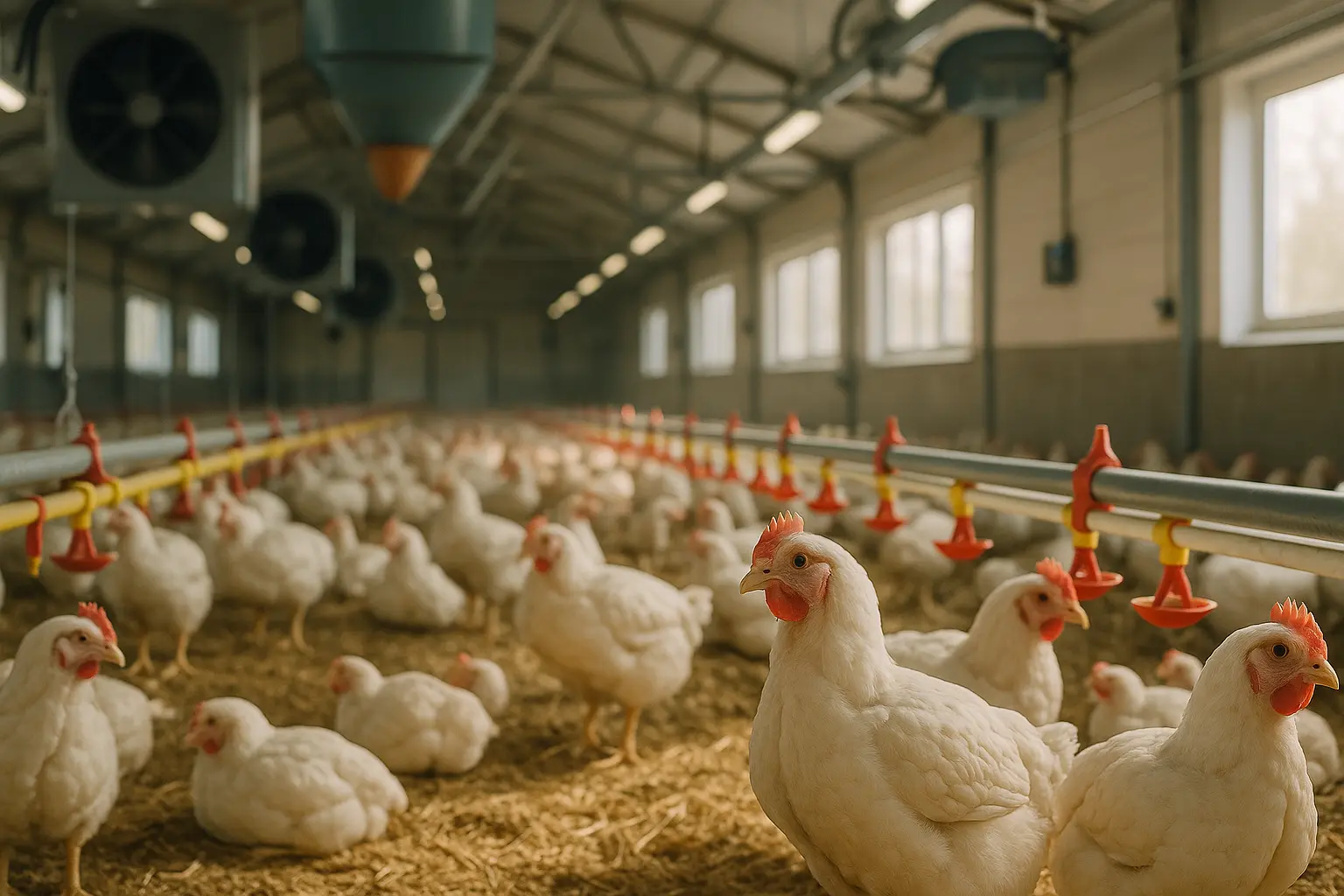
Cold costs performance mainly through energy diverted to maintaining body temperature, which shows up as poorer feed conversion long before it shows up as mortality. The trap is different from heat: the instinctive response is to close the house down, and that is where a thermal problem becomes a respiratory one.
Minimum ventilation exists to remove moisture, ammonia and carbon dioxide, and it cannot be switched off to save heat without consequence. Wet litter in a closed winter house raises ammonia, and ammonia damages the respiratory tract, so the flock ends the cold spell more vulnerable than it started. This is the point where thermal management and air quality inside the house stop being two separate topics.
The structural answers are unglamorous and durable: insulation of roof and walls, sealing the gaps that create draughts at bird level, dry and friable litter, preheating the floor before chick placement rather than only the air, and heating capacity sized for the coldest week rather than the average one.
Reading the two extremes side by side
| Heat load | Cold load | |
|---|---|---|
| First visible sign | Panting, wings held away from the body, flock spread out | Huddling, fluffed feathers, birds away from draughts |
| Main production effect | Feed intake drops, growth and shell quality follow | Feed conversion worsens as energy goes to body heat |
| Immediate lever | Increase air speed at bird level, secure cool water supply | Add heat, block draughts, keep minimum ventilation running |
| Structural fix | Sealed house, correct inlet sizing, shading, evaporative capacity | Insulation, floor preheating, heating sized for the worst week |
| Classic mistake | Lowering the set point on a system already at maximum | Closing the house to save fuel and losing air quality |
Feed and water strategy around the forecast
Feeding strategy under thermal stress is mostly a question of timing and density rather than of a different formulation each season. When intake falls in the heat, moving the main feeding window to the cooler hours recovers part of what the afternoon costs, and nutrient density has to compensate for the volume the bird no longer eats. In cold conditions the logic reverses: the bird eats more, and the ration has to support the extra energy demand without unbalancing the rest.
Two operational reminders carry most of the value here. Never let the drinker line be the bottleneck during a heat episode, and never assume a ration change compensates for a house that cannot ventilate. Any supplementation, including electrolytes during hot spells, should be discussed with the flock veterinarian or the nutritionist rather than applied from a generic recipe, since the right answer depends on the water, the ration and the birds in front of you.
What sensors and automation genuinely add
Automation adds consistency and reaction speed, not judgement. Controllers that combine temperature, humidity and, where relevant, carbon dioxide give a far more useful picture than temperature alone, and alarms with a real escalation path prevent the classic overnight failure. Sensor placement decides the value of all of it: a probe in the wrong position measures the house, not the birds.
What automation does not do is replace the walk through the house. The most reliable operations we work with run both, and treat any disagreement between the screen and the flock as a reason to check the sensor. Producers working to organic and outdoor specifications face the same physics with fewer mechanical options, which makes shade, tree cover, house orientation and pop hole management part of the thermal plan rather than landscape details.
Straight answers to the questions we get most
What temperature should I set for my house? There is no single figure. Target temperature depends on species, breed, age, housing type and humidity, and the reference is the management guide published for your genetics, adjusted with your veterinarian. Any number quoted without those parameters is decoration.
Can birds acclimatise to heat? Progressive exposure does improve tolerance to a degree, and this is used deliberately in some regions. It has clear limits, it does not protect against a sudden heat wave, and it never substitutes for ventilation capacity.
How fast can a heat episode become critical? Fast enough that the plan matters more than the reaction. A written hot weather procedure naming who checks the house, at what times, and what to do if a fan fails, is worth more than any equipment bought during the emergency.
When should the veterinarian be involved? As soon as mortality, respiratory signs or an unexplained drop in intake appear. Thermal stress weakens birds and opens the door to disease, and that assessment belongs to a qualified poultry veterinarian. This article is general operational guidance, not a clinical protocol.
Going further on the same house
Thermal control and air quality are managed by the same fans, the same inlets and the same litter. Reading them together is what keeps a winter house from solving one problem by creating another.