
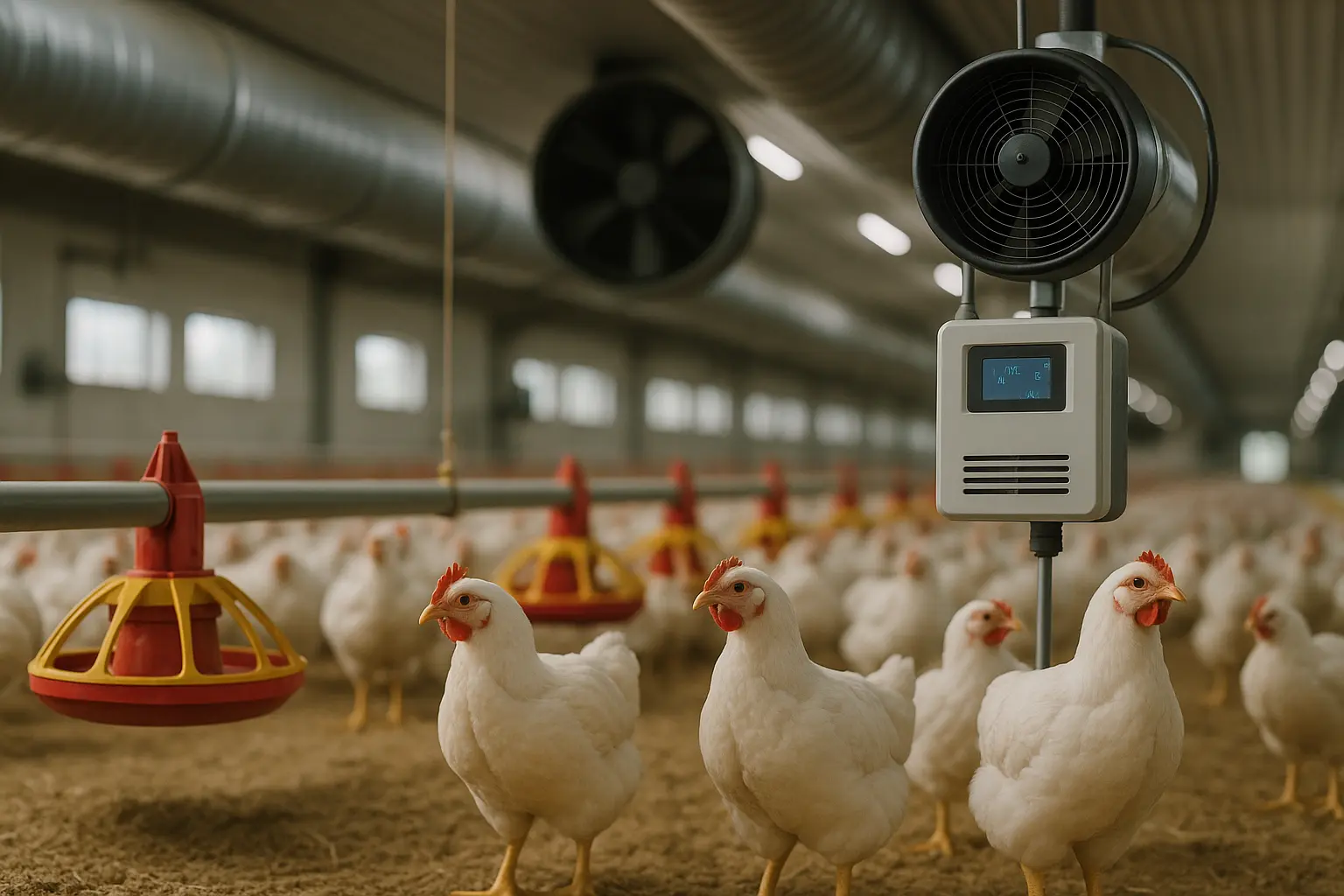
Two people can stand in the same broiler house, read two ammonia values three metres apart, and both be telling the truth. One holds the probe at chest height near the gable; the other crouches at bird level over the drinker line. The regulation is unambiguous about which of the two counts, and it is not the comfortable one.
Key takeaways
- The regulated limits are measured at bird head height, not at the controller, the wall sensor or the walkway.
- Ammonia costs performance well before it causes visible disease: the difference between 25 and 50 ppm has been quantified at 0.31 lb of body weight per broiler.
- Minimum ventilation exists to remove water vapour, not heat, and that is what keeps litter friable.
- Dust is rarely instrumented and rarely limited; a working guide is below 5 mg per cubic metre at bird level.
The four numbers that are actually written down
Council Directive 2007/43/EC is the reference text for meat chickens in the EU, and it is more specific than the general phrase “good ventilation” suggests. The obligation is placed on ventilation and, where necessary, heating and cooling systems, designed and operated so that the following hold.
| Parameter | Limit | Condition of measurement |
|---|---|---|
| Ammonia (NH3) | 20 ppm maximum | At the level of the chickens’ heads |
| Carbon dioxide (CO2) | 3,000 ppm maximum | At the level of the chickens’ heads |
| Relative humidity | 70 % maximum, 48-hour average | When outside temperature is below 10 °C |
| Inside temperature | No more than outside +3 °C | When outside temperature, in the shade, exceeds 30 °C |
Two of these are gas concentrations and two are climate conditions, and they are not independent. Push ventilation down to hold temperature in cold weather and both gas figures climb. Push it up and the heating bill follows. The regulated numbers are the boundary of that trade-off, not a description of it.
Where you measure decides what you read
The phrase “at the level of the chickens’ heads” is the most frequently ignored clause in the whole annex. Ammonia is released from the litter surface and is lighter than air, but the concentration gradient in a working house is driven by air movement, not by buoyancy alone: the highest readings usually sit low, near wet litter, out of the main airflow, under drinker lines and along walls where air stagnates.
A permanently installed sensor at controller height in the middle of the house will give you a stable, comparable, and systematically optimistic number. It is still useful, precisely because it is comparable over time. But it is a trend instrument, not a compliance instrument. The compliance measurement is a handheld reading taken low, in several positions including the worst ones, and recorded with its location.
Carbon dioxide behaves differently and is arguably the more useful of the two in cold weather. It has a single source, the birds themselves, and it rises predictably when ventilation is inadequate. That makes it the cleanest available proxy for whether minimum ventilation is genuinely sufficient at a given bird age, before ammonia has had time to accumulate in the litter.
Ammonia is a feed conversion problem first
The welfare argument for controlling ammonia is well rehearsed. The economic argument is more persuasive to most operators and rests on the same physiology. Ammonia-laden air destroys the cilia in the trachea, which impairs mucus flow and thickens tissue around the alveoli, and a bird whose first respiratory defence is degraded is a bird more available to every respiratory agent circulating in the house.
Poultry extension guidance from the University of Kentucky recommends holding ammonia below 25 ppm throughout the growout for optimum broiler performance, and quantifies the gap: the difference in body weight between broilers exposed to 25 ppm and to 50 ppm has been measured at 0.31 lb per bird. On a 25,000-bird house that is 7,750 lb of live weight per cycle, lost quietly, with no clinical event to point at.
Ventilation removes water, not just heat
The most common conceptual error we encounter is treating minimum ventilation as a heat management setting. In cold weather its job is moisture removal. Birds add water to the house continuously through respiration and droppings, and if that water is not exported, it lands in the litter.
From there the chain is mechanical. Wet litter releases far more ammonia than dry litter, because the microbial conversion of uric acid depends on moisture. Wet litter also compacts, loses its friability, and starts producing contact lesions on the birds standing in it. The 70 % humidity ceiling in cold weather is not a comfort target; it is the point past which the litter stops being litter and becomes a substrate.
This is why air quality and litter management cannot be separated on a site. The relationship between litter moisture and footpad lesions is one of the best-documented outcomes in broiler production, and we have set it out with the published figures in our article on broiler welfare beyond the standards. The short version: the ventilation setting and the footpad score are the same conversation.
Dust, the parameter nobody instruments
Ammonia and carbon dioxide have regulated ceilings. Dust does not, in the same text, and as a result it is very rarely measured on commercial sites. The working guidance from the same extension source is that air in poultry houses should contain less than 5 mg per cubic metre of dust at broiler level, with 8 mg per cubic metre tolerable if the birds are not simultaneously stressed by ammonia, heat or respiratory disease agents.
That conditional clause is the interesting part. Dust tolerance depends on what else the respiratory tract is dealing with. A house running at 22 ppm of ammonia and visibly dusty air is not experiencing two independent problems; it is experiencing one compounded problem, and correcting the ammonia raises the dust tolerance at the same time.
From a reading to a control loop
Sensors and controllers have made continuous measurement cheap. They have not made interpretation automatic, and a site that installs instrumentation without deciding in advance what each reading triggers usually ends up with a good archive and unchanged practice.
The minimum useful loop has four elements. A continuous trend from fixed sensors, accepted as optimistic. A periodic handheld verification at bird head height, in the worst positions, logged with the location. A defined action per parameter, written down: what the operator does when CO2 exceeds a set threshold at a given bird age, and who is called if the correction does not work. And a calibration schedule, because an electrochemical ammonia cell that has drifted is worse than no sensor at all, having replaced uncertainty with false confidence.
Questions that come up at the ventilation review
Which parameter should be instrumented first on a limited budget?
Carbon dioxide, in cold-weather climates. It has a single source, responds immediately to ventilation rate, and tells you whether minimum ventilation is adequate before litter condition and ammonia have deteriorated. Ammonia measurement then serves to confirm and to document compliance.
Does poor air quality show up in production figures?
Yes, and usually before it shows up as disease. Reduced weight gain and impaired feed efficiency at sustained ammonia concentrations in the 25 to 50 ppm range are the classic signature, alongside a rising rate of respiratory findings at processing.
How is ammonia reduced without simply ventilating more?
By attacking its source. Keep litter dry through drinker line management and moisture removal, remove and replace wet caps promptly, manage stocking density, and consider litter amendments where they are authorised locally. Extra ventilation dilutes ammonia; dry litter stops producing it.
Where should the handheld measurement be taken?
At bird head height, in several positions, deliberately including the ones you expect to be worst: near drinker lines, along walls, in corners outside the main airflow, and at the coldest end of the house in winter. Record the position with the value, otherwise the next reading is not comparable.
When does this become a veterinary matter?
As soon as there are clinical respiratory signs in the flock. Air quality correction is a management action; a respiratory outbreak needs a diagnosis, and the two are frequently present at the same time in the same house.
When the air is no longer the whole explanation
Degraded respiratory defences and a circulating pathogen produce a similar picture, and telling them apart changes what you do next.
Avian respiratory diseases: symptoms, prevention and treatment
Sources: Council Directive 2007/43/EC laying down minimum rules for the protection of chickens kept for meat production, Annex I and Annex II, for the 20 ppm ammonia and 3,000 ppm carbon dioxide limits measured at the level of the chickens’ heads, the 70 % average relative humidity limit over 48 hours below 10 °C outside, and the inside temperature limit of outside plus 3 °C above 30 °C outside; University of Kentucky Department of Animal and Food Sciences, poultry extension chapter on air quality, for the recommendation to hold ammonia below 25 ppm throughout the growout, the 0.31 lb body weight difference between 25 ppm and 50 ppm exposure, the resulting 7,750 lb per 25,000-bird flock, the dust guidance of below 5 mg/m3 with 8 mg/m3 tolerable in the absence of other stressors, and the effect of ammonia on tracheal cilia and alveolar tissue. Consulted August 2026.
Published previously, fully revised on 14 August 2026. General technical guidance for poultry professionals. It does not replace veterinary diagnosis, and the regulated limits cited apply in the European Union: verify the values in force in your country of production.