
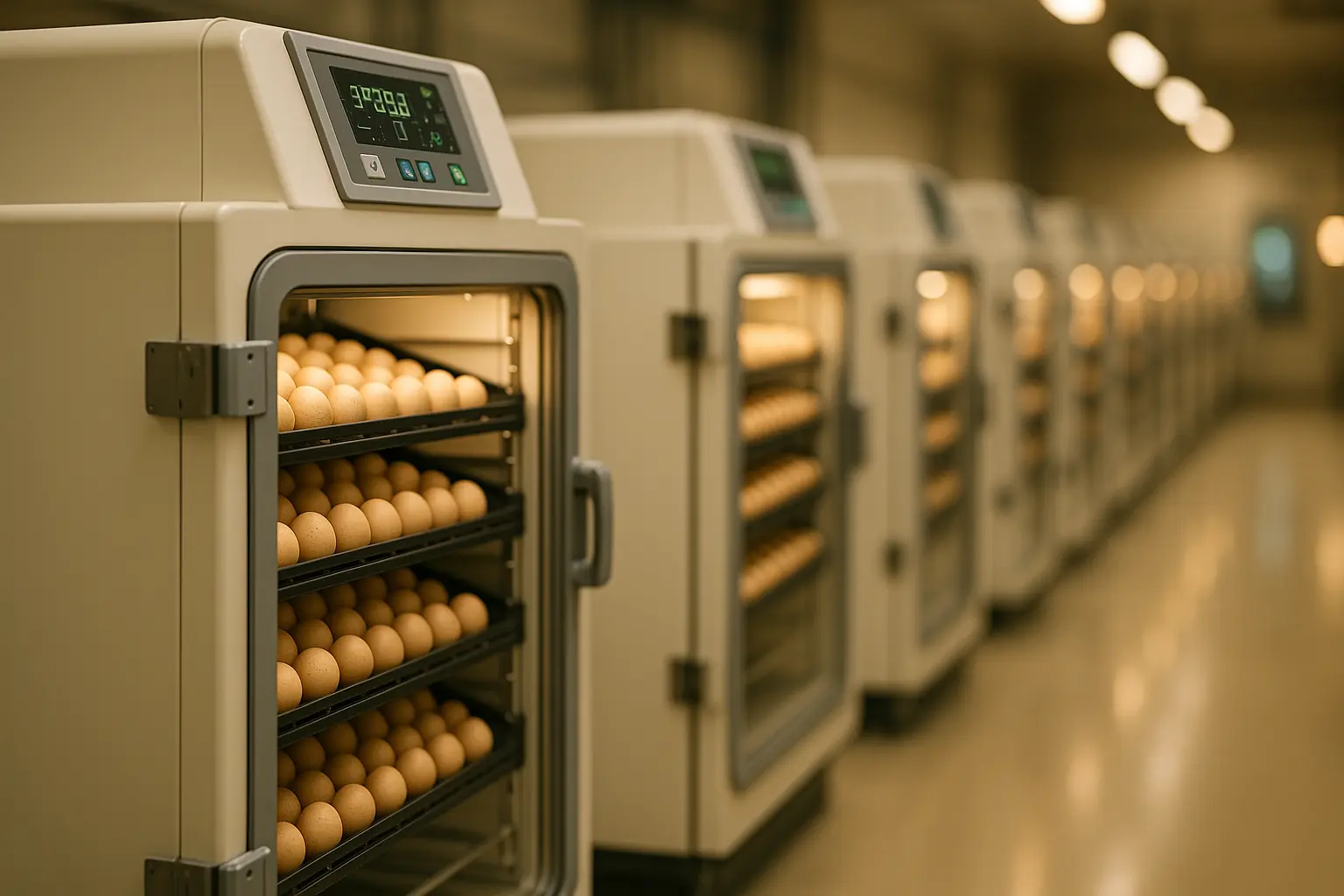
“Zero defect” reached hatcheries the way it reached every other industry: borrowed from manufacturing, printed on a wall, and rarely converted into a number anyone audits. The ambition is sound. It becomes operational only once someone writes down what counts as a defect, and what does not.
Key takeaways
- Zero Defects is a prevention doctrine from 1960s aerospace, not an inspection method that transfers whole to a biological process.
- Hatch of set punishes you for breeder fertility, hatch of fertile forgives second grades. Only saleable first-quality chicks measures what the customer receives.
- Defects are created in three distinct windows: the egg store, the machine, and the hours between the first pip and the loading bay.
- The Pasgar score turns chick quality into an auditable batch figure, with an acceptable average of at least 9.0.
The phrase was written for missiles, not embryos
Zero Defects began as a management programme at the Martin Company’s Orlando plant in 1961, on the Pershing missile contract, and is generally credited to Philip B. Crosby, then a quality manager on that programme. Crosby codified it in Quality Is Free (1979) around one idea: the cost of poor quality always exceeds the cost of preventing it.
The prevention half transfers to a hatchery. The inspection half does not: a casing that fails a check goes back for rework, an embryo that stopped on day three never comes back. And an infertile egg is not a hatchery defect, it arrived that way. Counting it as one produces a target nobody can reach, which is the fastest way to lose a quality programme.
The metric you pick decides whether the target is honest
Three figures circulate on hatch reports, and they answer three different questions. Choosing between them is what makes a zero defect ambition auditable rather than decorative.
| Metric | What it really measures | What it hides |
|---|---|---|
| Hatch of set | Commercial yield per egg placed in the setter | Breeder fertility. A well-run hatchery on an ageing flock looks incompetent |
| Hatch of fertile | The ability to carry a living embryo through to a hatched chick | Culls and second grades. A chick the farm will reject still counts as hatched |
| First-quality chicks per fertile egg | What the customer actually unloads at the farm | Very little, provided the culling standard is written down and does not drift |
The case for the middle line is well made in the trade press: no skill or equipment hatches a chick from an infertile egg. We push it one step further. Hatch of fertile still rewards a batch that hatches everything and delivers half of it in poor condition. The honest denominator is fertile eggs, and the honest numerator is chicks a customer accepts without argument.
Three windows in which a defect is actually created
Before the eggs reach the setter
Storage costs points that never appear on an incubation trace. Dutch hatchery data published by Yassin and co-authors in 2008 puts it at roughly 0.2 percentage points of hatchability per storage day up to seven days, and about 0.5 points beyond; chicks from eggs held seven days were reported more than 200 g lighter at slaughter. Royal Pas Reform grades storage temperature with holding time, from 18-21 °C over the first three days down to 10-12 °C past day eight, and where long storage is unavoidable, SPIDES is documented by Aviagen as recovering around 63 % of the loss.
Inside the machine

Incubation defects cluster around three controlled variables. Eggshell temperature sits near 37.8 °C (100 °F) in a band of 37.5-38.3 °C, read at the equator and only on eggs carrying a live embryo, since a clear egg produces no heat. Carbon dioxide follows a profile, not a set point: inlet air below 0.09 %, a graded rise tolerated to about 1.5 % by day 4 and held to day 10 in broilers, then ventilation trimmed to 0.4 % maximum. Moisture loss should land at 11-13 % by day 18 on Aviagen figures, 10.5-12.5 % on Cobb’s.
Petersime places normal early embryonic mortality at 2.5 to 5.5 % depending on breeder flock age, and attributes about 65 % of those early deaths to incubation conditions rather than to the eggs. That figure is what justifies a defect programme at all: most of what dies early is something the hatchery did.
The discipline lies in reading the pattern across a flock rather than the individual egg, a loop we set out in our guidance on reducing embryonic mortality through precision incubation.
Between the first pip and the loading bay
The last window is short and expensive. Transfer belongs between day 15 and day 19, optimum at day 18-19. A controlled hatch window runs 12 to 18 hours, around 24 hours once drying is counted; a spread past 36 hours is not a wide window but a fault to investigate. Early chicks wait, and waiting costs condition: dehydration reads on the hocks, which turn angular with sharp edges, a check Michigan State University Extension recommends before take-off rather than after.
Scoring the output with the Pasgar method
The Pasgar score converts chick quality into a batch figure an operations meeting can argue about. Royal Pas Reform built it as a working simplification of the Tona score, sound for research but too labour intensive for daily hatchery use, and borrowed its shape from the Apgar score used on human newborns.
Five demerit points are checked on each chick, one point each: the reflex (standing within three seconds when placed on its back), the navel (clean, closed, dry, no black scab or string), the hocks (no red patches), the beak (no dried blood in the nostrils, no red dots, no dried albumen) and the belly (supple, a tight belly signalling an oversized residual yolk sac). A faultless chick scores 10, one with red hocks and a thick belly scores 8, and the range runs from 10 down to 5. Sample at least 30 chicks per batch, preferably 50, for an acceptable average of 9.0 or better. Because navel closure, yolk uptake and vitality dominate the result, a falling average points first at hatcher conditions, which makes Pasgar a diagnostic instrument rather than a grade card.
What we will not promise
A biological floor sits under every hatchery, made of flock fertility, breeder age, genetics and pathogen pressure, and no equipment budget removes it. Zero defect is a direction of travel and a way of allocating blame honestly, not a percentage to sign into a supply contract. Biosecurity frames the exercise: chapter 6.5 of the WOAH Terrestrial Animal Health Code sets the expectation of physically separated zones and a one-way flow of eggs, chicks and people moving with the air. Any suspected health problem in a batch stays a veterinary matter, so treat the above as general good practice rather than a protocol to apply without your own poultry veterinarian.
Questions raised when a zero defect target lands on a hatchery
Is it a realistic target or a slogan? As a percentage, not realistic. As a management rule that no known and controllable loss is accepted as normal, it is both realistic and demanding, which is how Crosby framed it in the first place.
Which single figure should we track if we track only one? First-quality chicks per fertile egg, by breeder flock and by setter. It survives a change of flock age, which hatch of set does not, and it cannot be flattered by hatching weak chicks.
Where do we start if nothing is measured yet? With the egg store, because those losses are cheap to correct and are already running before the setter is switched on. Record set date and storage duration by flock for a month, then read the hatch differences.
The defect count does not stop at the hatchery door
Chick quality is judged on the farm during the first week, not on your take-off table. Our guide to the handover follows the same batch through transport and placement.
Ensuring the quality of day-old chicks from hatchery to farm
Published 22 May 2025. Updated 18 August 2026.
Sources: Royal Pas Reform (egg storage, hatch window, Pasgar score); Aviagen (SPIDES, egg weight loss); Cobb-Vantress (weight loss); Petersime (early embryonic mortality); Yassin et al., 2008 (storage duration and hatchability, Dutch hatcheries); Michigan State University Extension (chick dehydration); WOAH Terrestrial Animal Health Code, chapter 6.5; Philip B. Crosby, Quality Is Free, 1979.