
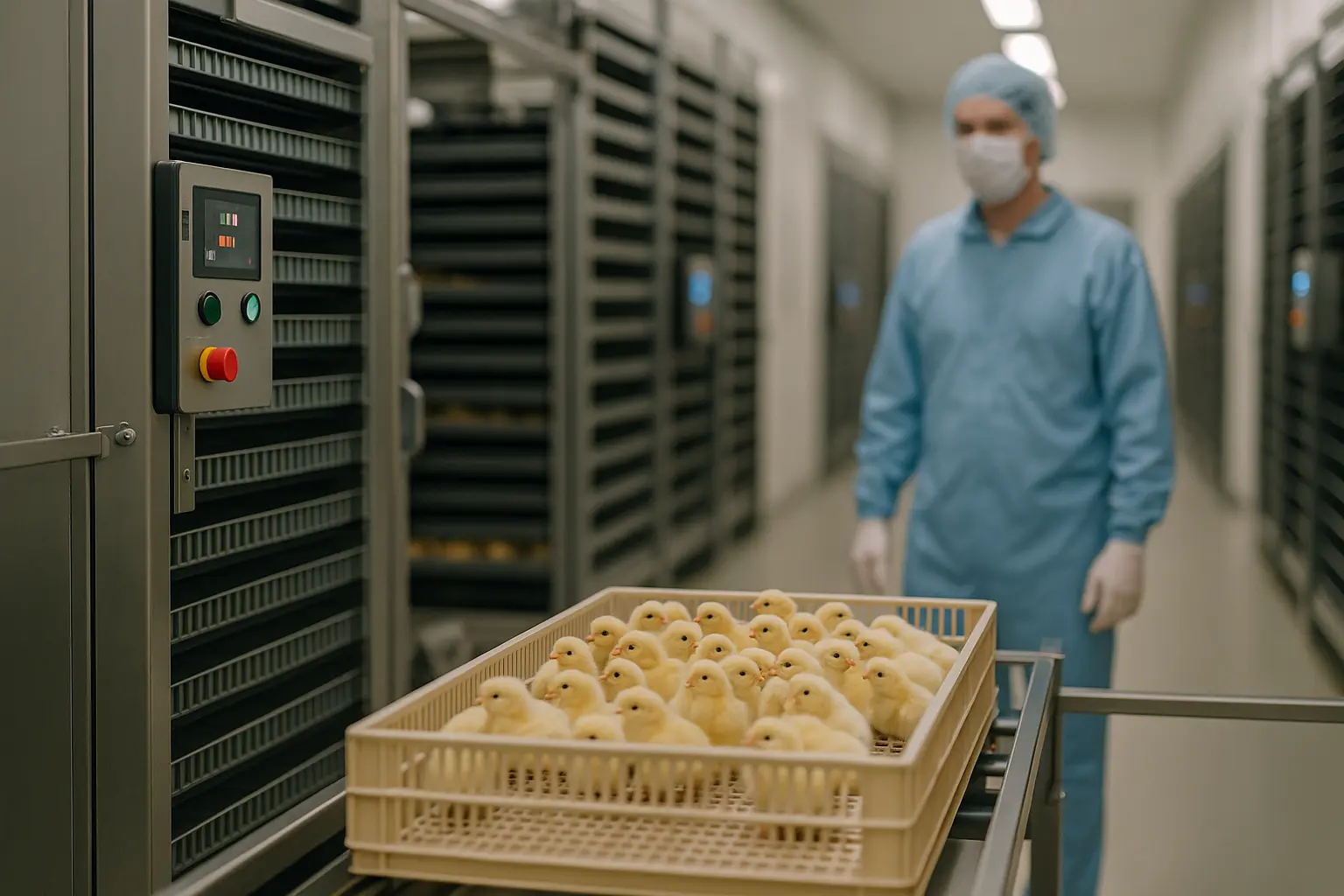
There is an accounting quirk at the heart of every hatchery, and it explains why optimisation work here pays back faster than almost anywhere else in the chain. The cost of incubating a tray is committed the moment the eggs are set. What comes out of it three weeks later does not change that bill at all.
Key takeaways
- Incubation costs are calculated per egg set, not per chick hatched, because most of them are independent of the hatch result.
- The largest recoverable losses sit before the setter door closes, in egg storage, and inside the first ten days of incubation.
- Chick quality exports its cost downstream, to feed conversion and first-week mortality, where the hatchery rarely sees the invoice.
- A credible business case uses the site’s own cost per egg set. Sector averages and supplier brochures are not a baseline.
Why a point of hatchability behaves like margin
Because the cost has already been spent. Published hatchery costing methodology treats incubation as a cost per egg set, precisely because energy, depreciation, labour and most consumables are independent of how many chicks eventually emerge. The tray occupies the same square metre of setter, draws the same kilowatt-hours and is turned by the same staff whether it yields 82% or 86%.
That is the whole economic argument for hatchery optimisation, and it is worth stating plainly because it is frequently mis-stated. Recovering a percentage point of hatchability is not a 1% improvement in revenue. It is an additional saleable chick whose production cost was already sunk, minus the marginal cost of vaccinating and handling it. On a machine running a full year, a single point is one percent of every set that machine takes.
The money that leaves before incubation begins
Egg storage is the most under-priced variable in the building. Data from Dutch commercial hatcheries published by Yassin and colleagues in 2008 put the cost of storage at roughly 0.2% of hatchability per day up to the seventh day, and about 0.5% per day after that. The curve is not linear, so a planning decision that pushes a batch from six days to nine is materially more expensive than the same three days added earlier in the window.
Storage temperature follows the same logic, with Royal Pas Reform guidance placing eggs at 18 to 21 °C for zero to three days, 15 to 17 °C for four to seven, and 10 to 12 °C beyond eight days. Where long storage is unavoidable, SPIDES, short periods of incubation during egg storage, is documented by Aviagen as recovering around 63% of the hatch loss caused by extended storage, with field trials in a 60 to 70% band.
The cost does not stop at the hatch figure either. In the same body of work, chicks from eggs stored seven days finished more than 200 g lighter at slaughter, a gap that only becomes visible from around day 14 of rearing. That loss is real, it is measurable, and it never appears in the hatchery’s own accounts.
Inside incubation, most of the loss is self-inflicted
Early embryonic mortality has a normal range, and a large share of what exceeds it comes from the machine rather than the flock. Petersime places normal early mortality at 2.5 to 5.5% depending on breeder flock age, and attributes about 65% of early deaths to incorrect incubation conditions. That ratio is the practical justification for spending money on control rather than on capacity.
The controlling parameter is eggshell temperature, not air temperature. The working optimum sits near 37.8 °C, inside a 37.5 to 38.3 °C band, measured at the equator of the egg and only on eggs containing a live embryo, since a clear egg produces no heat of its own. Above 39 °C the embryo is in danger; below 37.5 °C the hatch is simply late, which then costs you in the hatcher.
The cost the hatchery exports
Chick quality is where hatchery economics stop being a hatchery matter. A wide hatch window means the first chicks out wait for the last, and Royal Pas Reform puts a well-managed window at 12 to 18 hours, with around 24 hours acceptable once drying time is counted. Beyond that, early chicks dehydrate while late ones are pulled damp, and Mississippi State University Extension describes the field read for it: shanks that look angular and sharp-edged indicate a dehydrated, stressed chick.
| Lever | What it moves | Where the money appears |
|---|---|---|
| Shorter egg storage | 0.2% per day of hatch before day 7, about 0.5% after | Hatchery P&L, same week |
| Eggshell temperature control | Early embryonic mortality, hatch timing | Hatchery P&L, next cycle |
| Narrower hatch window | Chick uniformity and hydration at take-off | Grower’s first week, weeks later |
| Storage discipline over long batches | Slaughter weight, visible from day 14 of rearing | Processing yield, end of cycle |
In an integrated business those last two rows come home eventually. In a merchant hatchery selling chicks to independent growers, they arrive as commercial pressure on price and as a reputation, which is slower and considerably harder to reverse.
Building a case that survives the finance meeting
- Start from your own cost per egg set. Divide the site’s annual incubation cost by eggs set, not by chicks sold. Every subsequent calculation depends on that denominator being right.
- Price the loss before pricing the fix. A point of hatchability, a day of storage and an hour of hatch window each have a value on your site. Establish the three, then look at equipment.
- Say who collects the benefit. Split what lands in the hatchery accounts from what lands in the rearing or processing accounts. A gain that leaves the site needs a named beneficiary or the finance team will discount it to zero, correctly.
- Date every figure and repeat the measurement. A baseline taken in one season, on one breeder flock age, is a single observation. The decision deserves a series.
One caution on market-led arguments. Consumer interest in how food is produced is real, but we would not put a capital request in front of a board on the strength of rising Google search volumes for ethical food. Search interest measures curiosity. Contracts, specifications and audit requirements from your buyers measure willingness to pay, and only the second belongs in a business case.
What this looks like at sector scale
The base is large enough that small percentages stop being small. FAO statistics put world meat production at 374 million tonnes in 2024, with chicken among the three most produced items globally, and world egg production at about 100 million tonnes, of which 94% is hen eggs. Every one of those birds passed through an incubator.
That scale cuts both ways. It means incremental hatchery gains aggregate into a genuine effect on the cost of animal protein. It also means a systematic error, a badly calibrated probe or a storage practice inherited without question, replicates across an enormous number of eggs before anybody thinks to question it.
Straight answers
Does better hatchability always improve profitability?
Not automatically. It does when the extra chicks are sold, and when the measures taken to obtain them cost less than the chicks are worth. A hatch improvement bought with an energy bill that rises faster than the gain is an operational success and a financial loss.
Where should a hatchery look first?
At egg storage and at eggshell temperature, in that order. Both are documented, both are cheap to measure, and both act on the largest recoverable losses before any capital expenditure is discussed.
Can chick quality gains be quantified without the farm’s data?
Only partially. Uniformity, hatch window width and hydration are measurable at take-off, but the value of those measurements is realised in first-week mortality and feed conversion. Without a feedback loop from the rearing sites, the hatchery is optimising against a proxy.
How does technology fit into this?
As instrumentation before automation. Knowing the eggshell temperature, the real storage duration per batch and the actual hatch window changes decisions immediately. Automating a process nobody has measured mainly makes the existing error faster.
From the case to the capital plan
Once the losses are priced, the next question is what to replace, in what order, and what the payback period actually looks like on an ageing site.
Modernising an old hatchery: steps, costs and return on investment
Sources: published hatchery costing methodology on cost price for hatching eggs and day-old chicks, for the principle of costing incubation per egg set rather than per chick hatched; Yassin et al., 2008, on Dutch commercial hatchery data, for the storage penalty of 0.2% and 0.5% per day and the slaughter weight difference; Royal Pas Reform technical knowledge base, for egg storage temperatures and the 12 to 18 hour hatch window; Aviagen technical documentation on SPIDES, for the 63% recovery of storage-related hatch loss; Petersime, for early embryonic mortality of 2.5 to 5.5% and the 65% share attributable to incubation conditions, and for eggshell temperature targets; Mississippi State University Extension on chick removal from the hatchery, for the dehydration read on chick shanks; FAO agricultural production statistics for 2024, for world meat and egg production. Consulted August 2026.
Published previously, fully revised on 13 August 2026. General technical and economic guidance for hatchery professionals. It is not financial advice, and the figures cited are reference points to be re-established with your own site data before any investment decision.