
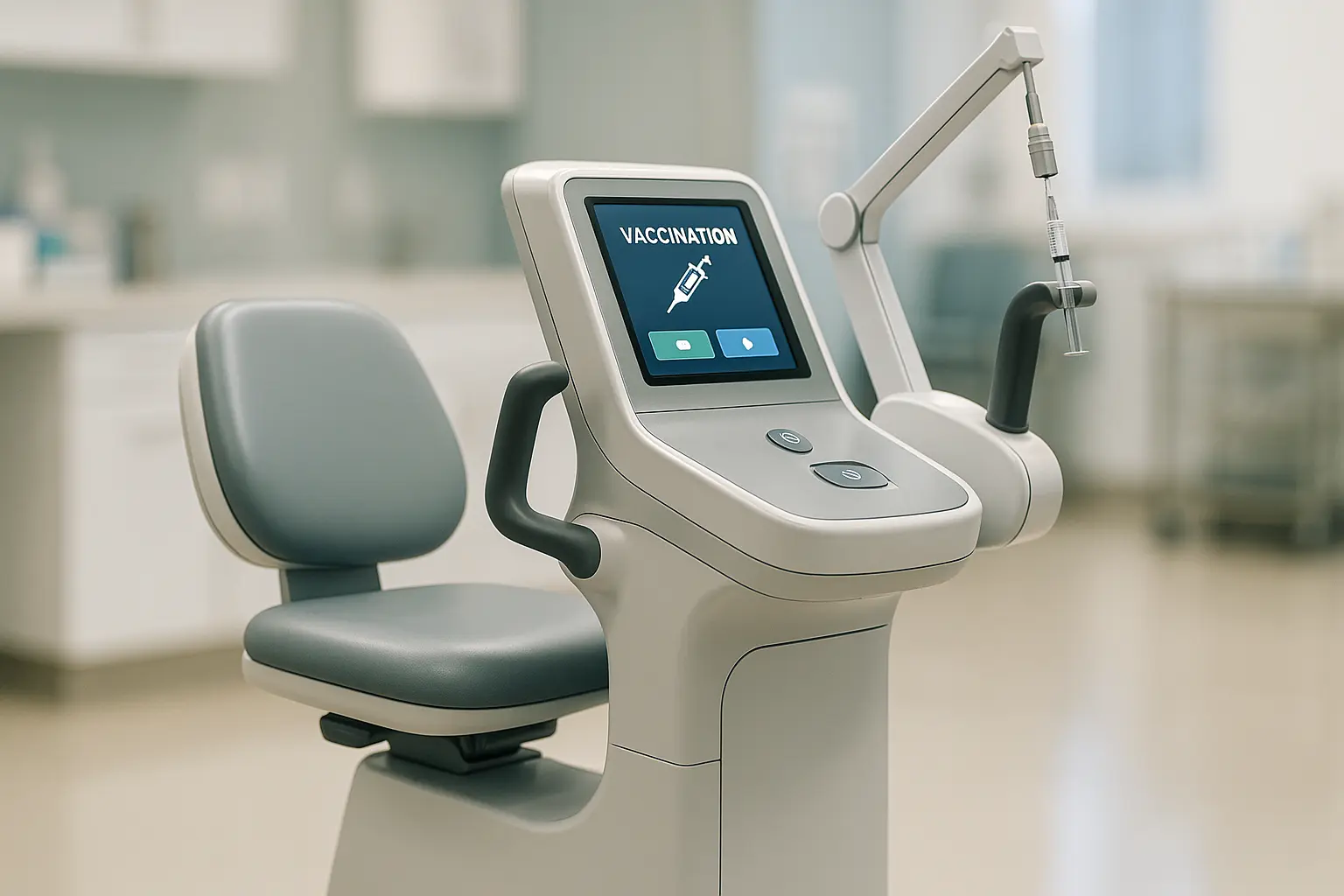
Start with the arithmetic rather than the equipment. A full size in ovo platform can inject up to 70 000 eggs an hour depending on configuration, and a compact machine designed for medium hatcheries runs between 12 000 and 20 000. Whatever the operator does at that station, they do it that many times, in the same posture, for the length of a shift. Ergonomics on a vaccination line is not a comfort question. It is a volume question.
Key takeaways
- Regulation (EU) 2023/1230 fully replaces Machinery Directive 2006/42/EC and becomes mandatory on 20 January 2027, with tightened ergonomics obligations and human machine interfaces adapted to operator characteristics.
- The machinery specific reference is the EN 1005 series: part 3 on recommended force limits, part 4 on working postures and movements, part 5 on high frequency repetitive handling. The ISO 11228 series covers lifting and carrying, pushing and pulling, and repetitive handling.
- European Working Conditions Survey data cited by EU-OSHA puts 43 % of workers reporting backache, 41 % reporting pain in shoulders, neck or upper limbs, and 61 % performing repetitive hand or arm movements.
- Accidental self injection is the hazard specific to this station. With an oil adjuvanted product, injection into a closed compartment such as a finger can require surgical treatment and has led to loss of the digit.
Why the vaccination station behaves differently from the rest of the hatchery
Most hatchery workstations alternate. A candling operator moves, a setter technician walks a room, a hygiene operator changes tools and posture through the day. The vaccination station does the opposite: it concentrates a single movement, at a single height, at a rate set by a machine rather than by the person.
Automated in ovo platforms sit at the high end of that concentration, with published throughputs between roughly 20 000 and 60 000 eggs an hour across the main systems and up to 70 000 for a full size unit in certain configurations. Even where injection itself is automated, the human work does not disappear: trays are loaded and unloaded, plates and needles are checked, misinjections are picked up, and the machine has to be watched. Post hatch subcutaneous vaccination concentrates it further still, because the bird is handled individually.
That is the reason a vaccination line deserves an ergonomic assessment of its own rather than an average one taken across the building.
Five points where comfort is actually decided
When we walk a vaccination station, these are the five things we look at, in this order.
- Working height and reach envelope. The critical measurement is not the height of the machine, it is the height of the point where hands do the work, relative to the elbow of the shortest and the tallest operator on the rota. A fixed station suits one body and penalises every other.
- Force and grip per unit. Pinch grips, trigger pulls and tray lifts are individually small and collectively decisive. EN 1005-3 exists precisely because a force that is trivial once becomes a risk at high frequency, and EN 1005-5 addresses that frequency directly.
- Presentation of the egg or the chick. Anything the operator has to reach across, twist towards or lean over is a posture the design has imposed. Bringing the work to the hand rather than the hand to the work is the single change that usually pays back fastest.
- Standing surface and dwell time. Long static standing on a hard floor is a load in its own right. Anti fatigue matting, a sit stand option and a rota that moves people between stations act on fatigue that no adjustment of the machine will fix.
- The interface and the noise. Alarms that cannot be distinguished, screens read at an awkward angle and a noise level that forces shouting all add mental load. This is exactly the dimension that Regulation (EU) 2023/1230 brings into scope alongside physical strain.
Self injection is an ergonomics problem, not only a safety notice
The occupational hazard specific to vaccination work is accidental self injection, and the recognised contributing factors are exactly the ones ergonomics addresses: inadequate training, poor injection technique, inadequate restraint of the animal, and fatigue. A station that forces awkward reach and a pace the operator cannot hold is a station that produces needle stick injuries, whatever the poster on the wall says.
The consequences are not proportionate to the size of the wound. Mineral oil adjuvants significantly increase local complications including inflammation, phlegmon, tenosynovitis and necrosis, and injection into a closed compartment such as the flexor sheath of a finger can have severe consequences up to loss of the digit. The correct response is immediate medical attention, with the product datasheet taken to the clinician, because treatment may require surgical removal of the injected oil. Nothing about that is a first aid box decision.
Two design consequences follow. Needle guarding and hand position must be treated as part of the workstation specification rather than as personal protective equipment added afterwards, and the written response procedure has to be posted where the injury would occur, not filed in an office.
What changes on 20 January 2027
Regulation (EU) 2023/1230 replaces the Machinery Directive and applies in full from 20 January 2027. For a hatchery, the practical effect is on procurement rather than on retrofitting: machinery placed on the EU market from that date must meet tightened essential health and safety requirements in which ergonomics is explicit, both physical and mental overload must be reduced as far as possible, and human machine interfaces must be adapted to the characteristics of operators.
The leverage is in the purchase order. Asking a supplier which ergonomic standards were applied, how the working height range was determined, what force is required at each control, and what assessment method was used gives a far more useful answer before signature than after installation. Equipment already on the floor stays governed by the occupational rules in force in your Member State, including the assessment obligations that flow from the manual handling framework, and by whatever your own risk assessment concludes. Those obligations sit next to the maintenance duties that keep the machine accurate in the first place, which is why we treat a preventive maintenance plan for vaccination machines and an ergonomic review as two halves of the same equipment file.
Assessing your own line without hiring anyone
A credible internal assessment does not need specialist software. It needs three habits.
- Observe at the end of a shift, not at the start. Posture at 07:00 tells you what the operator can do. Posture at 13:00 tells you what the station imposes.
- Score postures with a published method. RULA for upper limb work and REBA for whole body work are widely used observational scoring systems and both are usable from video, which also lets you compare two layouts fairly.
- Collect discomfort by body region, not as a yes or no. Asking where it hurts, on a simple body map, at fixed intervals, produces a trend you can act on long before it becomes an absence figure.
ISO 6385 sets out the general principle behind all of this: the work system is designed around the person, not the reverse. On a vaccination line that principle has an unusually direct payback, because the same fatigue that hurts the operator also degrades injection accuracy and therefore the value of the vaccine being applied.
What buyers ask us before an equipment order
Does a more ergonomic station slow the line down?
Not in our experience of what determines throughput over a full shift. Peak rate is set by the machine, but sustained rate is set by the operator, and a station that produces fatigue loses its early advantage in the second half of the shift and in error rate.
Is rotation between stations enough on its own?
Rotation limits exposure, it does not remove a badly designed work point. It is a useful control alongside adjustment and layout changes, and a poor substitute for them.
Which standard should we quote in a specification?
For machinery, the EN 1005 series is the direct reference, with part 3 for force limits, part 4 for postures and movements and part 5 for high frequency repetitive work. ISO 11228 covers manual handling more broadly, and ISO 6385 the design of the work system. Confirm the current version applicable in your Member State before writing it into a contract.
What should we do first if we cannot change the equipment this year?
Adjust what is adjustable, and buy back recovery. Height and reach corrections, matting, tray presentation, rotation and pacing are all available without touching the machine, and they are also the evidence base you will want when the replacement is finally specified.
Before the ergonomics comes the choice of machine
Working height, restraint method and interface design are mostly locked in at purchase. Comparing technologies against your own volumes is where that decision is made.
Sources: Regulation (EU) 2023/1230 on machinery, applicable from 20 January 2027, repealing Directive 2006/42/EC; EN 1005 series on safety of machinery and human physical performance, parts 3, 4 and 5; ISO 11228 series on ergonomics and manual handling; ISO 6385 on ergonomic principles in the design of work systems; EU-OSHA summaries of European Working Conditions Survey data on musculoskeletal complaints; manufacturer and industry press documentation on in ovo injection throughput; published case reports and veterinary occupational guidance on accidental self injection with oil adjuvanted vaccines. Consulted August 2026.
Published previously, fully revised on 17 August 2026. General operational guidance for hatchery and poultry professionals. It does not replace the occupational health and safety obligations applicable in your Member State, the instructions of the equipment manufacturer, or medical assessment following an injection injury.