
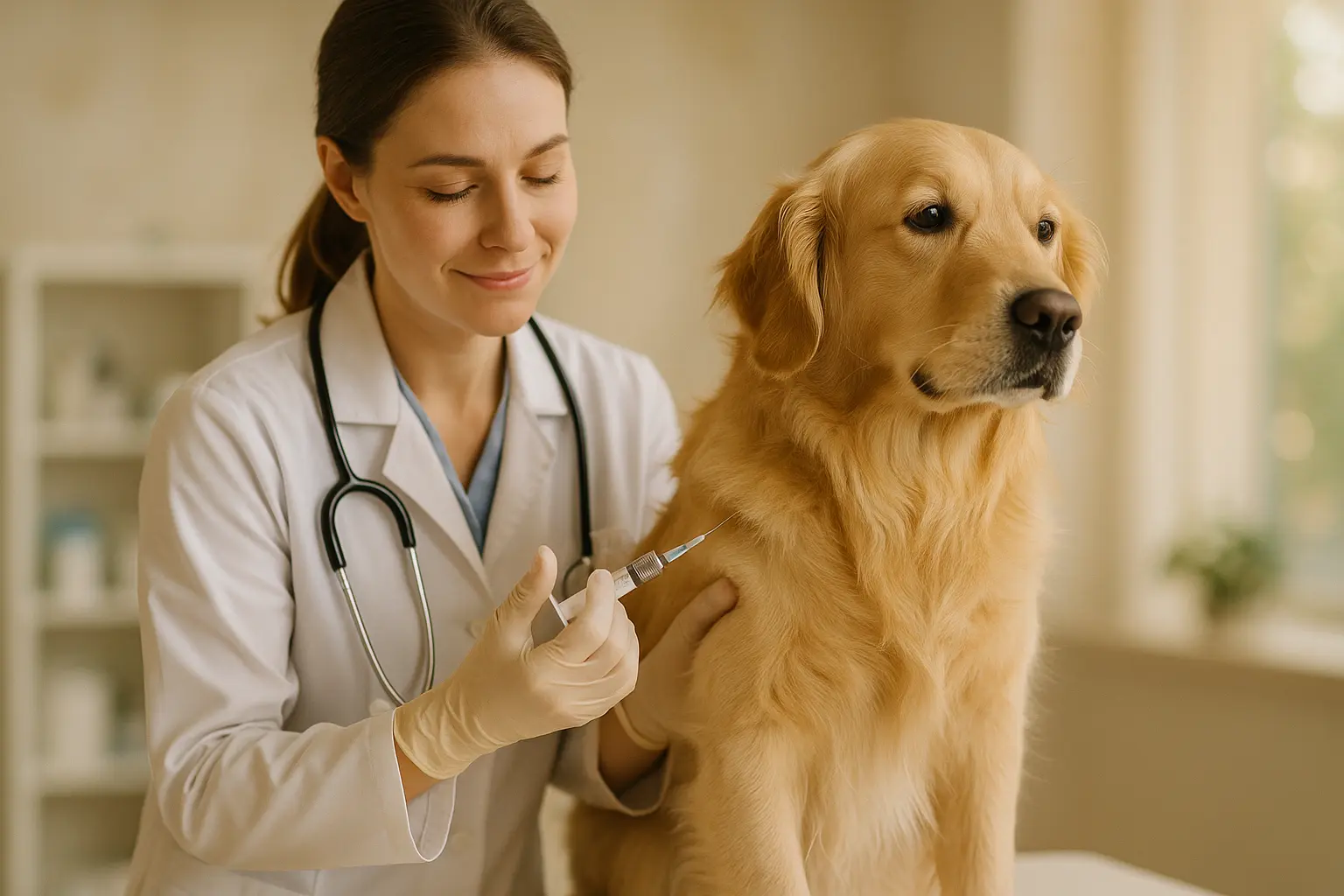
Welfare during vaccination is measured in seconds. The handling window for a single day-old chick is very short, and it is repeated tens of thousands of times in a morning. That arithmetic is the whole subject: a practice that is only slightly rough on one bird becomes a systematic welfare problem across a batch, and a small improvement in handling scales just as fast in the other direction.
Key takeaways
- Most avoidable stress is created before the injection, in catching, holding and waiting conditions.
- Equipment verified at the start of a session protects both welfare and vaccine efficacy at the same time.
- Line speed is a welfare setting: quality of application falls when the pace exceeds what the team can hold.
- Vaccine choice, dose and schedule are veterinary decisions and are outside the scope of any operational guide.
A handling problem before it is a product problem
The welfare cost of vaccination comes mostly from handling, not from the injection or the spray itself. Restraint, temperature during holding, noise, light, waiting time in a box, and the number of times an animal is picked up all accumulate before the vaccine is delivered, and they are all under operational control.
This matters commercially as well as ethically. A stressed bird is harder to position, which raises the rate of imprecise application, and imprecise application is the main route to an under-protected flock. Welfare and vaccination quality are not two objectives to balance against each other; they fail together and they improve together. That is the practical reason we treat stress reduction during vaccination as a production topic rather than an ethical supplement.
The three windows that decide the outcome
Before: preparation carries most of the result
Preparation determines more of the welfare outcome than anything done at the station. That means vaccines stored and reconstituted according to the manufacturer’s instructions and the veterinarian’s prescription, equipment cleaned, assembled and calibrated before the first bird arrives, and a work area at a stable temperature with even lighting and no unnecessary noise.
It also means planning the flow so animals wait as little as possible. A holding area that is too warm, too cold or overcrowded undoes everything the station does well. In hatchery conditions specifically, chick comfort during holding, in transport boxes and in the room itself, is part of the vaccination protocol rather than a separate logistics question.
During: the seconds that matter
During application, three variables carry the welfare outcome: how the animal is held, how accurately the product is delivered, and how sustainable the pace is for the operator. Firm, confident, brief restraint causes less stress than hesitant handling that lasts twice as long, which is why manual dexterity is a trained skill and not a personality trait.
Pace deserves to be treated as an explicit parameter. Every team has a rate above which precision falls, and pushing past it produces missed applications, repeated handling and injuries that would not otherwise occur. Operator fatigue is a welfare risk for the animals, and rotation between stations is a legitimate control measure rather than a comfort.
After: the check nobody schedules
Post-vaccination monitoring is the step most often left informal, and it is the one that closes the loop. A short structured observation window after the session, looking at behaviour, mobility, feed and water intake and any local reaction, catches problems while they can still be acted on. Anything unexpected goes to the veterinarian, and the observation is recorded with the batch so that a pattern across sessions becomes visible instead of being remembered differently by three people.
Routes of administration and what each one demands
| Route | Welfare consideration | Operational requirement |
|---|---|---|
| In ovo, before hatch | No handling of the live bird at all | Precise timing, strict hygiene, tightly maintained equipment |
| Spray, whole group | Very short handling, but chilling risk if birds stay wet | Droplet size control, room temperature and airflow management |
| Drinking water | No handling; risk shifts to uneven individual intake | Water quality, line preparation, controlled thirst period |
| Injection, individual | Restraint plus a puncture; site accuracy is critical | Trained operators, needle policy, calibrated dose, controlled pace |
| Needle-free, individual | No needle, but pressure settings must suit the animal | Frequent calibration, verified contact, rigorous maintenance |
No route is the humane choice in the abstract. Each one is only as good as its execution, and the applicable schedule for a given flock is a veterinary decision that depends on the disease pressure of the region and the production system.
What the recent innovations actually change
The innovations that have changed daily practice reduce contact with the animal or make correct application easier to achieve, rather than making the vaccine itself gentler.
- Automation of repetitive stations stabilises what a tired human hand cannot: constant dose, constant site, constant depth, session after session.
- Needle-free delivery removes needle-related injury and cross-contamination risk, on condition that pressure is calibrated for the animal and verified regularly.
- Operator ergonomics is an animal welfare measure in disguise. Equipment that reduces fatigue and awkward posture directly improves the handling the birds receive at the end of a shift.
- Traceability and monitoring systems record what was administered, to which batch, by whom and under what settings, which turns a suspicion into a verifiable fact.
The condition attached to all of them is maintenance. An automated station that is out of calibration applies its error with perfect consistency to every bird, which is worse than a human doing the same job carelessly. Verification at the start of each session and a preventive maintenance schedule are what make automation a welfare gain rather than a welfare multiplier.
Measuring welfare rather than asserting it
Welfare claims only hold if they rest on indicators recorded on site. The useful ones are simple and already within reach of most operations: application accuracy sampled during the session, injuries and losses attributable to handling, time spent in restraint and in the holding area, behaviour and intake observed in the hours that follow, and equipment calibration records.
Two habits make this data worth collecting. Record it per session rather than per month, so that a bad morning is visible instead of averaged away, and review it with the team rather than only with the auditor. Vaccination is a preventive act inside a broader plan, and it works best when it is read alongside the rest of the disease prevention strategy on the farm rather than as an isolated operation.
Where the operational stops and the veterinary begins
The boundary is clear and it is not negotiable. Which vaccine, which dose, which schedule, and how to respond to an adverse reaction are veterinary decisions, framed by the regulations on veterinary medicinal products, and in many cases require a prescription. What an operational guide can legitimately cover is preparation, handling, equipment, environment, pace, monitoring and record keeping.
Traceability obligations sit on the same line: batch numbers, animals concerned, dates and operators must be recorded, and the requirements vary between countries and between certification schemes. Confirm what applies to your site with your veterinarian and your competent authority before writing your internal procedure. This article is general operational guidance for professionals and does not replace veterinary advice or a validated health plan.
Three questions we are asked on site
Does slowing the line really improve results?
Beyond a certain pace, yes. The gain comes from fewer missed applications and less repeated handling, which reduces both stress and the number of birds that end up under-protected. The right pace is the one your team can hold for a full session, and it is best determined by sampling application accuracy rather than by opinion.
Is needle-free automatically better for welfare?
Not automatically. It removes needle-associated risks, and it introduces a dependency on calibration and maintenance. A well-maintained needle-free system is an improvement; a neglected one is not.
What should be done if a batch reacts unexpectedly?
Stop, isolate and record what was observed, then contact the veterinarian responsible for the flock without delay. Note the vaccine batch, the equipment settings and the conditions of the session, because that information is what makes the assessment possible. Do not modify a protocol on your own initiative.
Vaccination is one lever among several
A vaccination session performs to its potential only inside a coherent health plan, alongside biosecurity, housing conditions and daily observation of the flock.