
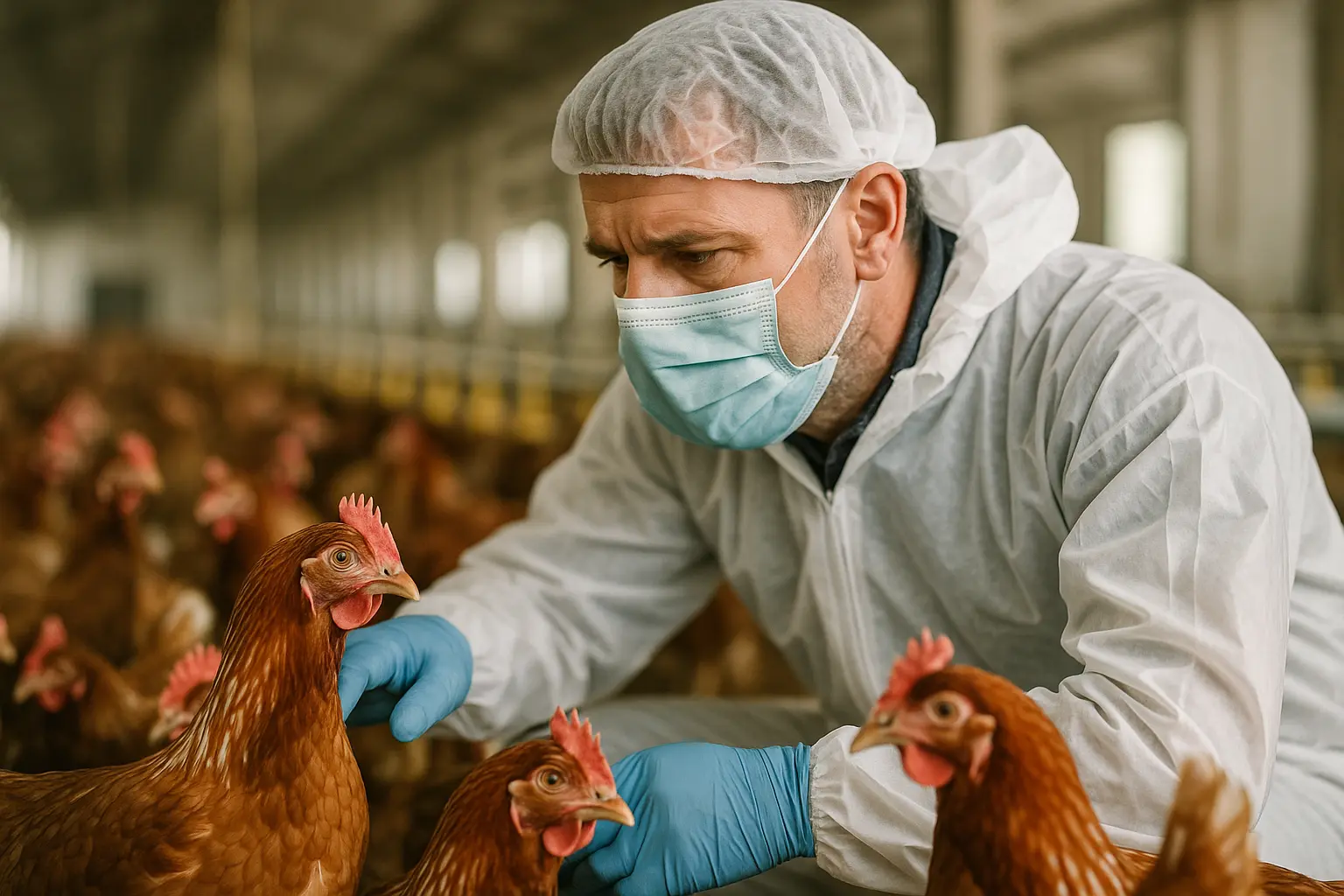
Avian influenza is a seasonal disease managed by an unseasonal discipline. The infection pressure arrives with the autumn migration and falls away in summer; the habits that decide whether it gets into your houses are built in the months when nothing is happening. Which makes the current quiet period the most useful part of the year, and the easiest one to waste.
Key takeaways
- Between 28 February and 4 June 2026, 949 HPAI A(H5) detections were reported in 30 European countries, 763 in wild birds and 186 in domestic birds.
- France dropped its national risk level to negligible on 4 June 2026 and lifted mandatory housing; the Netherlands had already narrowed its housing order to high-risk areas from 16 February 2026.
- An outbreak triggers a protection zone of at least 3 km and a surveillance zone of at least 10 km, with measures lasting a minimum of 21 days in the protection zone.
- Suspicion is notifiable immediately. The decision to test, cull or restrict is never the operator’s to make alone.
Where the disease actually is, in 2026
Managing risk requires knowing the current pressure rather than the memory of the worst season. The joint EFSA and ECDC avian influenza overview for March to May 2026 recorded 949 highly pathogenic A(H5) detections across 30 European countries between 28 February and 4 June 2026, split between 763 in wild birds and 186 in domestic birds. The downward trend seen at the end of the previous reporting period continued and was expected to hold through the summer.
Two details in that report matter more to an operator than the headline count. A(H9N2) of clade G5.5 was detected in poultry in Europe for the first time, which is a reminder that the surveillance picture is not static and that “avian influenza” is a family rather than a single adversary. And detections in wild mammals continued, including A(H5N5) in a polar bear and a walrus in Norway, following intense circulation in waterfowl.
The regulatory response has followed the epidemiology. France reduced its national risk level to negligible with effect from 4 June 2026, ending mandatory nationwide housing, with prefects retaining the ability to impose local measures. The Netherlands had already restricted its general housing order to high-risk areas from 16 February 2026. Both changes describe regional risk. Neither says anything about whether your own gate control is working.
The four routes in, and what closes each one
Wild birds, directly. Waterfowl are the reservoir, and the objective is separation rather than eradication. That means no poultry feed accessible outdoors, no standing water that attracts waterfowl anywhere near the houses, proofed feed stores, and ranges sited away from ponds and flight lines where the geography allows it. On free-range units this is also where housing orders bite, because the range is the exposure.
The environment and water. The virus moves as much through contaminated material as through direct contact. Untreated surface water should never reach poultry as drinking water or as wash water, and equipment that has been outdoors in wet conditions carries risk in from the yard. Litter and bedding stored uncovered where wild birds can access them is a classic entry point that costs nothing to fix.
People and portable equipment. A dedicated change of footwear and clothing at each house entrance, in a physical barrier arrangement that makes stepping over rather than around it the natural movement, is the single measure with the best return. Video-based work on Dutch farms with a recent HPAI history has documented how frequently the breaches are procedural rather than structural: the barrier exists, and it gets crossed incorrectly under time pressure. Shared tools, egg trays and crates move between units and belong in the same discipline.
Vehicles and deliveries. Feed lorries, catching teams, litter contractors and maintenance visits are the connections between your unit and every other unit they served this week. A gate that stops vehicles at a defined point, a visitor and vehicle log completed at the moment of entry rather than reconstructed afterwards, and wheel and wheel-arch disinfection are what turn a boundary into a barrier.
The general framework these sit inside, the ordering of segregation, cleaning and disinfection, is set out in our biosecurity checklist and precautions for a poultry farm. What follows here is what changes specifically when avian influenza is the threat.
A calendar rather than a checklist
Biosecurity written as a permanent list gets read as a permanent list, which is to say not at all. Written against the season, it gets done.
| Period | Priority work |
|---|---|
| Low-risk summer | Repair the physical barriers, proof feed stores and buildings against wild birds, retrain staff and contractors, review and update the written plan, audit the visitor log honestly |
| Pre-migration, late summer to early autumn | Confirm housing capacity and range contingency, check water sourcing, agree delivery protocols with hauliers before you need them, verify mortality recording is running daily |
| High-risk season | Apply national measures as issued, minimise non-essential visits, tighten movement records, watch water and feed intake and daily mortality as the earliest signals |
| Any point, on suspicion | Stop movements on and off the unit, contact your veterinarian and notify the competent authority immediately |
The signals worth watching daily are unspectacular. A sudden fall in feed or water consumption, a drop in egg production, a rise in daily mortality against the flock’s own baseline, respiratory signs, or swelling around the head. None of these is specific to avian influenza, which is precisely why they are useful: they are the trigger to call, not the diagnosis.
What happens once a case is confirmed nearby
Operators plan for their own outbreak and are then caught out by someone else’s. Under Commission Delegated Regulation (EU) 2020/687, which supplements the Animal Health Law, an outbreak of highly pathogenic avian influenza in poultry triggers a protection zone of at least 3 km and a surveillance zone of at least 10 km around the affected establishment. Annex X sets the minimum duration of measures in the protection zone at 21 days, with a further 9 days of additional surveillance measures.
Practically, a neighbour’s outbreak can freeze your movements for three weeks with no infection on your site at all. Chicks scheduled to arrive, birds scheduled to leave, litter to be removed and eggs to be collected all become subject to authorisation. The units that come through this well are the ones that had already asked, in advance, what happens to their placement schedule if a zone is drawn around them in November. That question costs nothing to ask in August.
Where vaccination fits, and where it does not
Vaccination has moved from theory to field experience in Europe, and the French duck programme is the reference case. Work published in Emerging Infectious Diseases (volume 31, number 7, July 2025) reported 10 observed H5 outbreaks in 2023 to 2024 against 487 modelled in the absence of vaccination, with a 95 % confidence interval of 314 to 756, a reduction of roughly 96 to 99 %. By 1 July 2024 more than 35 million ducks had received two doses.
Three qualifications belong with those figures every time they are quoted. The comparison is against a modelled counterfactual rather than an observed control population. Vaccination was applied in addition to biosecurity, not instead of it. And the programme is species-specific, nationally organised and nationally funded, with its own surveillance obligations attached, which is why it is not something an individual operator adopts by choice. Whether vaccination is available, permitted or required for your species and your country is a question for your veterinarian and your competent authority.
Questions we get during the high-risk season
What exactly has to be reported, and to whom?
Suspicion of a listed disease is notifiable immediately to the competent authority under the EU Animal Health Law framework, and in practice the call goes to your veterinarian and to the official veterinary service in parallel. The threshold is suspicion, not confirmation. Waiting for a laboratory result before notifying is both a legal failure and the single most costly delay in an outbreak.
Is poultry meat and are eggs safe during an outbreak?
Properly cooked poultry meat and eggs are considered safe, and the virus is inactivated at cooking temperatures. Food safety is not the reason for the control measures. The reasons are animal health, the economic consequences of uncontrolled spread, and limiting opportunities for the virus to adapt.
What is the risk to the people working on the unit?
The assessment by EFSA and ECDC for the current European situation places the risk from circulating A(H5N1) clade 2.3.4.4b viruses as low for the general population and low to moderate for those occupationally exposed. That distinction is the case for protective equipment during depopulation and carcass handling, and for occupational health advice being part of the plan rather than an afterthought.
Does a lower national risk level mean the housing order will not come back?
No. Risk levels move in both directions and can be raised within days on the basis of new detections, and local authorities frequently retain powers to act in specific areas regardless of the national level. Treat the current period as the window for preparation, not as the end of the problem.
Should dead wild birds found on the property be reported?
Yes, in most jurisdictions and certainly for waterfowl, gulls and birds of prey found dead in numbers. Follow your national reporting route, do not handle carcasses without protection, and never bring them near the poultry houses or through them.
When the signs are respiratory but the cause is not influenza
Most respiratory episodes in a flock are not avian influenza, and telling them apart quickly is what keeps a response proportionate without delaying a notification that matters.
Sources: EFSA and ECDC, Avian influenza overview March to May 2026 (EFSA Journal 2026); Commission Delegated Regulation (EU) 2020/687, Article 21 and Annex X; Regulation (EU) 2016/429 (Animal Health Law); national risk level decisions in France (June 2026) and the Netherlands (February 2026); Emerging Infectious Diseases, volume 31 number 7, July 2025, on the French duck vaccination programme; published video-monitoring work on biosecurity breaches on Dutch poultry farms. Consulted August 2026.
Published previously, fully revised on 15 August 2026. General operational guidance for professional operations. Avian influenza control measures, notification duties and vaccination policy are set nationally and change quickly. Confirm the current position with your competent authority, and treat any suspicion of disease in the flock as an immediate matter for a qualified poultry veterinarian and the official veterinary service.