
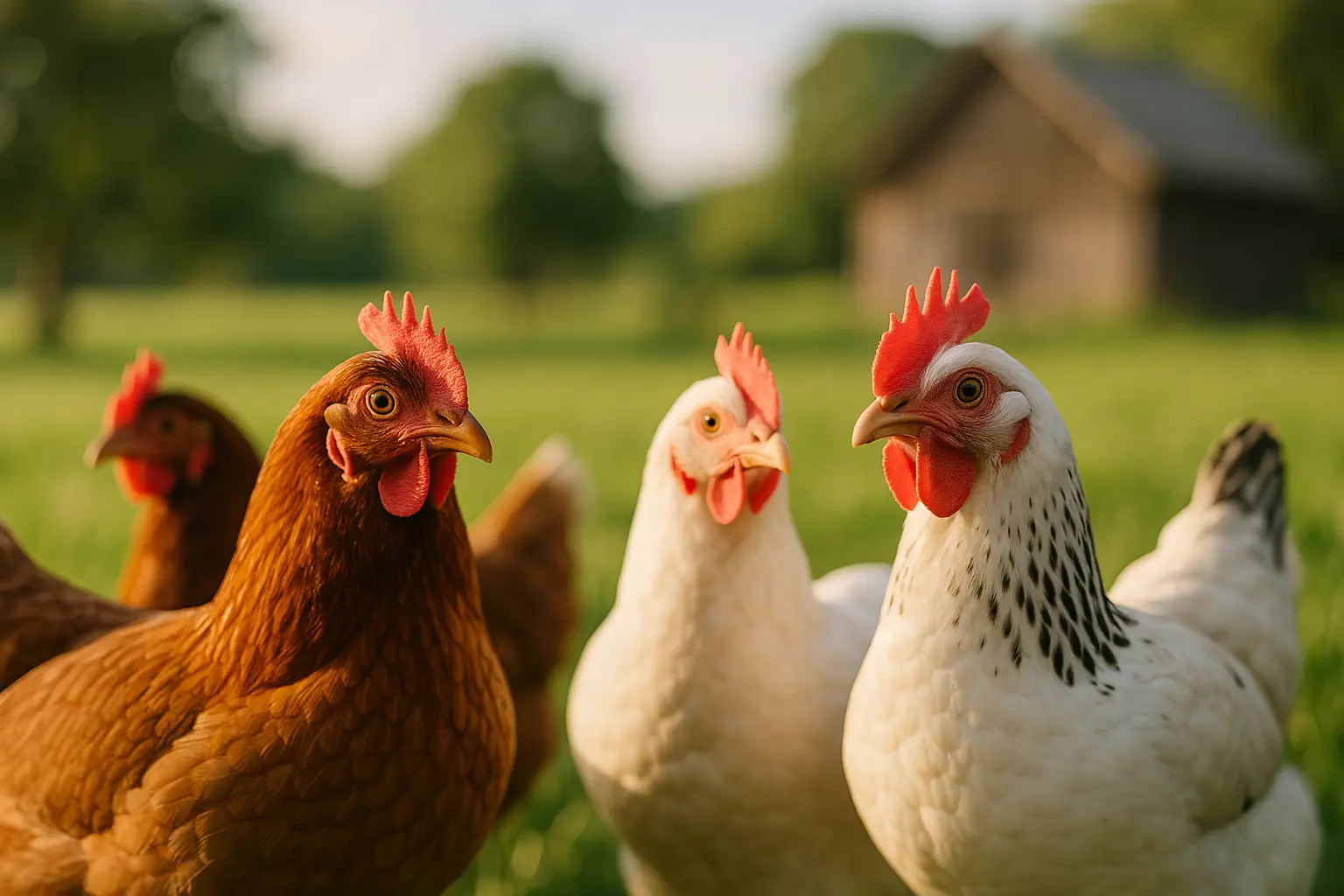
The word “breed” is doing two different jobs in every conversation about laying hens, and the confusion costs real money. One meaning is the historic pure breed, the White Leghorn or the Rhode Island Red. The other is the commercial line that a hatchery will actually deliver to you, a hybrid built from those ancestors and sold with a performance chart. You choose the first for a story and the second for a feed budget.
Key takeaways
- At 72 weeks, white and brown lines can deliver almost identical egg mass; the white line does it on a lighter bird and less feed per day.
- Housing system now drives the decision as much as market colour: 60.8 % of EU laying hens were in alternative systems in 2023.
- Published standards run to 90 weeks for brown lines and 100 weeks for white and tinted lines, which changes what persistency is worth.
- Heritage breeds earn their place in speciality egg lines and dual-purpose operations, not in commodity production.
Breed, line and hybrid are not interchangeable words
A pure breed is a recognised population with a written standard for appearance and type. A commercial layer line is a four-way cross bred and maintained by a primary breeding company, selected over decades on egg number, egg weight profile, shell strength, feed intake and livability. The Rhode Island Red and the White Leghorn sit somewhere in the ancestry of most brown and white lines respectively, which is why line names and breed names get used loosely in catalogues.
The practical consequence is that a production decision should be made from a published performance chart, not from a breed description. Breed descriptions tell you about plumage and disposition. Performance charts tell you daily feed intake, cumulative egg mass and livability at a stated age, which is what the business plan runs on.
The white versus brown arbitration decides the feed bill
Set the two most widely documented Classic lines side by side in alternative housing and the argument becomes very concrete. Both reach 50 % production at 140 to 145 days and both peak at 94 to 96 %. Both carry a shell breaking strength above 40 newtons. Where they separate is the cost of producing the same kilogram of egg.
| Criterion (alternative housing) | LOHMANN LSL-CLASSIC (white) | LOHMANN BROWN-CLASSIC (brown) |
|---|---|---|
| Eggs per hen housed, 72 weeks | 327 | 321 |
| Egg mass per hen housed, 72 weeks | 20.30 kg | 20.32 kg |
| Eggs per hen housed, end of published cycle | 467 at 100 weeks | 412 at 90 weeks |
| Daily feed intake in production | 110 to 120 g | 115 to 125 g |
| Feed conversion | 2.0 to 2.2 kg/kg egg mass | 2.15 to 2.25 kg/kg egg mass |
| Body weight at end of production | 1.79 kg | 2.05 kg |
| Livability in lay | 95 to 96 % at 72 wk, 90 to 91 % at 100 wk | 94 to 95 % at 72 wk, 91 to 92 % at 90 wk |
Read the second row again. At 72 weeks the two lines produce essentially the same egg mass, 20.30 against 20.32 kilograms. The white line gets there carrying 260 grams less body weight and eating five grams less per day. Over a flock of 50,000 birds across the laying period, that daily difference is the whole argument, and it is the reason white lines dominate wherever the market is indifferent to shell colour. It also puts a premium on the ration itself, down to details such as the role of fibre in a laying hen diet, since a smaller daily intake leaves less room for error in formulation.
The brown line answers with egg weight and shell colour: 63.3 grams average to 72 weeks against 62.0 to 63.2 grams for the white, and a brown shell that many European retail markets still price above white. Neither line is better. One is cheaper to run, the other sells into a premium, and the arbitration is made by your customer, not by the bird.
Housing now selects the bird as much as the market does
Based on EU Member State data for 2023, 39.2 % of laying hens were housed in enriched cages and 60.8 % in alternative systems, split between barn and aviary at 38.9 %, free range at 15.1 % and organic at 6.8 %. That balance has moved steadily, and it changes the selection criteria.
In an aviary or a free-range house, the traits that decide the result are not on the classic performance chart. Nest acceptance, willingness to use tiers and ramps, and behaviour under group size are what separate a good flock from one with floor eggs and feather damage. Ask the supplier for field results from the housing system you actually operate, in the climate you actually operate in, rather than the headline cage figures.
Where the heritage breeds still earn their place
None of the above makes the pure breeds irrelevant. It puts them in the right column of the business.
- Speciality shell colour. The Araucana and the Ameraucana carry the blue shell gene; crossing a blue-shell bird with a brown-shell bird gives the green tones sold under the Easter Egger label, which is a type rather than a standardised breed. The Marans supplies the dark chocolate-brown end of the range. These birds lay fewer eggs and sell them for considerably more.
- Dual-purpose operations. The Plymouth Rock, the Sussex and the Australorp are the classic compromise between carcass value and egg output, which is why they persist in mixed and short-circuit systems where both revenues count.
- Temperament and management load. The Orpington, including the Buff Orpington, and the Silkie are kept for calmness and for display and broodiness respectively. In a professional context, calm birds mean lower handling stress at vaccination and depopulation, which is a real if unquantified operational argument.
- Light-framed foragers. The Ancona belongs to the same Mediterranean group as the Leghorn, small-bodied and active, which suits extensive systems with space and poor tolerance for confinement.
What none of these breeds will do is match a commercial line on eggs per kilogram of feed. If a customer is comparing them on that basis, the comparison itself is the mistake.
The long cycle changes what you are buying
Published standards have been extended: 90 weeks for brown lines and 100 weeks for white and tinted lines in the Classic range, and other breeders publish in the same territory, with Hy-Line quoting production approaching 500 brown eggs per hen housed to 100 weeks. Longer cycles reduce the number of pullet purchases and depopulations per decade, which is where the economics come from.
They also shift the risk. From roughly 70 weeks onward the limiting factors are shell quality and livability, not lay rate. Livability at 100 weeks in the white Classic line is quoted at 90 to 91 %, against 95 to 96 % at 72 weeks. That difference is the price of the extra 140 eggs, and whether it is worth paying depends on your downgrade rate and on whether your packing centre can absorb older-flock shells.
What to settle before the pullet order
Which factors genuinely decide the choice?
Shell colour and egg weight demanded by your buyer, the housing system, the planned flock age at depletion, and feed cost per tonne in your region. Temperament and appearance matter for management, but they do not change the economics enough to override the first four.
Which lines are known for the highest egg numbers?
White lines derived from Leghorn stock carry the highest egg counts per hen housed and the lowest feed intake, with published figures around 467 eggs to 100 weeks for the Classic white line. Brown lines trade a little of that for heavier eggs and a coloured shell.
Do different breeds really lay different shell colours?
Yes, and it is genetically determined, not managed. Leghorn-derived birds lay white, most heavy breeds lay brown, Araucana and Ameraucana lay blue, and green shells come from crossing blue with brown. Shell colour cannot be altered by feed or lighting, only shell quality can.
How much does climate change the answer?
Enough to be worth checking, mainly through body weight. Lighter, Mediterranean-type birds tolerate heat better; heavier brown birds hold condition better in cold housing. In a controlled-environment house the effect is much smaller than the ventilation specification, which is where the real climate adaptation happens.
Does temperament have a measurable effect on output?
Indirectly. Calmer flocks are easier to inspect, handle and vaccinate, and handling stress has a documented cost in production. Treat temperament as a labour and welfare criterion rather than as a yield criterion.
If the flock is not only for eggs
The arbitration changes completely when carcass value is part of the plan, and dual-purpose birds deserve to be compared on their own terms.
Choosing the right poultry breed for meat, eggs or dual purpose
Sources: LOHMANN Breeders published performance data for LOHMANN LSL-CLASSIC and LOHMANN BROWN-CLASSIC in alternative housing (age at 50 % production, peak, eggs and egg mass per hen housed at 72, 90 and 100 weeks, egg weight, daily feed intake, feed conversion, body weight, livability, shell breaking strength); Hy-Line International product information for the Hy-Line Brown, for production approaching 500 eggs per hen housed to 100 weeks; EU Member State data for 2023 on the structure of the laying hen flock by housing system, reported through the European Commission egg market dashboard. Consulted August 2026.
Published previously, fully revised on 14 August 2026. General technical guidance for poultry professionals. Performance figures are breeder standards obtained under stated management conditions and are not a guarantee of results on any individual site.